Stevns Klint is the main reason I was in Denmark in the first place. I wanted to make a weekend trip of it with this as the star of the show but I haven’t had a free weekend for it since about January, so when Iceland was too full of eclipse-hunters for my usual birthday on the Ring Road, it seemed the obvious choice to spend it in Denmark instead and cross Stevns Klint off my to-do list.
It’s just a cliff, 11 miles of yellow-white chalk cliff an hour and a half south of Copenhagen by car or two hours by public transport. A nice bit of beach, a nice bit of Baltic sea but what about it is drawing me all the way across the North Sea to visit it, especially when I have very similar cliffs a 45-minute drive from my house? Well, it’s that 5cm layer of black stuff, called fish clay in Danish, that you can just about see if you know where to look. That’s a layer of iridium-rich debris laid down about 66 million years ago. No? Ok. It’s called the K-Pg Boundary and it marks the moment, the day, that the Cretaceous period gave way to the Paleogene period. And as they were the last and first periods of their respective eras, this is the boundary, the very moment, that divides the Mesozoic era from the Cenozoic era, the second-largest of the five divisions of geological time. Usually the boundary between periods, never mind eras, is a bit vague, defined down to a several hundred thousand years if scientists are feeling particularly accurate that day, but here, everything changed in an instant.
Because this is what was scattered across the planet the day the dinosaurs died.
66 million years ago, an asteroid six miles wide hit what’s now northern Mexico. The entire surface of the Earth rippled with the impact. Tsunamis on a scale we can’t even imagine today would have bounced around the world. An even more unimaginable amount of debris would have been thrown out, superheated by the impact, spreading all over the world. Some of it was even thrown out of the atmosphere and burned up on reentry when gravity brought it back down. Anything that wasn’t vaporised would have caught fire. Anything within the rough area of modern North America would have destroyed almost instantly. And the atmosphere filled with the steaming remains of an entire continent turned to dust, causing a double climate catastrophe – first the temperature plummeted as the combination of toxic vapours and blocking of sunlight caused a kind of extreme artificial winter, and then the massive release of carbon dioxide from vaporised carbonate rocks plus that blanket of dirt caused a greenhouse effect on an epic scale, heating the planet way beyond anything humans could achieve even if everyone in the world had their own private jet and burned petrol in the garden for fun. Some marine life and some avian life survived but the land-dwelling dominant life of the day, the dinosaurs, were gone. I’m not enough of a scientist to say for sure how long it took but days? Months? A handful of years at the most. One period ended, one era ended, and a new one begun, just like that.
I’ve thought a lot about it. I sat on a bench one day and tried to picture the asteroid. I measured the map from where I was sitting to a certain village you haven’t even heard of, six miles away, and imagined an asteroid that stretched from me to that village, moving at more than twelve miles per second. Would you even see it, as it plunged through the atmosphere, all fire and rushing wind and blood chilling roar? Would the shockwave kill you before the giant rock landing on you? Once I had a picture of the asteroid in my head, it was much easier to imagine the impact. A hole a thousand metres deep just bashed into the planet. The waves of heat and the ripples and the fire and the dust and dirt and smoke and the sun blacked out by clouds and every dinosaur in the world crashing dead to the ground…
The Cretaceous-Paleogene extinction event wasn’t the first extinction event in the planet’s history. There have been five or six of them – we’re living through one right now. If you thought 40° for weeks on end in May and June in the UK was “just a heatwave”, it’s not. It’s part of the Holocene extinction event. On the one hand, it’s kind of a soothing thought that these are just part of history, that life has been extinguished five or six times and wow, humans have never been first-hand witnesses to one before. On the other hand, humans have also never caused an extinction event before. No dominant sentient species has ever caused an extinction event. Nature and stupid bad luck have always been the cause. The K-Pg extinction wasn’t even the biggest in Earth’s history – that was the Permian–Triassic one, which was also an era-ender. It’s just the K-Pg extinction is the one the average person hears most about because everyone loves dinosaurs. We can’t even muster up enthusiasm for fixing our own extinction event; we’re never going to find any for the P-Tr extinction being the largest mass extinction of insects in the history of the planet.
Now, the dinosaurs existed between the late Triassic and Cretaceous periods, which is 237 to 66 million years ago. Some of your favourites, like the Diplodocus, the Apatosaurus, the Stegosaurus and the Iguanodon, were Triassic or Jurassic dinosaurs, long gone tens, if not hundreds, of millions of years before all this happened. But the Triceratops, the Velociraptor and the T-Rex would all have been there that day. There are a handful of places around the world where you can still see that layer of clay with your own eyes. Most of them are in North America and there’s a bit in Italy but for us Europeans, the best place to see it is at Stevns Klint. (According to the border guard who laughed at me on my way into Denmark, it’s pronounced more as if the V is a Y – Stay’ns Klint, not Stephen’s.)
And so I got on a train – two trains actually – and spent an hour and a half travelling down to the Stevns Klint Experience at Rødvig. The S-Bahn to Køge conveniently goes from the station right by my hotel, saving me the effort of going all the way to Copenhagen Central first, and then you change onto the Lokaltog (literally “local train” which is the name of the network rather than merely a description of what it does) that runs from Roskilde to Rødvig. From the station, it’s two kilometres to the Experience Centre if you follow the road but the pavement suddenly seems to run out just as you reach a footpath that runs to the Experience Centre via the clifftops, which isca much more picturesque way to get there.
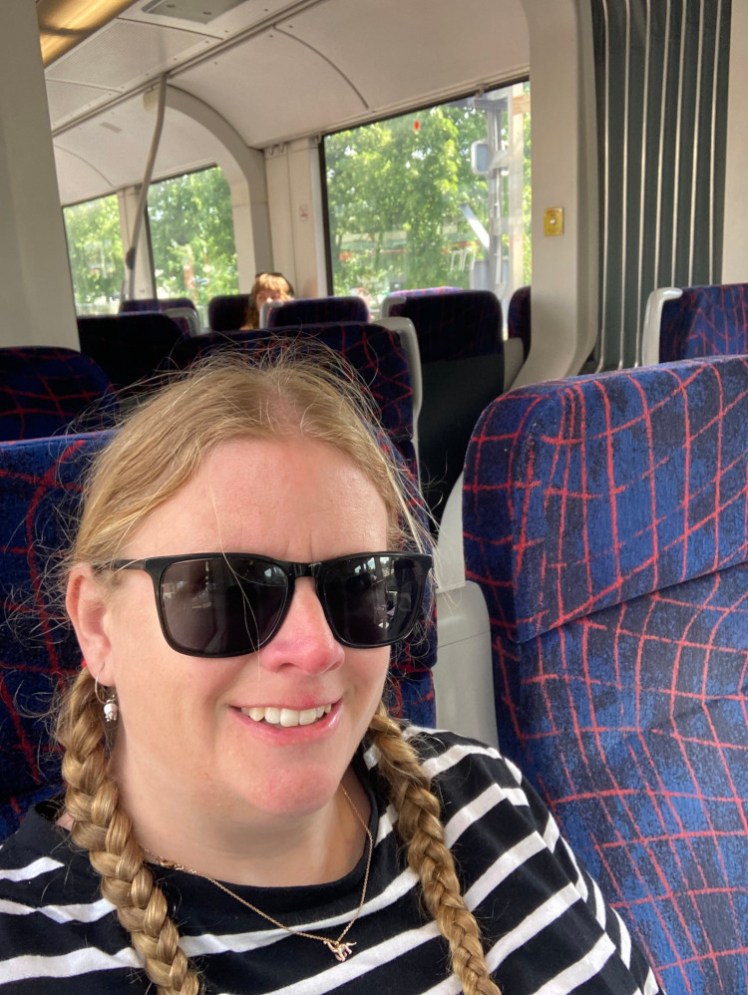
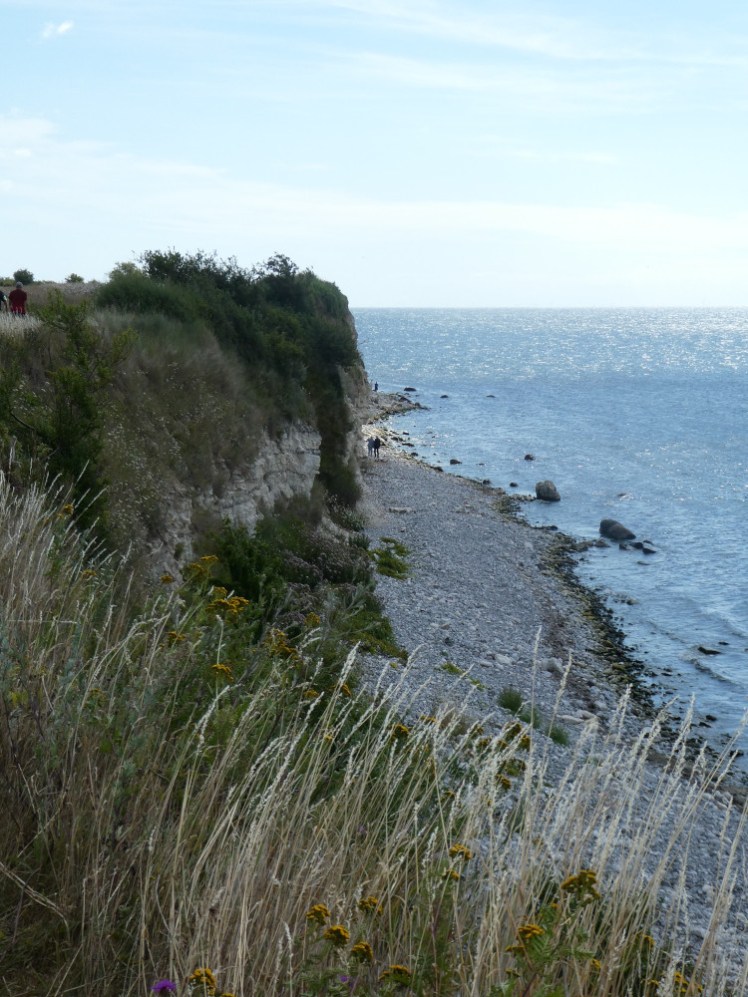
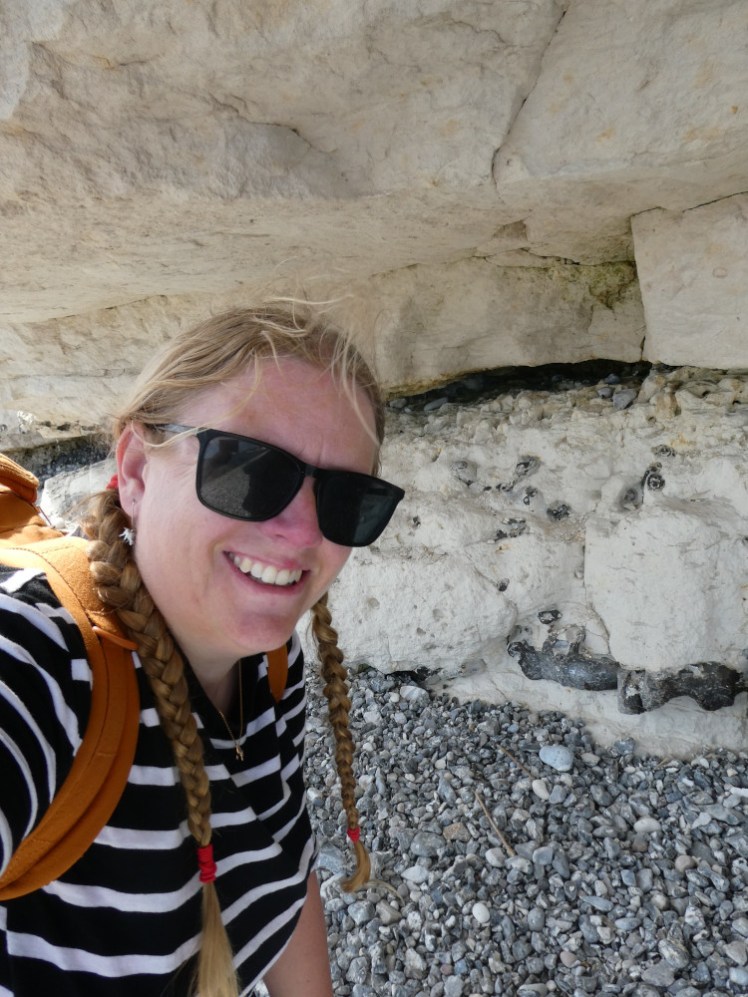
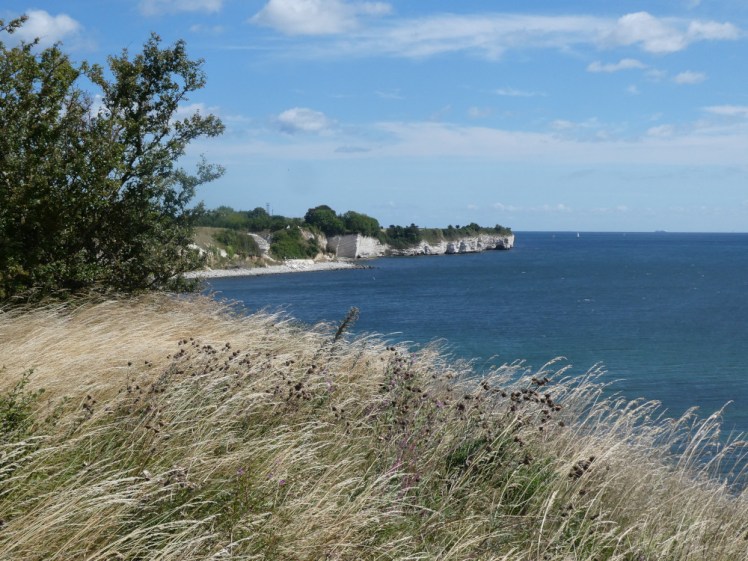
Yes, I fangirled a little over it. Shortly after I joined the coast path, I found an angle where I could take a selfie with a black layer in the cliff… which turned out not to be the K-Pg boundary. It meanders up and down this length of cliff and at the Experience Centre, it drops down low enough that in places it’s below sea level. You need to join the Fish Clay tour to see it in person. But for now, I walked this nice bit of footpath. Sparkly blue sea on one side, wildflower meadows on the other until you reach the quarry below the visitor centre. Then it’s a bit of a labyrinth down into the quarry and back up to the concrete montrosity that turns out to be the Experience Centre.
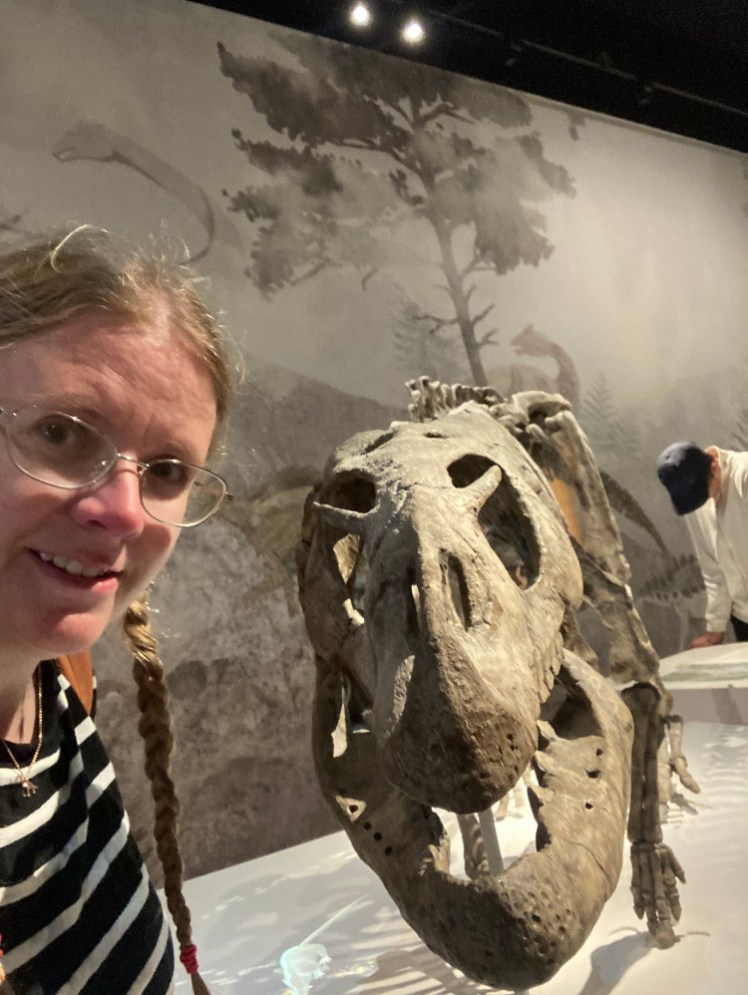
You have to go into the exhibition first so that you understand exactly what you’re seeing in the fish clay but I’d done enough reading and enough visualising to know what I was looking at. The exhibit is in three parts – before the impact, during it and the aftermath. Before, this part of Denmark was all underwater, chalk and limestone and lots of water-dwelling prehistoric creatures. There are fossils and rock samples and so on. Then you find out about Luis and Walter Alvarez, who first discovered the K-Pg boundary and came up with both hypothesis and evidence for the asteroid strike. There’s a projection table that runs through everything that happened that day and the immediate aftermath and then there’s the rise of the mammals and the new life that rose from the ashes of the disaster. It’s complemented by a cinema show projected onto a slab of limestone alternating in English and Danish and then it’s tour time. It’s a good thing I never found time to get to Denmark for this one weekend earlier in the year – the fish clay tour only runs on weekdays.
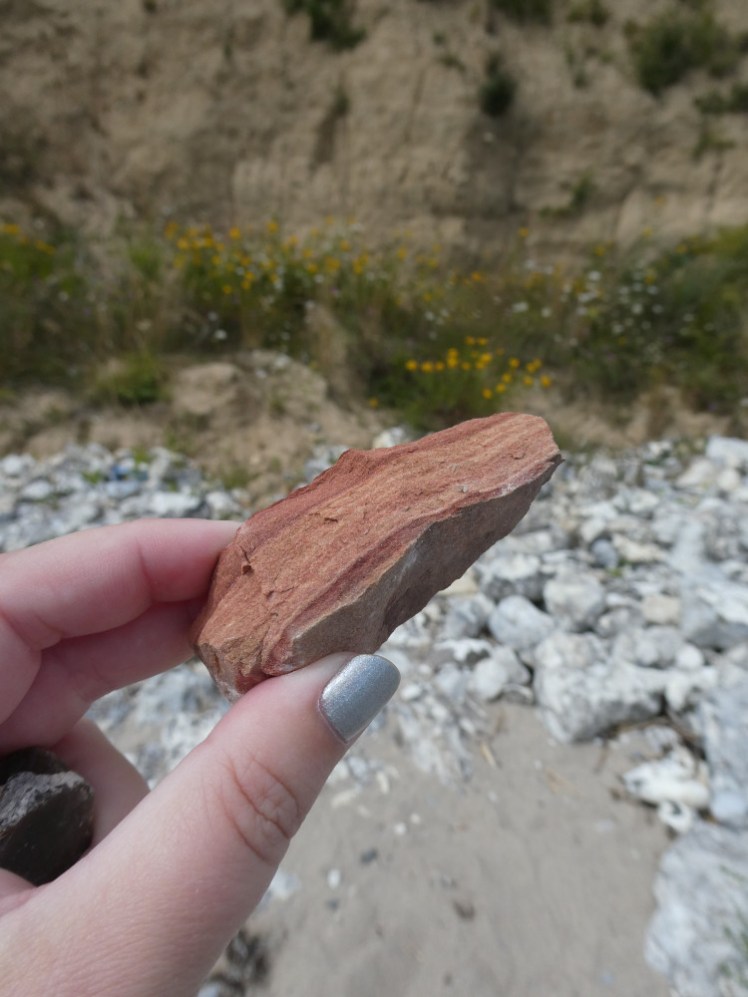
We went down past the pyramid – once storage for quarried limestone and now being restored as some kind of events space – and onto the beach. I’d been a bit concerned that the guide would find my mountain sandals insufficiently “sturdy” but an entire Danish-Swedish family turned up in matching Birkenstocks which don’t have the grip, the tight fit or the heel strap and I began to feel like my shoes were fit for climbing Everest in comparison. We made our way along the beach, looked at the section of cliff that’s been quarried out with neat, perfect square cuts and picked up bits of rock. There’s a black layer here which is easily mistaken for the fish clay, as I’d done closer to Rødvig harbour but it’s just your average layer of flint in a chalk and limestone cliff. Over the last several million years, a lot of the cliff has ended up on the beach and we were encouraged to have a look around, see if we could find anything interesting and if we wanted to pick a couple of bits up and take it with us… well, better to do on the way back so you don’t have to carry it so far. I have a piece of pure white limestone the size of my top thumb joint, a piece of something mysterious and orange with perfect stripes in it like a piece of plywood and a tiny piece of flint with a sharp edge so I can use it with the firesteel I bought in Iceland when the weather makes flint-steel sparks a bit less dangerous.
And then we went on to the fish clay. Our guide took us towards the end of the headland and then stopped just before the cliff starts to overhang and no further because it’s not really safe. She pointed out the thin orange-brown layer a foot or two above the beach, right underneath the cliff and then said that if we had any questions, we could either ask it now or drop by the Experience Centre later because she’d be leaving us here. Or, as we all understood, she can’t take us somewhere as risky as underneath a potentially crumbly cliff but if we chose to do it ourselves when she’d left, that was on us.
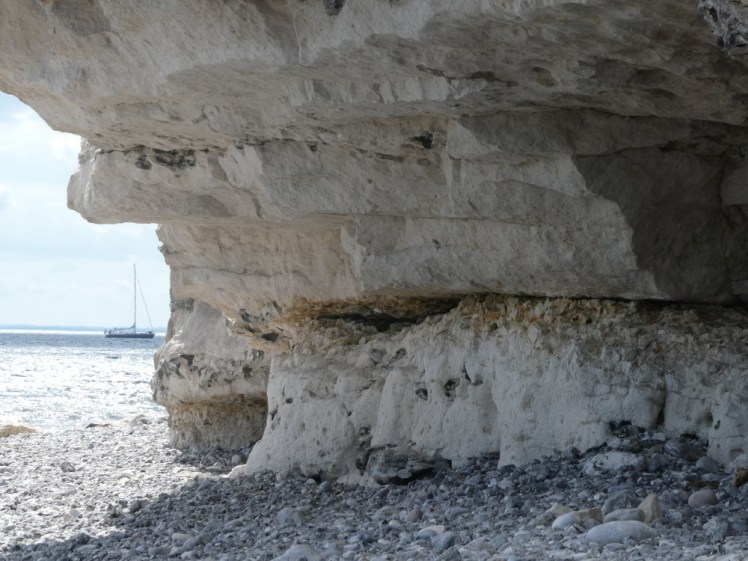
And we did! I live close enough to my own local crumbling chalk and limestone cliffs to have a certain amount of awe and fear but yes, I ducked underneath, took some photos, thrilled at how close I was getting to this evidence of dinosaur destruction 66 million years ago and then ran away to a bit of beach without a cliff leaning over it. I suppose, in a way, it did feel a little underwhelming – an exhibit that mostly just showed me the research I’d already done and a guide who pointed us at a cliff she couldn’t actually take us to but… I made it to Stevns Klint and saw the layer of pulverised bones and clay and space debris that was showered over the entire planet on the day when everything about existence changed.
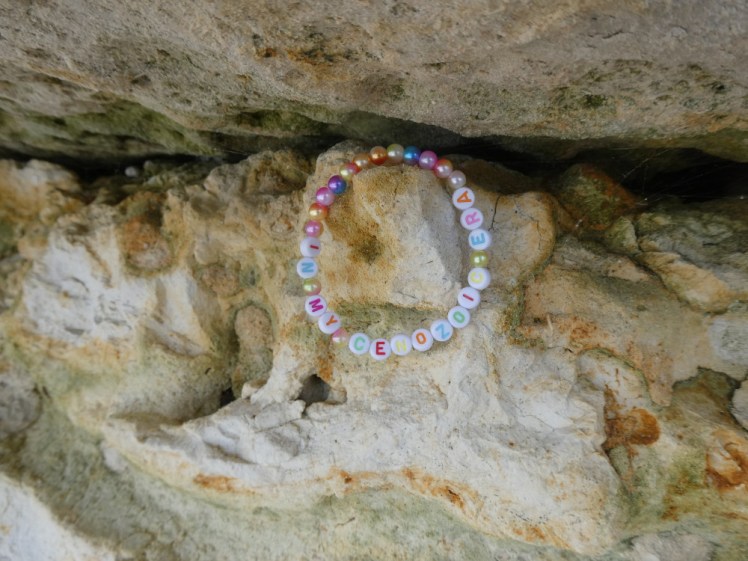
I’m ridiculous and have a lot of beads left over so I made an Eras-style friendship bracelet for the occasion – the only geologically accurate Eras bracelet in existence, I suspect – and was delighted to find just the piece of rock to hang it over to take a photo, just as I’d dreamed about a month earlier.
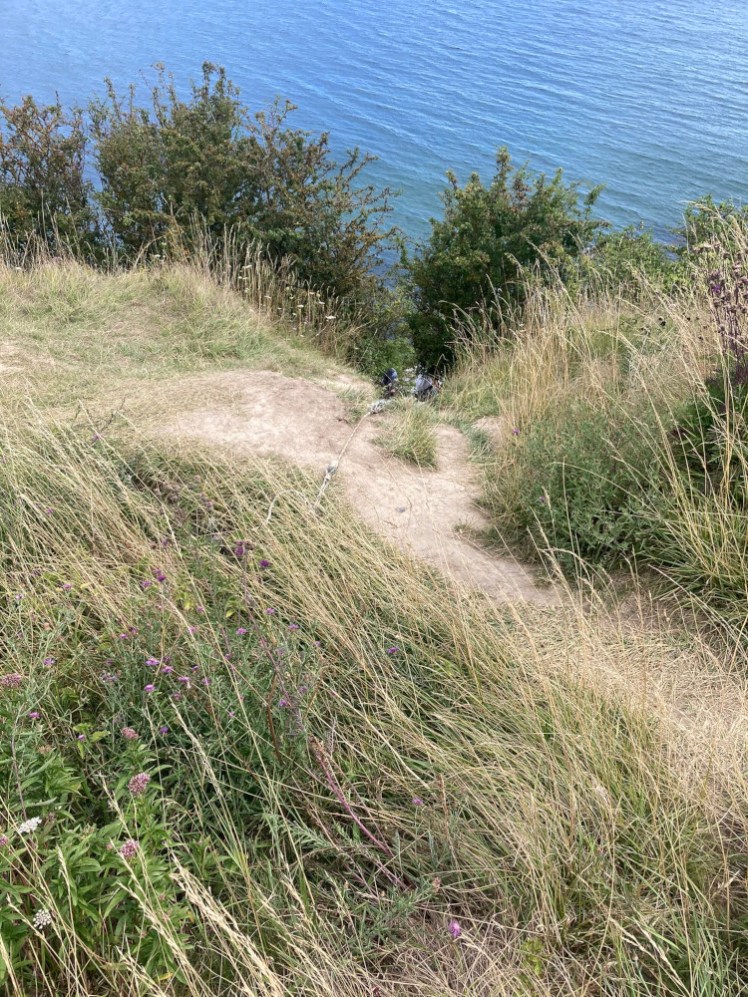
I did something stupid after that. I picked my way back across the beach quite merrily, enjoying the water and the cliff and the sunshine and then I saw a path straight up the cliff, marked by a rough length of rope. The caver that will forever live in me knows that you don’t trust ropes that you haven’t seen rigged by someone you trust but I climbed that cliff. I tried to rely on my own feet as much as possible but there was plenty of it where it was so steep and so dusty that my entire weight and my entire life was on that rope. My little plastic film camera fell out of my pocket on the way up but luckily crashed against the foot of the person climbing up behind me and I had a panic at the top that I’d lost my glasses, until I remembered that I’d had the sense to put them in my bag before the fish clay tour even began. I can’t even begin to explain how much I do not recommend that route back to the footpath. That was easily the stupidest thing I’ve done in a long time, even more stupid than walking under the fish clay cliff in the first place.
When my boss asked on Monday what the highlight of my trip was, this was it, no hesitation. I went all the way to Denmark to see these cliffs and this layer of debris and I saw it and it was incredible.
 I Am A Polar Bear