Welcome to the first of a new series, hopefully monthly, covering all the tools you should have in your travel toolkit. I don’t mean literal tools – no penknives or hammers to be taken away at security here! – but your skills and abilities toolkit to be able to make the most of your travels. And the first is, appropriately enough, First Aid.
As someone who’s been doing first aid since I was a child – we learned it at Brownies, revised it as Guides, I did a caving-specific first aid course at uni, and as a Girlguiding leader, I have to renew my training every three years – it’s incomprehensible that there are adults, a lot of adults, walking around with zero first aid knowledge or training. We went round the office about ten years ago and discovered that out of ten or or so of us, I was the only one with a current first aid qualification and only one other person had ever done first aid training, and that had been in her previous career over a decade earlier. No matter how little you do or how unconfident you are, you’re miles ahead of anyone else. It’s always, always useful to be able to look after yourself and while it’s always useful to be able to help in an emergency, the number one most useful thing you can do in an emergency is be the person who can keep their head and one of the best ways to become that person is to do your first aid training.
Yes, even if you’re not physically able to get down on the floor to do CPR, even if you’re not big enough or strong enough to do abdominal thrusts on someone choking, even if you just think getting too close to someone who’s a bit bloody or putting your mouth over theirs is too icky – you can still direct! You, go and call an ambulance and say this. You, get down there, lock your hands like this and do CPR, I’ll tell you exactly what to do. You, form a human shield so no one can gawp. You, run and fetch the nearest defibrillator. That sort of thing. If there’s someone who can keep their head and control the situation, suddenly the problem is halved. That’s why we teach our Brownies CPR – they’re not big enough to actually do it themselves but they can tell an adult who’s never done any first aid training what to do and that in itself is an incredibly valuable thing.
Knowing how to do CPR or work a defibrillator or even deal with choking is all well and good but 95% of the first aid most people ever deal with is just day to day minor injuries. Cuts, scratches, grazes, the occasional minor burn from getting too close to a metal kettle and if you’re really unlucky, twisted ankles. When I’m dealing with a first aid issue, the number one thing I say in that situation, by a long way, is “Are you allowed plasters?”. Last term there was one night when we ended up putting four plasters on in a single Brownie meeting.
But outside of Guiding and back to travelling: you really should be carrying a basic first aid kit with you, even if it’s just a tiny ziplock bag containing a handful of plasters and your favourite non-prescription painkiller. If you’re hiking, add in a silver blanket, some blister plasters, a tic remover and a rolled-up bandage and you’re already more able to deal with minor injuries than 99% of people.
If you can attend an in-person first aid course, even if it’s just a single day, that’s the best thing to do. Even better if you can get your job to pay for it. There are plenty of organisations that run reputable first aid courses – the Red Cross and St John Ambulance come to mind but there are also online courses and while you don’t get to practice the CPR or the defibrillator online, knowing the theory is better than knowing nothing. In fact, just watching some videos on YouTube is better than knowing nothing.
This is what we covered at my first aid course last month. Once upon a time, you’d do a full day course to get your First Response certificate – this is the standard basic Guiding & Scouting first aid qualification – and after three years, you’d do an evening session to renew it. But because of some things that have happened in Scouting, our shared First Response course has been updated and everyone has to redo the full day course every three years. Because Guiding & Scouting revolve around children, it has a stronger paediatric element than many first aid courses, especially the First Aid at Work ones.
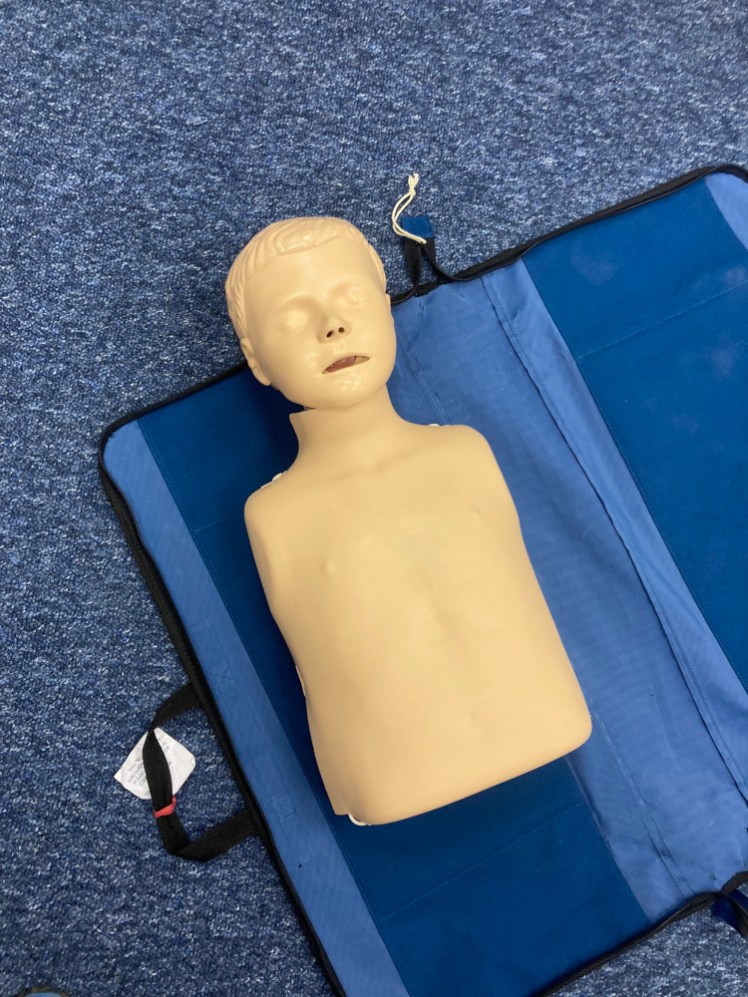
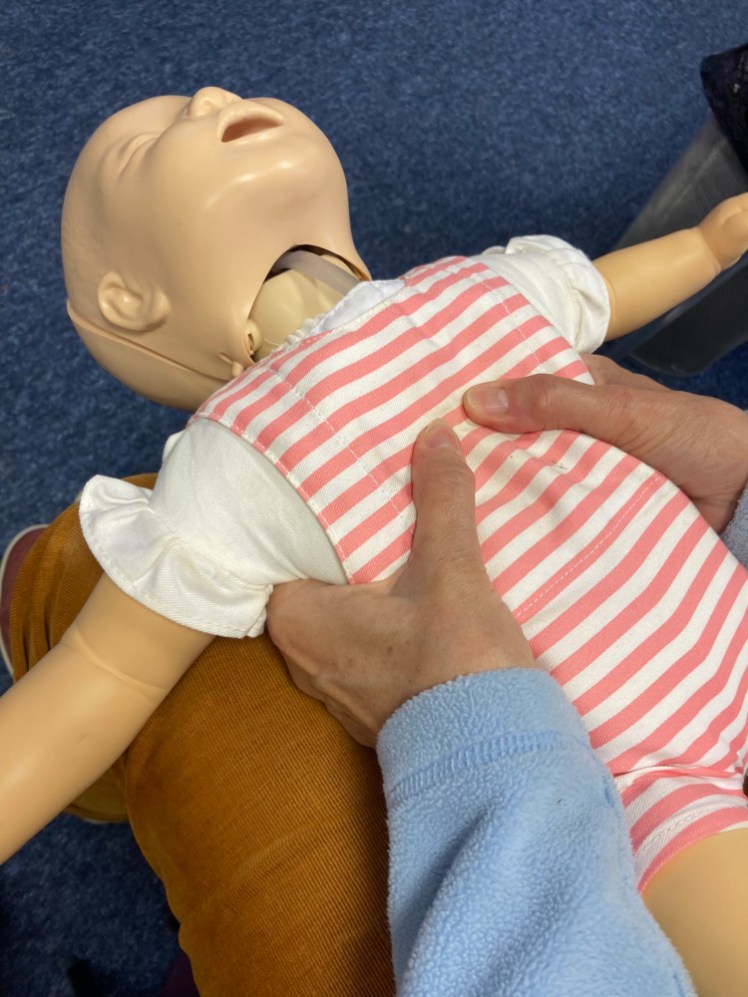
The new First Response consists of four modules in decreasing size, by which I mean that we got through each quicker than the last. The first module is Life Support, which covers DR ABC – that is, Danger, also known as the primary survey (look at the situation when you arrive), Response (is your casualty responsive – not can they speak but can they respond to voice or movement or anything that tells you they’re conscious) and then Airway, Breathing and CPR. We practice that on limbless mannequins: adult ones first and then how you do CPR slightly differently on a child and then a baby. Incidentally, if you’ve ever done infant CPR, the guidance has very recently changed and instead of doing almost what you do for an adult, just with two fingers, you now hold the baby in both hands with thumbs on top and press with the thumbs. It looks and feels very different to what I’ve been taught my entire life but this is why we redo the training – partly to refresh our memories, partly for the confidence boost in dealing with situations and partly to get the up-to-date guidance.
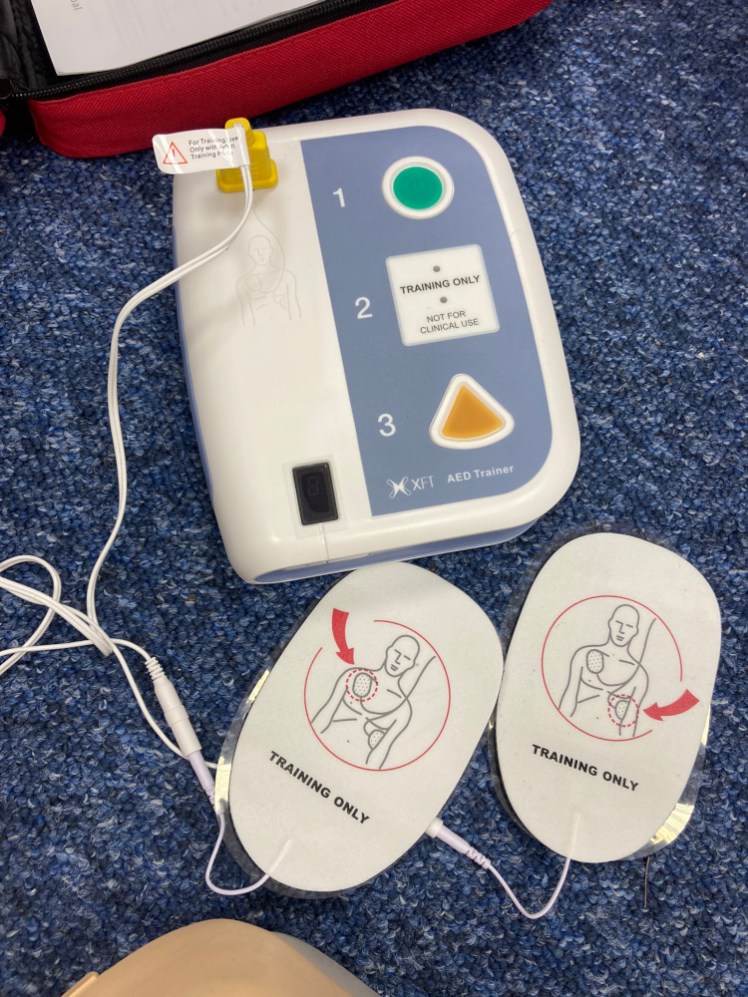
CPR training also comes with defibrillator training now. Apparently only 1 in 10 people who have a cardiac arrest outside a hospital will survive; add in a defibrillator and that number doubles. 2 in 10 is still very low but it’s a lot better than nothing. Defibrillators are a bit intimidating but they talk you through what to do and will only administer shocks if one is needed, so you don’t need to worry about doing it wrong. They’re designed so an eight-year-old can follow. I have faith that you can do what you’re told by a machine.
Recovery position and choking also come under this module. The CPR is something we’re pretty unlikely to actually use in Guiding but we should know for life in the wider community. Recovery position and especially choking might well come up. So we got the children and babies out again and tried our back blows and abdominal thrusts on them.
Module 2 is Trauma & Injury – shock, bleeding, burns, spinal injuries, fractures, head injuries and dental. The group was horrified that the guidance on dental incidents is to try and push the tooth back into the gap. Considering no one made a sound at packing special bandages into gaping wounds ten minutes ago, I was a bit surprised how squeamish they were over a mere mouth. There wasn’t anything practical to module 2 – if you break out the practice bandages, it takes a lot longer than you think and doesn’t really benefit the learners so our trainer didn’t bother. Same with the choking vest for trying out abdominal thrustsin the previous module. Key takeaway from this bit: we don’t elevate major bleeds anymore. There’s very little evidence it helps and it definitely makes it harder to keep pressure on it.
Module 3 is Major Illness and this is the stuff we’re most likely to deal with. Asthma, anaphylaxis, seizures and hypoglycaemia along with chest pain, strokes and sepsis. A lot of this section is ruled by Adjustment Plans, documents leaders write with the parents/guardians to deal with a particular girl’s needs. For example, a Guide with epilepsy. At what point does she have a nap after a seizure and then get back to the activity, at what point do you call the parents and at what point do you call an ambulance? Conditions like these can vary hugely from person to person so you have it all in writing for this particular person and follow that.
Module 4 is called Environmental Emergencies and it’s about emergencies that can arise in particular outdoors scenarios: drowning, hypothermia, heatstroke, snake bites and ticks. The snakes were a mystery. Around 50 people get bitten by a venomous snake per year in the UK and no one has died from an adder bite since 1975. So why has this been added to First Response in its latest iteration? Tick bites, fine. We do go out in long grass and shrubbery sometimes.
And that’s the lot. We squeezed all of that into just under six hours and now there are another dozen leaders in the county qualified to deal with incidents in Guiding and in our wider general lives – all except the literal paramedic who finds it easier to sit through this every three years than wait for someone in an office to sort through the paperwork of her day-to-day serious medical job and mark her as having met the equivalent standard. If you get the chance to do some first aid training, or you just want to watch a few videos on the subject, I hugely recommend it.
 I Am A Polar Bear