On Friday afternoon I arrived at Karlovy Vary, the third spa town on my little train adventure round Czechia’s West Bohemian Spa Triangle. Karlovy Vary, or Karlsbad in German, is the biggest and best-known of the three towns, meriting an entire chapter in my guidebook instead of a mere “and this place exists too” like Mariánské Lázně and Frantiṣ̌kovy Lázně got. YouTube had also yielded ten times the videos on Karlovy Vary than it had on its sibling towns and within five minutes of getting off the train, I understood why.
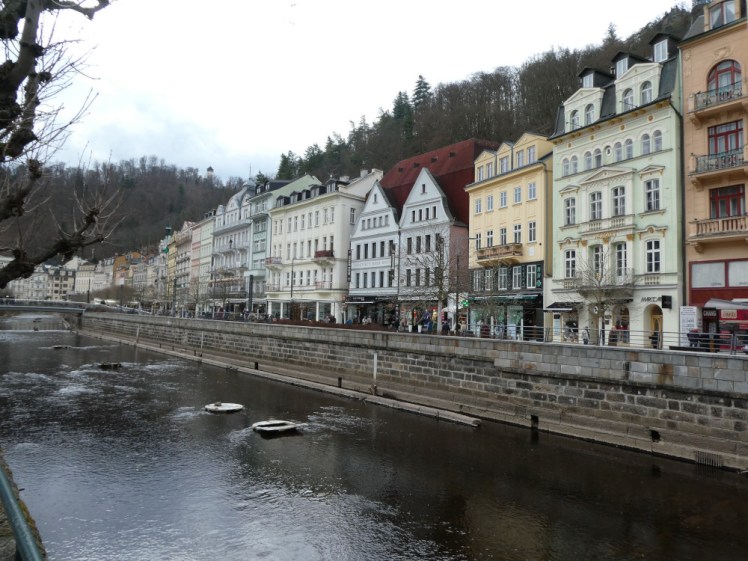
Coming from two towns where the main draws were hotels that doubled as small hospitals on the edge of a spa park where you could walk quietly and sample the waters, Karlovy Vary felt like a massive city. There was the dual carriageway to cross on the way down from the station, the roundabout to negotiate, traffic that came in more than a single car or trolleybus every minute or two and more people walking up past the concrete monstrosity of the Hotel Thermal than I’d seen in nearly four days put together. The phrase “shock to the senses” bounced around in my brain for almost my entire time in Karlovy Vary and I couldn’t quite fathom how UNESCO or the tourist board that came up with the West Bohemian Spa Triangle could think that these three towns had anything in common.
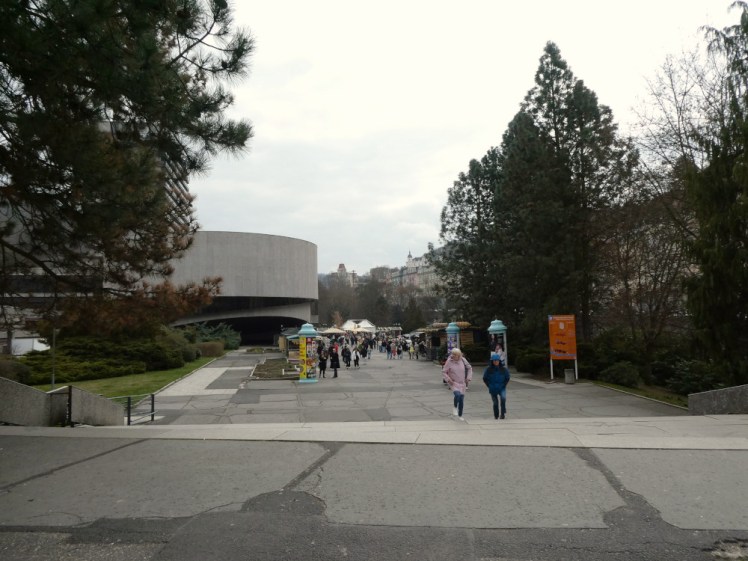
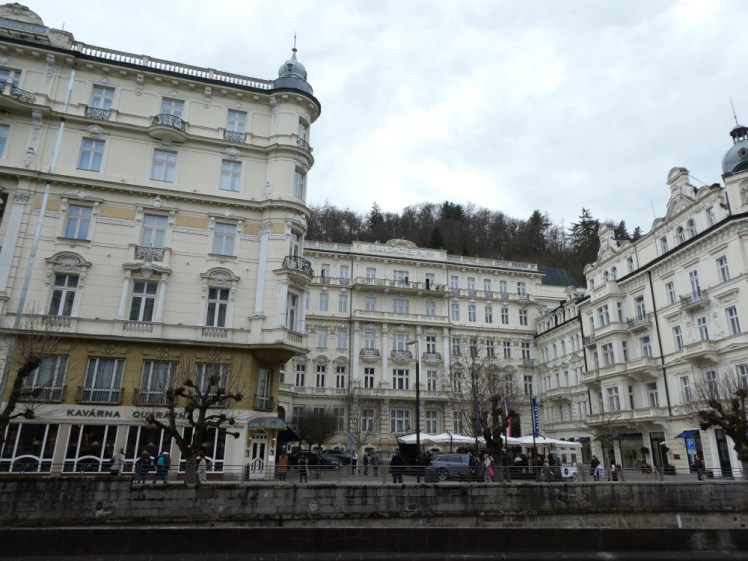
I’m sure Karlovy Vary does have the spa-and-medical hotels but it doesn’t have a large open spa park. Instead, the town is arranged along the banks of a river that winds its way between low mountains, forcing the town into the narrow valley in the middle. In fact, if you take the Diana funicular up to the lookout tower at the southern end of the spa area, you’ll find Karlovy Vary actually sprawls quite a way up the hillside and that’s probably where the more medical hotels are. In the town centre, the walls are steep enough that you have no idea what’s going on just above you and there are only a handful of relatively large, relatively prominent hotels right there. The first is the communist-era Brutalist Hotel Thermal. I knew this had an excellent pool which was on my to-do list and, in fact, that one turned out to be excellent enough to merit its own post on Monday. At the far end is the Grandhotel Pupp, which my guidebook features as probably the best (and most expensive) hotel in all Czechia. This is where all the celebrities stay when they come to the Karlovy Vary film festival and you may recognise it as the casino from Casino Royale.
One thing Karlovy Vary has in common with its siblings, which is why UNESCO and Czech tourism put them on the same list, is mineral springs which patients drink on prescription and tourists sample for the fun of it. What makes Karlovy Vary very different is that the fifteen springs arranged in five very different sets of colonnades through the town are hot. The coldest I found was about 56⁰C and the hottest is 72⁰C. These springs are much more Icelandic. They steam as they pour from fountains into metal basins almost blocked by the growth of orange and white mineral deposits, exactly like you’d see at a geothermal area, they smell faintly sulphuric (or maybe it’s my imagination, smelling what I expect to smell instead of what I actually smell) and… you’ll never guess what. They taste terrible. Not just terrible because they’re full of minerals that case an orange buildup on the edge of their basins but terrible in the way that liquids often taste terrible when they’re not meant to be drunk hot. Imagine a 60⁰ beer. Imagine a cup of tea that’s just cooled a bit too much. Imagine drinking from the hot tap instead of the cold one. Am I the only one who’s ever accidentally turned the tap the wrong way before brushing my teeth?
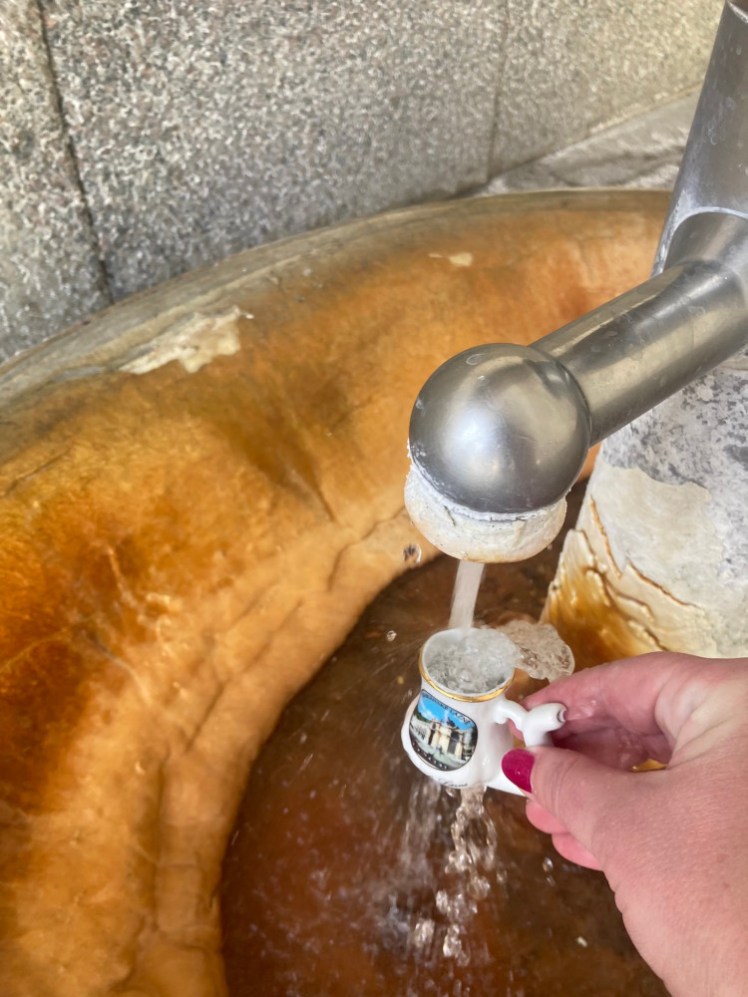
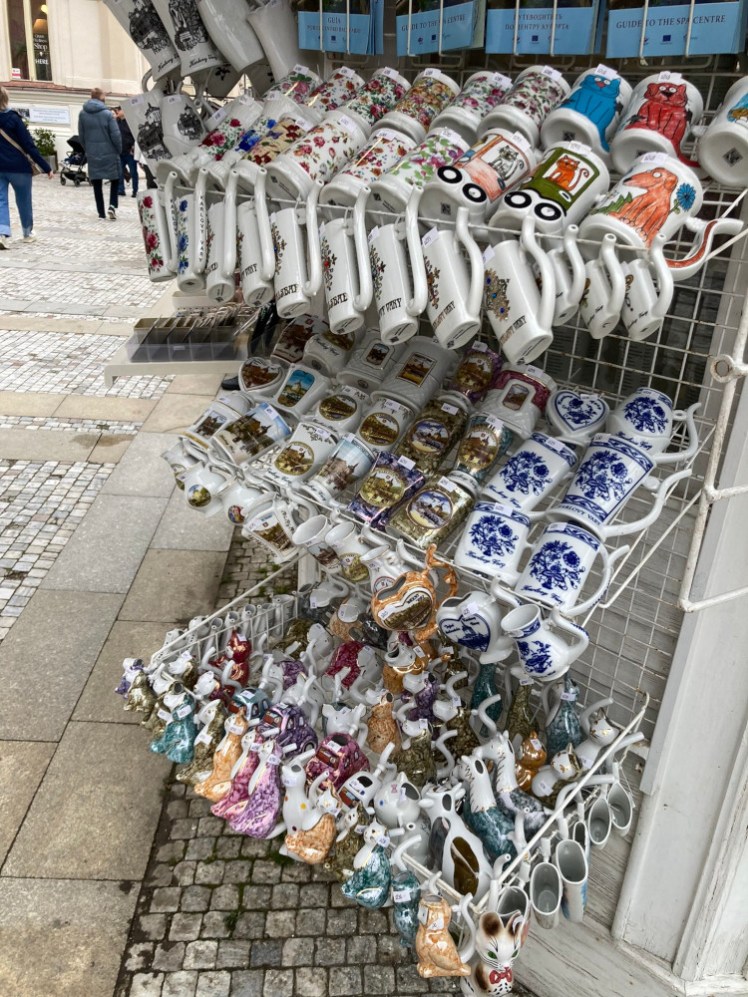
So, you buy a spa cup from one of the many kiosks and shops along the river. The choices put the kiosk in Mariánské Lázně to shame. Big cups, tiny cups, flat cups, racing car-shaped cups, cow cups, cat cups, elephant cups, pearlescent cups, cups with pictures of the town on them, willow patterned cups, cups with children’s drawings on them… the choice is overwhelming. Fortunately, I bought mine in Mariánské Lázně a few days ago and I could look with curiosity rather than worry about “I need to buy one of these before I can do anything!!!”. Of course, you don’t need to buy one. Plenty of people were filling metal bottles or empty plastic drinks bottles. It’s just that the cup serves a double purpose in being a practical souvenir as well as providing you with an in-built straw for drinking the hot water.
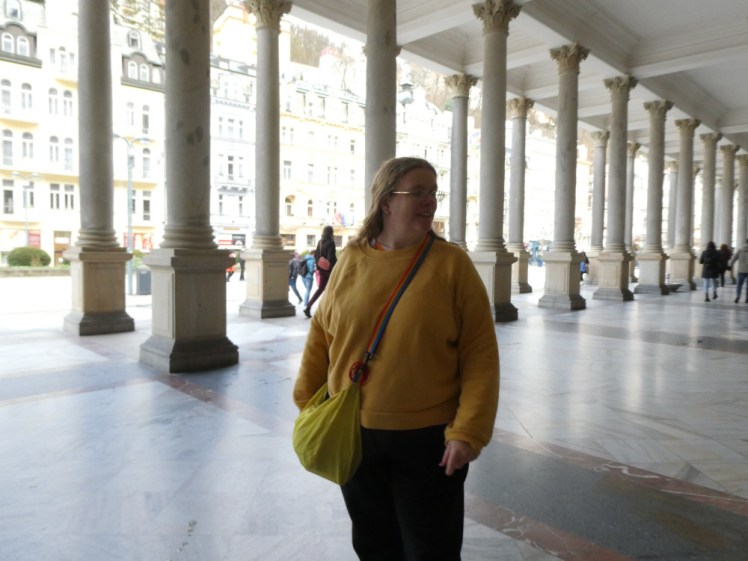
There are five main colonnades. The first one I found was the Mill Colonnade, a Pseudo-Renaissance stone-pillared spectacle housing five different springs. I think I only tasted two or three. By now, on my third town in four days, I was running out of the stomach for mineral waters. I’d be terrible at taking “the cure”.
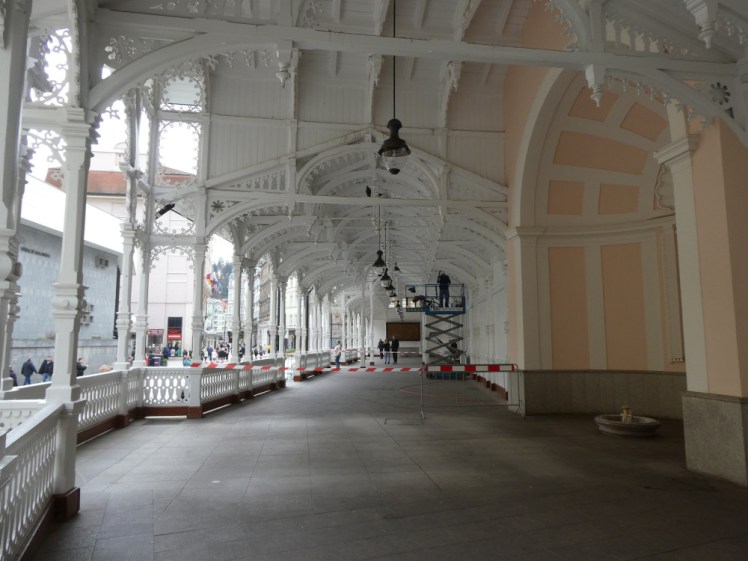
The next one is the Market Colonnade, which is made in Swiss style lacy wood and houses three streams. This one is prettier than the Mill Colonnade but on the other hand, it lacks the majesty and grandeur. They’re all different, they all have different appeals.
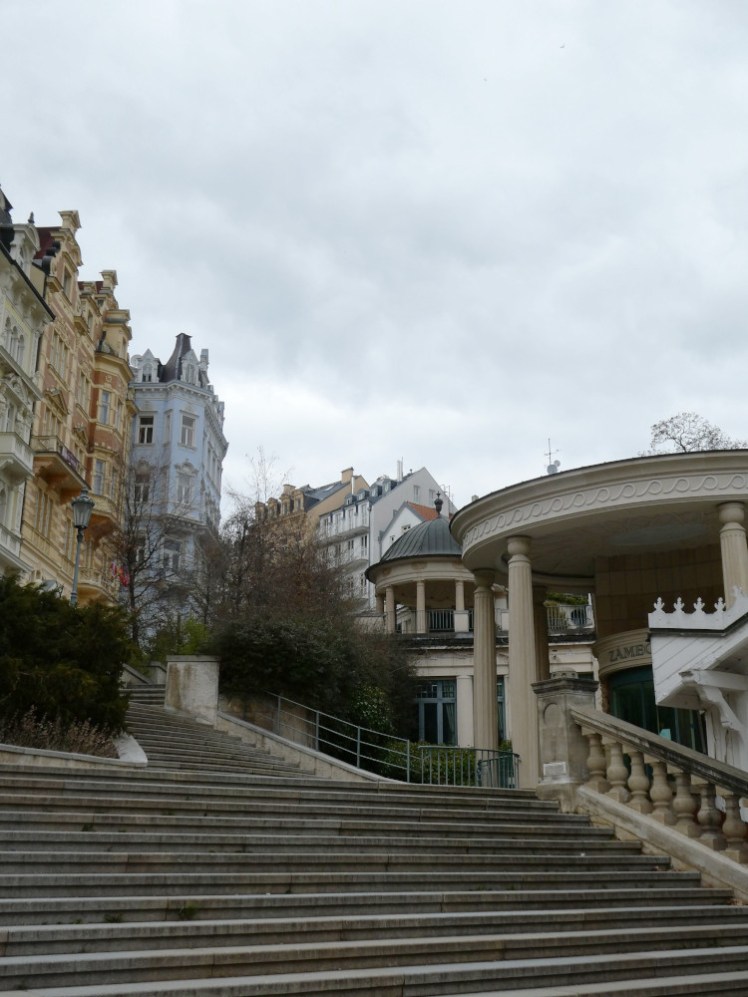
I missed the Castle Colonnade which is up the steps at the end of the Market Colonnade but that’s fine. It’s just another two springs that I didn’t sample. I did accidentally get a photo of it, though, without realising what it was.
The one I nearly missed is the Hot Spring Colonnade. I walked south until I reached the Pupp and then walked back up and it was only when I was nearly back at the hotel that I realised I hadn’t found the most famous of all Karlovy Vary’s springs, the Vřídlo Pramen, the 72⁰ spring that erupts into the sky. That’s partly because the obvious walkway to where it’s located on the east bank of the river was under some roadworks. On the other hand, I walked down the west side and back up the east side so I would have walked right past it without realising and that’s because it’s in a modern glass and concrete building that looks more like a 90s shopping centre than home to the town’s most popular spring.
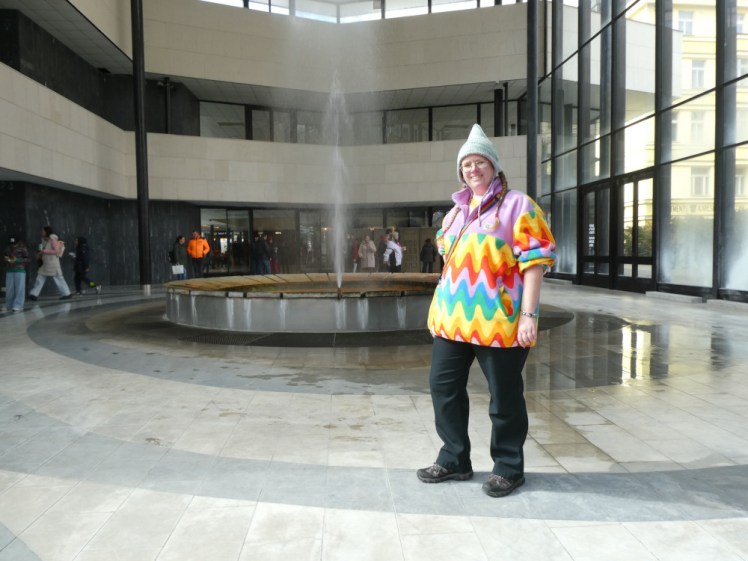
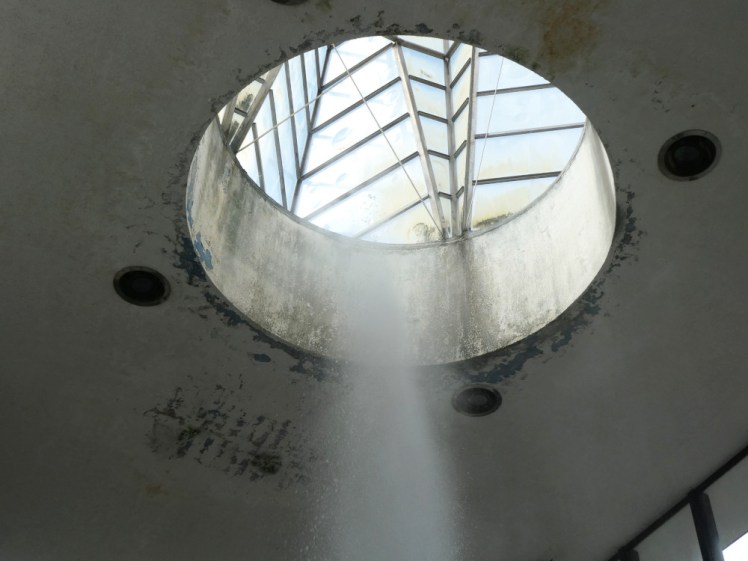
Actually, Vřídlo, which gushes up to twelve metres, is too high for the colonnades and has to burst into an extra geodesic dome built into the ceiling. Even if you couldn’t see it through the crowds and couldn’t guess from the presence of said crowds, you’d know you were in the right place immediately because the pavilion is hot, humid and smells slightly of sulphur. Go to the far side – the floor is a little splattered from spray but you’re more likely to see the geyser and less likely to see the back of someone’s head from there. If you want to drink from it, there are three taps just outside. Iceland would have some kind of expensive pool experience here, I kept thinking. Why haven’t they built one when they’ve got this much natural hot water? Ha. You’ll find out exactly why on Monday.
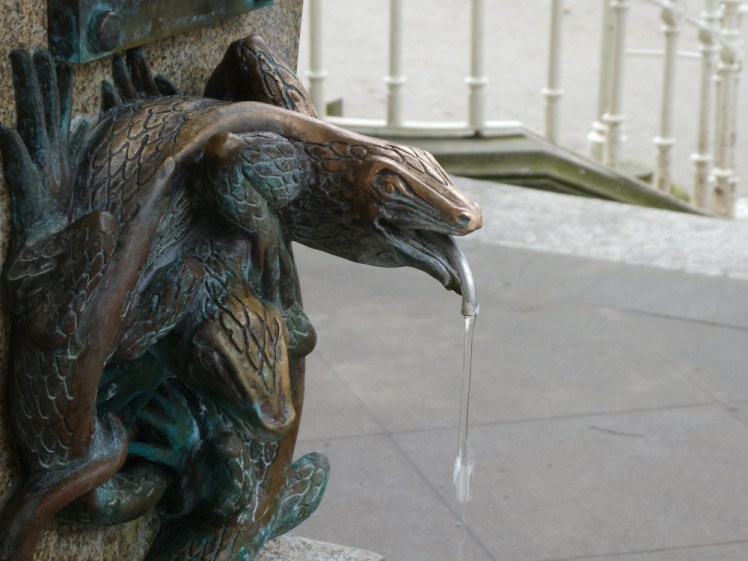
Another colonnade I missed that afternoon because it’s on the wrong side of my hotel but made a point of seeking out the next afternoon is the Park Colonnade, a cast-iron thing that’s apparently the last remnants of a long-gone concert hall and restaurant. I quite like that one of the two springs here is Hadí pramen, the Snake Spring, and the bronze tap from which the fizzy water pours is shaped like a snake. This one is a little less mineraly than the others but makes up for it with extra carbon dioxide. That done, I put my tiny cup triumphantly back in my pocket. No more spring water for me! I’m done with drinking spring water!
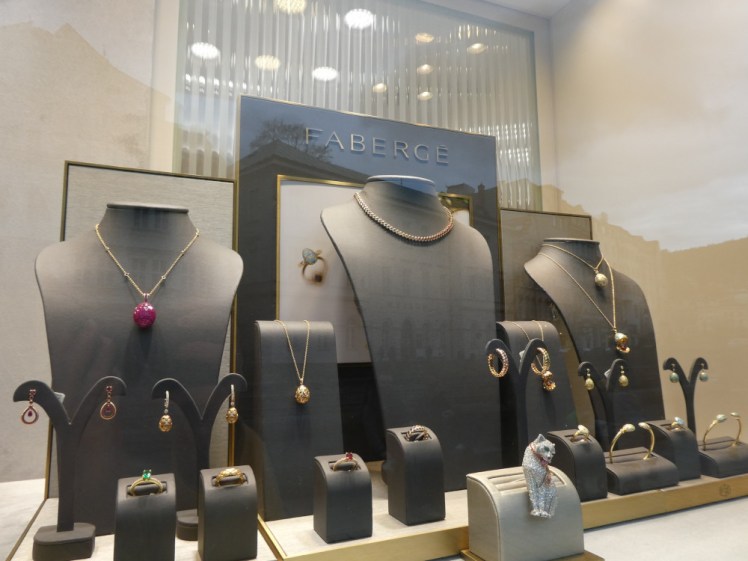
Of course, the springs are important, they’re what put Karlovy Vary on the map in the first place but the town seems to have become more than that – it seems to have become a bit of a resort for the wealthy. Not only is there the Grandhotel Pupp (which actually, now I’m looking at it, could work out at much the same price as Mariánské Lázně’s Nové Lázně hotel where I stayed) but in the jewellery shops at the southern end, I spotted Fabergé jewellery – yes, as in the makers of the jewelled eggs made for the Russian czars. The discovery that Unilever bought Fabergé in 1989 was a shock – the people who own Marmite, Persil and Lynx also own the imperial jeweller?? – but nonetheless, that’s a prestigious brand and not the kind that I stumble upon most days.
Being a resort, when you’re not buying expensive jewellery, you can go to endless cafes and restaurants, to the theatre, take the bus out to one of the best Czech glassmakers (I wish I’d had time for that; on the other hand, I couldn’t afford anything they make and nor could I transport it home in my easyJet personal item) and if you time it right, attend the film festival along with the A-list celebrities who all invariably stay at the Pupp. Oh, you can keep yourself occupied in Karlovy Vary for quite a few days. This town is a world away from Františkovy Lázně where I was only this morning! Twenty-four miles, that’s all that separates these siblings. A shock to the senses I said to myself yet again.
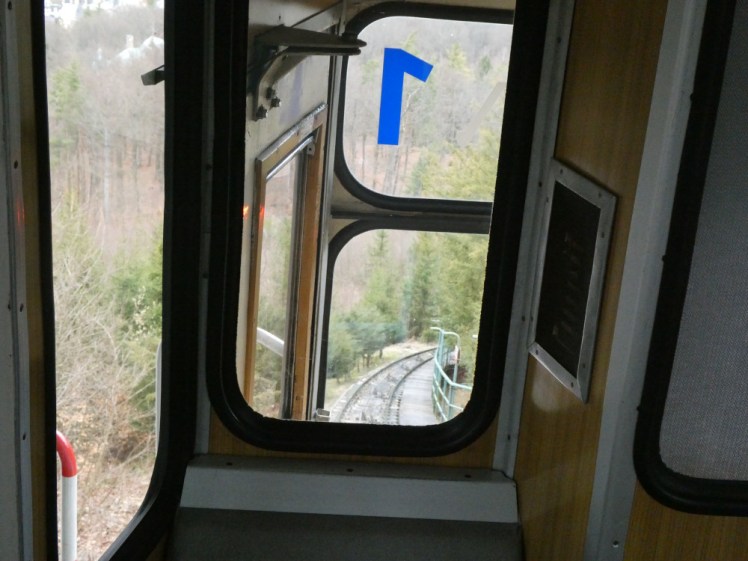
The last must-do in Karlovy Vary is a trip up the Diana funicular to the viewpoint tower at the top. There’s also a restaurant here and a butterfly house and a very pleasant walk back down if you fancy it – or indeed, you could walk up in the first place. A return adult ticket costs 165 CZK, which is about £5.90 and it takes about five minutes to glide gently from the valley station hidden away next to the Pupp up to the top station 167m above you. I very highly recommend taking a free trip to the top of the lookout tower, either via its 150 steps or via the lift. Once you look out over Karlovy Vary, you’ll probably be just as blown away as I was by how big the town is, how sharply the river turns and how much of it is sprawled over the mountains. The spa end of Karlovy Vary alone dwarfs the entirety of Mariánské Lázně. I don’t quite know if I’d actually call it a “city” rather than a “town” but while you’re walking around sampling water and spending the evenings in your hotel’s pool, it’s very hard to really grasp the scale of the place. The views up here are amazing but seeing Karlovy Vary sprawling was my favourite bit.
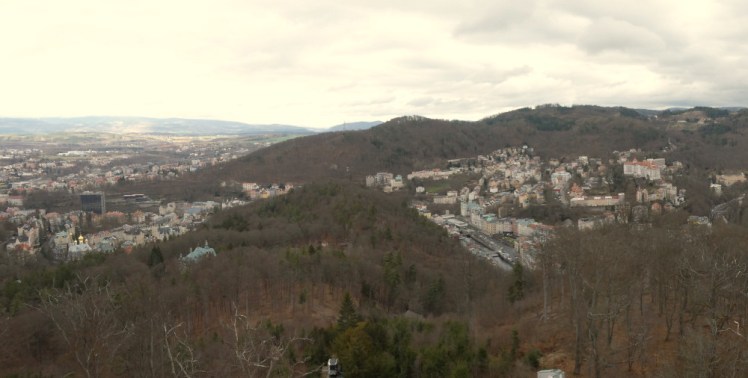
I didn’t have a lot of time to really appreciate much else up here at Diana – by the time I’d spent the morning at Hotel Thermal and the afternoon tracking down springs and forming opinion, the funicular only had another hour or so to run by the time I was buying my ticket in the valley station. I could have lingered and walked back down but I didn’t have a clue where the route went, how long it would take, what the weather was planning to do (it had rained on and off all morning and half of the afternoon) and I hadn’t come out with anything other than my camera, my wallet and my spa cup. I’m 95% sure walking down would have been no problem at all but I like to be just a little more prepared for a mountain walk than that so I enjoyed the views for half an hour and jumped back on the funicular.
So that’s Karlovy Vary. Crowds, springs, shops, viewpoints… and on Monday, I’ll tell you all about the excellent pool that might tempt me back for a second visit one day.
 I Am A Polar Bear