After you’ve sampled all Mariánské Lázně’s natural health-giving spring waters, you have to soak in the stuff and, quite frankly, there’s only one place in town to do that. Well, lots of the spa hotels have pools and some may even have mineral pools (which might only be available on prescription because spa in Czechia is very medical) but far and away the best bath in town is the Roman bath at the Nové Lázně hotel. It even has both the royal and the imperial seal of approval.
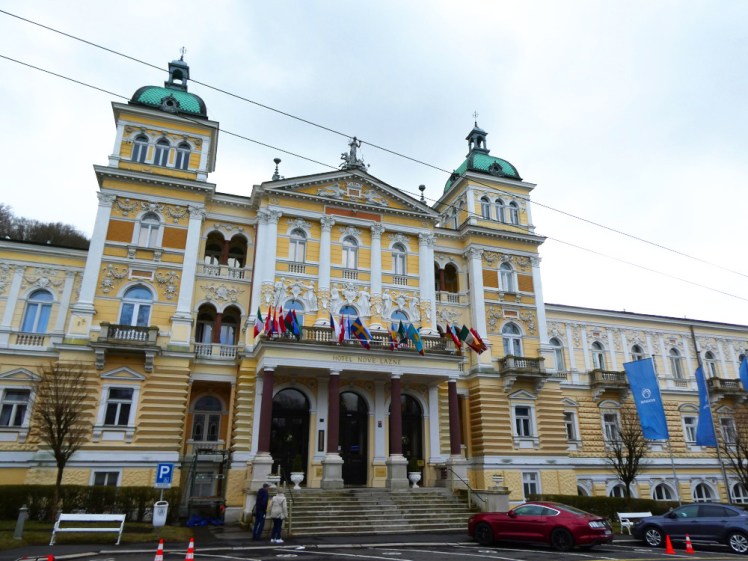
This is one of the best hotels in the country. My guidebook has a page dedicated to different kinds of accommodation in Czechia and it specifically picks out Mariánské Lázně’s Nové Lázně and Karlovy Vary’s Grandhotel Pupp as two of the standout best hotels in the entire country. The five-star Nové Lázně was once host to King Edward VII (they’re very proud) who had his own private bath, the Royal Cabin, and Franz Josef I, Emperor of Austria and King of Hungary who they don’t boast about so much but who nonetheless seems to have had his private bath too, the Imperial Room. Goethe has stayed here too, but he seems to have done a trip much like mine because there are “Goethe stayed here!” hotels in both Františkovy Lázně and Karlovy Vary. Czar Nicholas II, Franz Kafka and Frédéric Chopin have also been guests here.
Reader, I stayed there! I don’t think I’ve ever stayed in a five star hotel before but Czech hotels aren’t quite as expensive as they might be in other places, and it included breakfast (which is itself often €15 a day) and access to the spa – or that which I’d previously known as a spa, since the entire park falls under the title “spa” in this country – and for once, the maths did kind of math. Yes, €147.61 plus VAT was more than I’d usually want to pay but it wasn’t as horrifyingly out of reach as I might have expected from a place of that calibre. I looked up the sort of thing that ladies who lunch might wear to arrive at a spa hotel but it was all “wear robes and slippers and have something soft to put on afterwards” rather than what one should wear to arrive at a five star hotel and in the end, this urchin with her easyJet personal item backpack just came in lined outdoor trousers and a rainbow-coloured fleece and felt a little out of place.

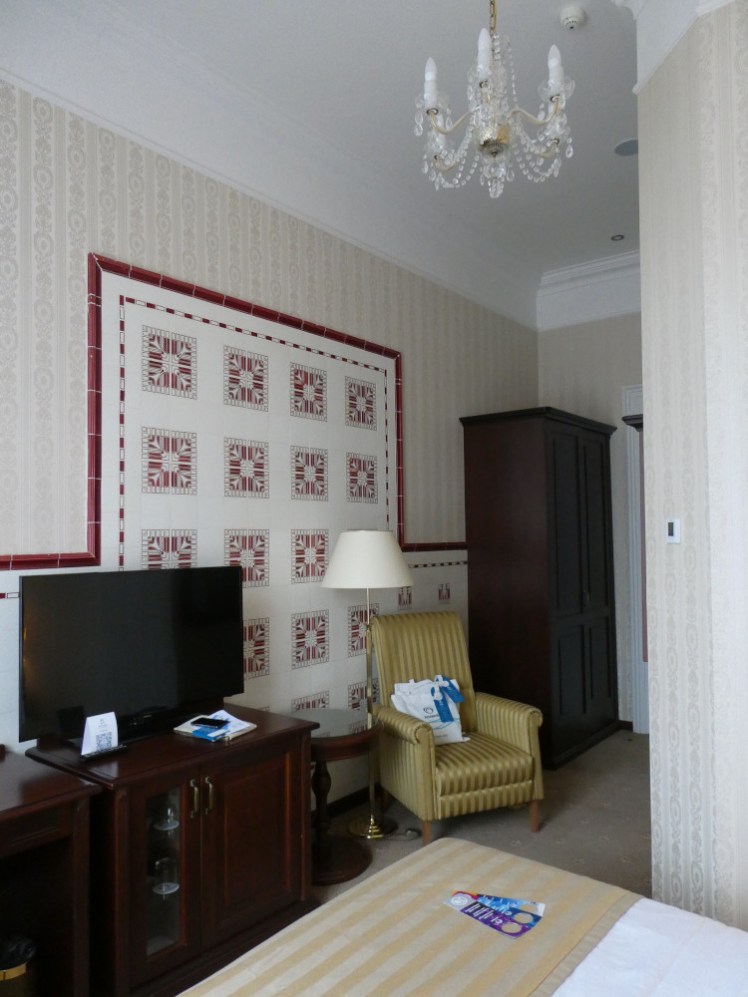
It was a bit of a shock to have a pleasant gentleman in a bellboy’s uniform offer to take my bag and then lead me to my room and show me around. I’ve never stayed anywhere where this kind of treatment was even available, let alone given to someone like me. A bit of a shock to find there was a dress code for breakfast, especially as I wasn’t sure whether my grubby approach shoes, the only footwear I had with me, constituted “sportswear” or not. A bit of a shock to discover my room was quite pleasant instead of a miniature bed shoved into a cubbyhole somewhere, which is what I assumed it must be for the price I’d paid for admission to this palace. I had a robe hanging up in the wardrobe, slippers and more citrus-scented toiletries in the bathroom than I’ve ever seen in one place that wasn’t Boots.
And so to the Roman baths!
Oh, the Roman baths are lovely! It’s in the basement of the hotel or you can access it via a separate door further down the hill, along with the Vienna Cafe. As an external visitor, you probably want to go to the spa reception to pay for access and if you want any treatments, that’s where you go to arrange them. As usual in Czechia, “spa” means medical – on the non-prescription list, you can have assorted “mineral baths with natural CO₂”, cryotherapy, lavatherm, whirling baths, just about any massage you can think of, oxygen therapy and local speciality, a natural dry carbon gas bath. And that’s just the non-prescription stuff!
As for the Roman baths, hotel guests let themselves in with their key cards or non-guests can pay 800 koruna (£28.55) for access for three hours. Someone on reception gives you a nice crisp white sheet (but doesn’t tell you what it’s for) and offers a lucky dip of locker keys on branded silicon bracelets, blue for boys and pink for girls. You get changed, or take off your robe if you came downstairs in your swimwear, lock everything away in your locker and go off to the bath. There’s a map on the inside of the changing room door because the complex is a little more complex than you think – I had to come back to consult it, having failed to find the whirlpool.
The trouble with places like this is that some rooms are public and some are by appointment only and it’s not necessarily all that obvious which is which, so you have no idea which doors you can explore and which you can’t. The same goes for the rules. You know there are rules, you just don’t know exactly what they are. One rule is no phones or cameras – the polished brass plaques make that unmistakable but people scroll on the loungers and some people were very blatantly taking selfies so I don’t feel guilty about discreetly taking a few pictures without disturbing anyone or getting them in the pictures. I did accidentally get someone full in one of the pictures while she was lounging and reading but I deleted it.
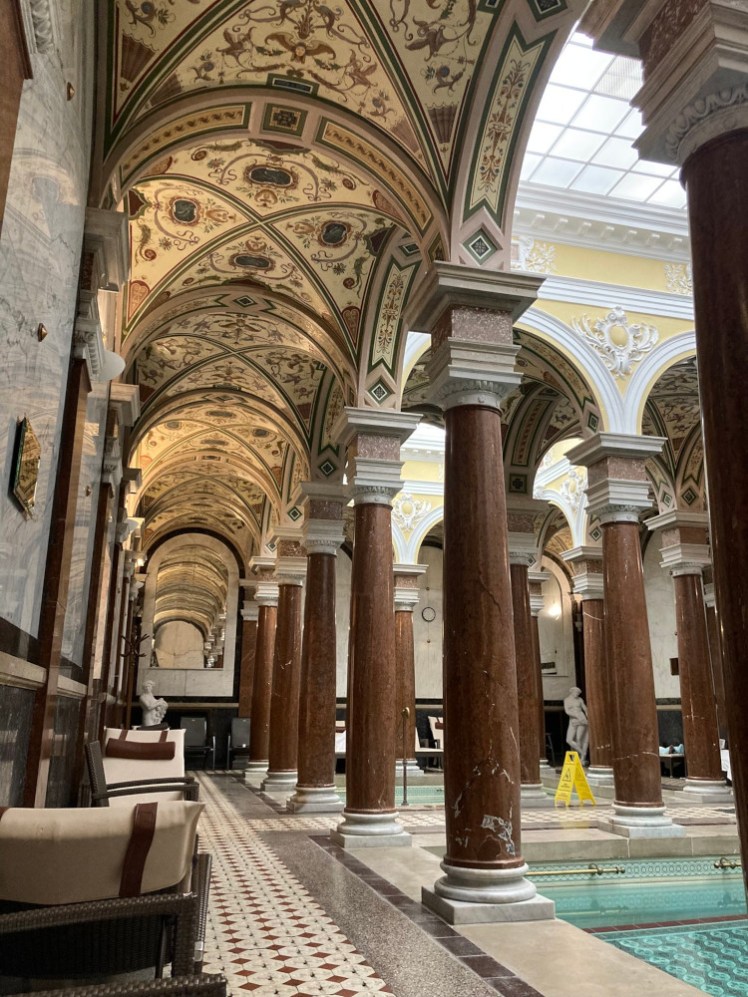
The Roman baths themselves are the centrepiece, of course, and they’re far and away the best bit. Whereas the rest of the bath complex veers between neoclassical (most of the corridors and the swimming pool) and just plain modern (the sauna and Kneipp bath area), the Roman baths are a bit of 1896 mock-Roman mock-classical over-the-top gorgeousness. Columns, colourful tiles, wooden loungers, warm faintly-blue water and wooden loungers all around the edge. The water is around 30⁰ and rather than the usual plain white tiles or a pale blue plasticky liner, these are the original decorative tiles – at least, I think they are. They’re in very good condition for 130 years old. They have red edges and green trees on them, the stairs down into the water are edged in red and there are brass poles around the edge of the pool for holding on, although the pools are barely chest-deep on me, with brass dragons sticking out of the sides. I assume once upon a time, they were decorative spouts but when they feed fresh water into the pools these days, it’s through holes in gleaming steel rails that run along the bottom of the walls. The double-height ceiling is held up by brown marble pillars and although the central part, over the baths, is frosted glass, the parts over the walkways is also decoratively tiled.
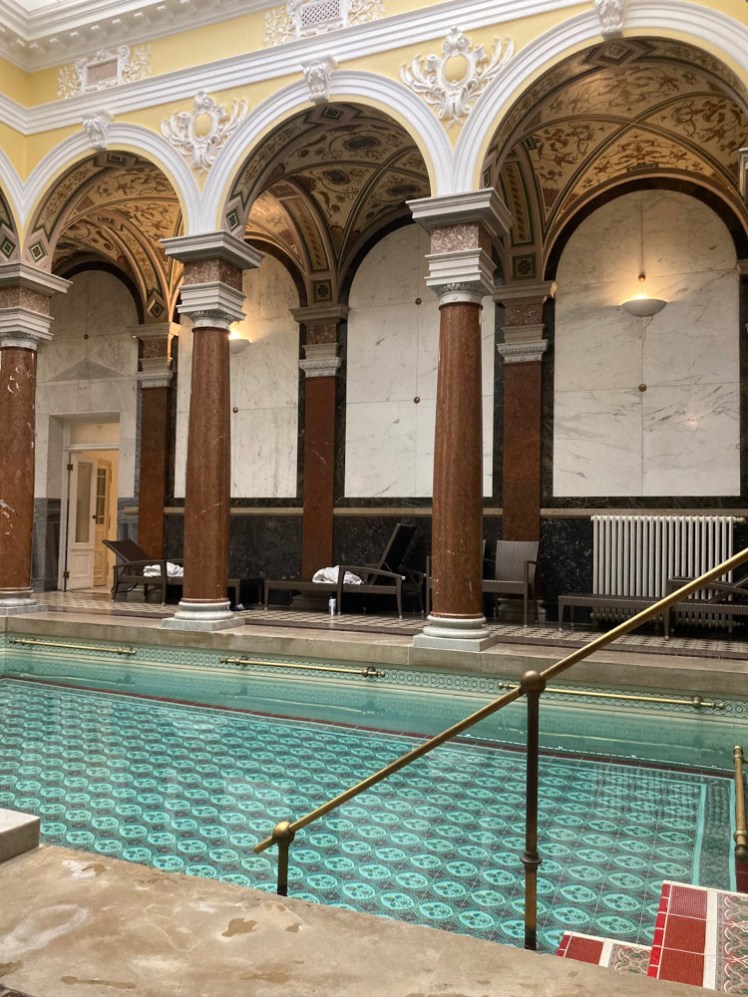
Around the edges of the room are wooden loungers and people lie there, either with books or phones or actually asleep. Google reviews talk about screaming kids but my experience was of an almost eerie silence. You feel guilty about the noise the water makes as you step in it, then you feel like Venus as you let the warm water envelope you while making the gentlest splashes and then you try to enjoy the water as quietly as possible. I’ve often been frustrated by people making a racket in spas, which are supposed to be tranquil environments and now I see what it can be like. It’s incredible.
In the corner, there’s a naked sauna. Not knowing the rules, I didn’t venture in but I got a glimpse of a hatstand when someone came out so it seems there’s room in there to strip before entering the actual sauna. I stuck to the clothed sauna on the opposite side of the Roman baths. This is where you need your sheet; it has to cover every inch of wooden bench that you’re touching. It’s not the hottest sauna I’ve ever been in and it’s very dry, so it’s quite pleasant. Behind that is the showers, a bucket of cold water on a chain, the steam room and something called a Kneipp bath. It’s two troughs full of white pebbles and with gleaming steel rails to take as much weight off your feet as possible as you walk up the first one, which is 60⁰ hot water (or as Mr Lowe, my chemistry teacher, once called it “it’s 60⁰ when you can touch it but it hurts”) and then step into the second, at 12⁰ and walk back down. You’re supposed to repeat this ten times. Because of the pain of the pebbles and of the cold water, the most I managed was one hot, one cold, another hot and then out. The internet says most Kneipp paths are around 32⁰ and 20⁰ so this one is extreme. Either that or I’m misremembering the sign up on the wall explaining it all but I swear that’s what it said.
Hiding round the back, behind the massage room, are the whirlpool and the swimming pool. The swimming pool isn’t much bigger than the Roman baths so it just wasn’t that interesting to me. The whirlpool is a hot tub with jets, although it’s also only about 30⁰, which is really only a tepid tub. There’s a switch on the wall behind the whirlpool to switch the jets on; I think they turn off eventually by themselves instead of using the switch. I had it to myself in the evening so I spent a while lounging on the inbuilt beds and the seats before deciding it was warmer and more comfortable to crouch in the middle. Nice enough but the Roman baths are the stars of the show and on my second visit, I skipped the whirlpool in favour of just hanging out in the bath.
Now, as an Ensana guest, you have another pool option and that’s use of the hotel pool at the Hvězda hotel, the furthest of five linked hotels along the edge of the spa park. The quickest and easiest way to get there, frankly, is to walk the 400m up the road. The more fun way is to follow a series of corridors and passageways that runs through the five hotels. The major advantage of this route is that you can do it in your robe and slippers, although it’s not the “underground passage” I was told it would be and you walk right through the lobby of at least two hotels. The signage isn’t always that clear and I got so lost at the Centralni hotel that I needed to ask directions (which were unhelpful; “it’s over there to the right of the bar” was an area I’d already searched).
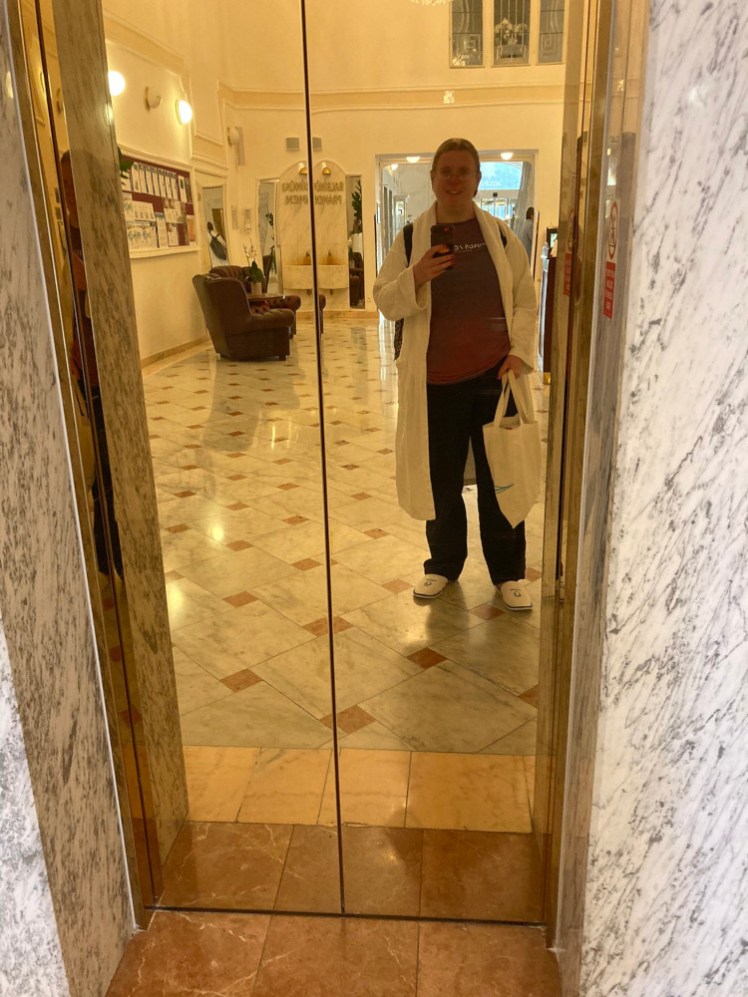
For the record, while the path is an adventure, the Hvězda pool is a letdown. More mysterious doors and the pool itself is massively underwhelming for “the biggest hotel pool in Mariánské Lázně”. Yes, it’s bigger than the Nové Lázně pools and you can swim proper lengths there but if you’re in town for the spa experience, I’d recommend the Roman baths a thousand times over the Hvězda pool. I stayed there for half an hour and then returned to the Roman baths, via the passage because I was wearing my spa slippers, because they’re lovely. It was so much more atmospheric, so much more satisfying and just so much more of an experience.
 I Am A Polar Bear