I’ve just got back from a week discovering Czechia’s contribution to the UNESCO list of Great European Spa Towns, which is three towns up in the top left corner known by the tourist title, the West Bohemian Spa Triangle. Even as I was on my way round, I was already excited about transforming all this into a series of blog posts and here’s number one. My first stop was Mariánské Lázně, better known to the non-Czech world by its German name Marienbad. Its name comes from one of its mineral springs, known as Maria’s spring for the painting of the Virgin Mary kept next to it.
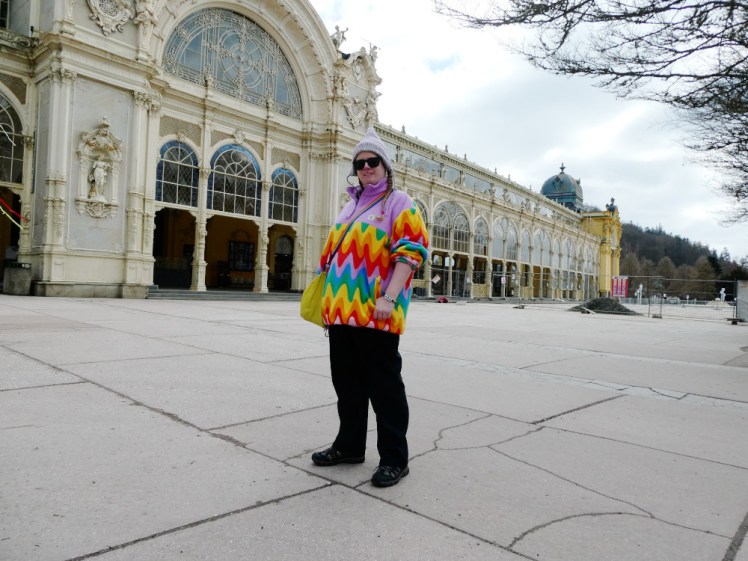
I know roughly what a spa town looks like. I did the German equivalent of this trip last year, three spa towns and (quite) a few trains (and rail replacement buses) and I’ve been to Spa, the town in Belgium that either gave all spas their name or had zero imagination when it came to its own. So I knew more or less what to expect from Mariánské Lázně: parks, benches, casinos, hotels with pools.
It turned out I was wrong.
Czech spa towns are very different from spa towns elsewhere. Czechia’s idea of “spa” is less about relaxing and “wellness” and more about medical treatment and “the cure”, ie drinking the mineral-rich spring water that pops up all over these towns. Sure, there are tourists like me (except they’re almost exclusively Czech and German; not an English voice to be heard until I was back in Prague) but spa towns mostly cater to patients rather than guests. People come here either on prescription (and yes, that means that often the only cost is upgrading to a private room so you don’t spend a month living in close proximity to a total stranger) or for convalescence after an operation. For me, that’s unimaginable. Not just that you can get a prescription for a month at a spa but that the NHS or society at all would tolerate a month’s convalescence for anything. This feels like the days of Girl’s Own books where people were packed off to the seaside for six weeks after appendicitis. It just doesn’t happen in the 21st century. And yet, in Czechia, it does.
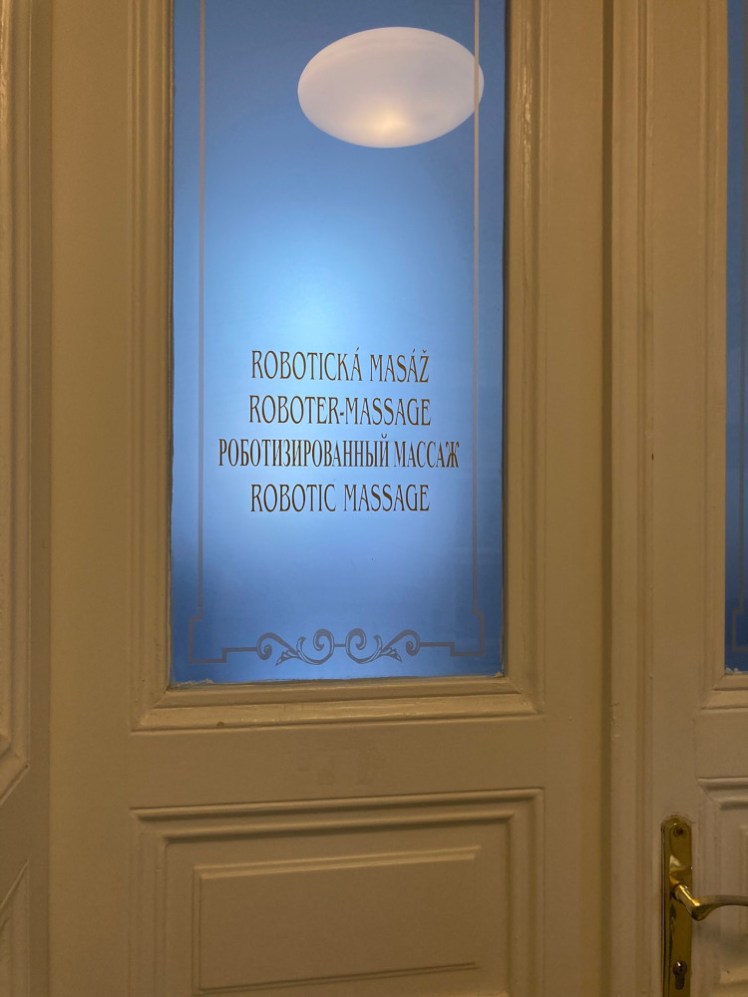
The trick is to stop seeing spa hotels as “hotels“ and start seeing them as small hospitals or nursing homes. You’re here to be treated, not to go on holiday. So although there will be rooms and a dining room and a pool, there will also be either a doctor or a nurse on call 24 hours a day, a physiotherapist, and a dozen rooms somewhere between the lift and the breakfast room, each labelled with the name of a treatment, many of which you’ve never even imagined. There are generally two price lists in a rack somewhere nearby: treatments on prescription and treatments generally available. And just in case you didn’t realise that this is the main purpose of the hotel – and the whole town – every hotel website contains a page detailing the full medical evaluation that will be done on your first day. That’s why it took so long to plan and actually do this trip: I wanted to find warm water and saunas and not have to worry about spending three days out of the trip having blood tests.
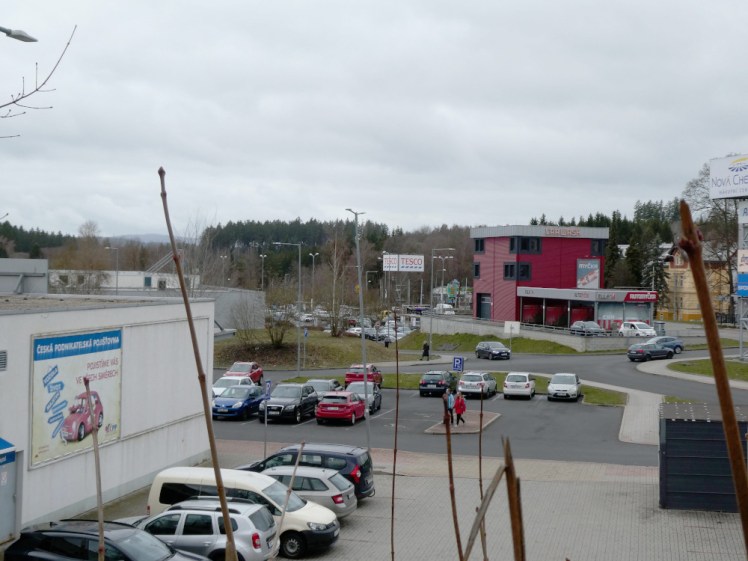
The other thing that feels weird about Mariánské Lázně in particular is that the spa part of town and the “normal” part of the town almost seem to be two separate entities. It’s a 2.5km walk up from the station to my hotel, passing some perfectly ordinary residential streets, a school, an out of town shopping centre featuring a big Czech Tesco, Lidl and Kaufman and then you walk up a reasonably normal street and then you reach a certain junction and- bam! You’re in the spa!
“The spa” consists of a park on a gentle hill, with colonnades around the top and hotels in vaguely neo-something style around the edge. There’s also the woods behind but that’s just ordinary exercise rather than spa. This park is where to do all the things you must do before leaving Mariánské Lázně.
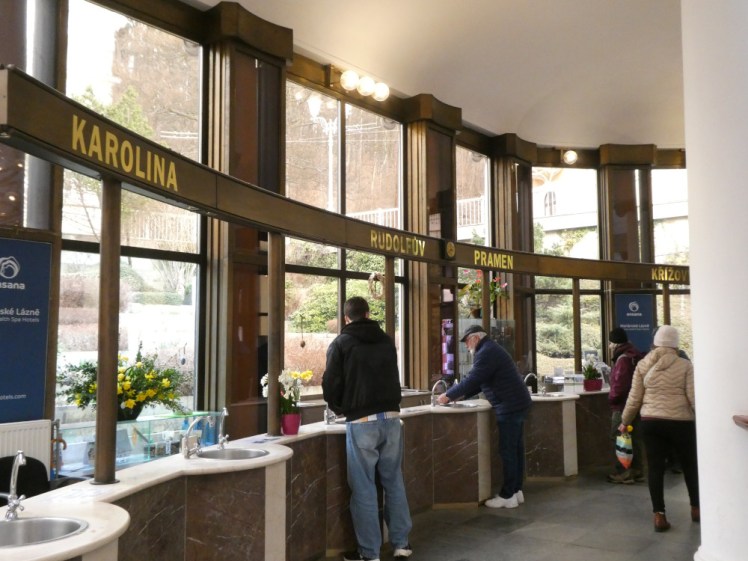
Actually, the list of must-dos is pretty short. I arrived around 1.15pm from Prague, took 40-ish minutes to walk up to my hotel and had still pretty much done everything by bedtime. First, you walk up to the top of the park and visit the Cross Spring Pavilion. Inside you’ll find two bubbling springs and at least three different spring waters to taste from taps. There’s a kiosk here selling spa mugs, spa soaps and toiletries and all kinds of souvenirs. You don’t need a spa mug but it’s the ultimate souvenir from this region. It’s a porcelain cup where the handle is also a straw. In Karlovy Vary, where the spring water is hot, this helps cool it as you drink it but Mariánské Lázně’s waters are cold. Cold but fizzy. As someone travelling with an overstuffed easyJet personal item only, I knew I could only bring back a small cup but I also had a presentiment that these waters were going to be revolting. So my cup is about the size of my thumb. Great for packing, great for tasting, no good for cooling.
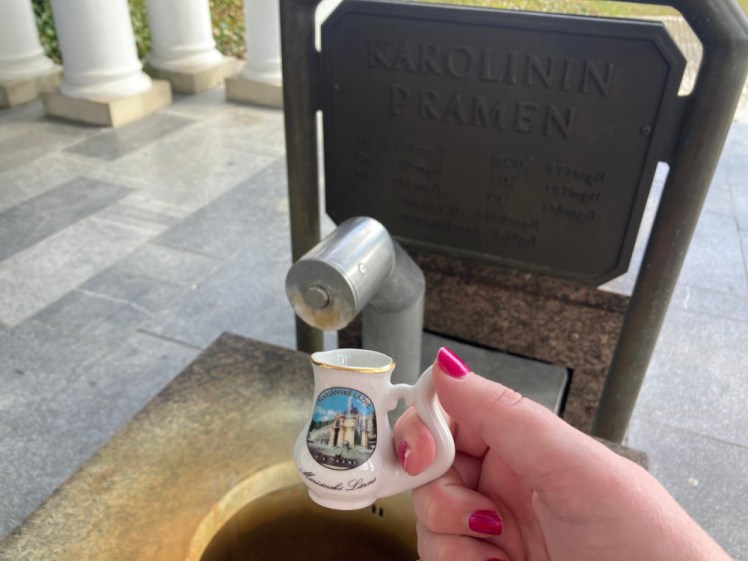
You go around the pavilion sampling the waters. Sampling is fine but if you wish to undergo “the drinking cure”, you should do so under the supervision of a Czech doctor – you’ll find one at your hotel. They know exactly which spring you should drink for whatever condition you want to “cure”. Odd how back home, drinking mineral water just isn’t a thing and how the word “cure” never ever gets used in any even vaguely medical context. That’s because drinking this mineral-rich spa water is basically a laxative. I’ve drunk sulphur water in Iceland and I’ve seen documentaries on spa towns. I really don’t mean to be indelicate but 90% of “the cure” is diarrhoea. So don’t do what “the cure” recommends which is to spend 5-10 minutes slowly sipping 220-250ml of spring water before each meal.
But tasting is fine. As someone who just can’t stand fizzy water, I’m instinctively revolted by Mariánské Lázně’s carbon dioxide-rich waters but going back and trying to be more analytical and actually taste as if it’s wine or a drink I’m actively trying to appreciate reveals… that it does taste revolting. I’d rather have the disease than cure it by drinking three cups of this stuff a day. Oh, there are multiple springs in the pavilion and more out and about in the woods and in the vicinity of the town and they all taste a little different because they all have surprisingly different mineral compositions considering they’re popping up in much the same place but none of them taste good. They’re chalky and metallic and fizzy and it’s all I can do not to spit out the two millilitres I’ve managed to pour into my mouth right ther ein the pavilion. Conventional medicine will do me fine, thanks.
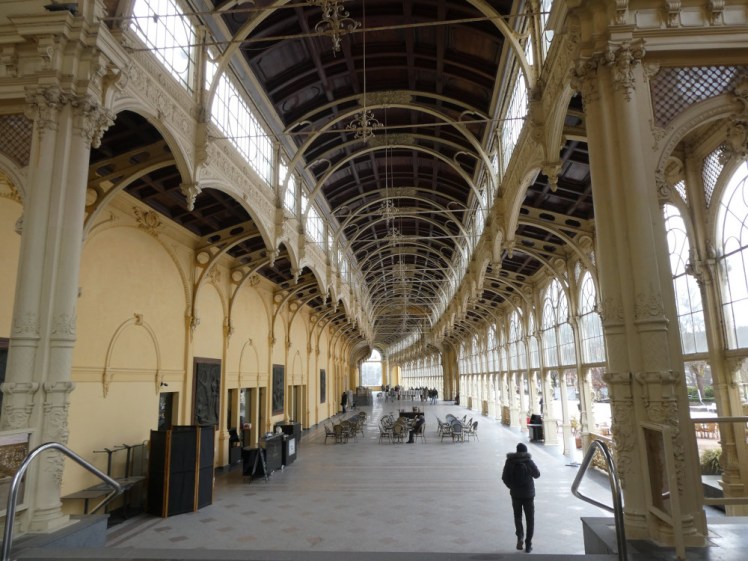
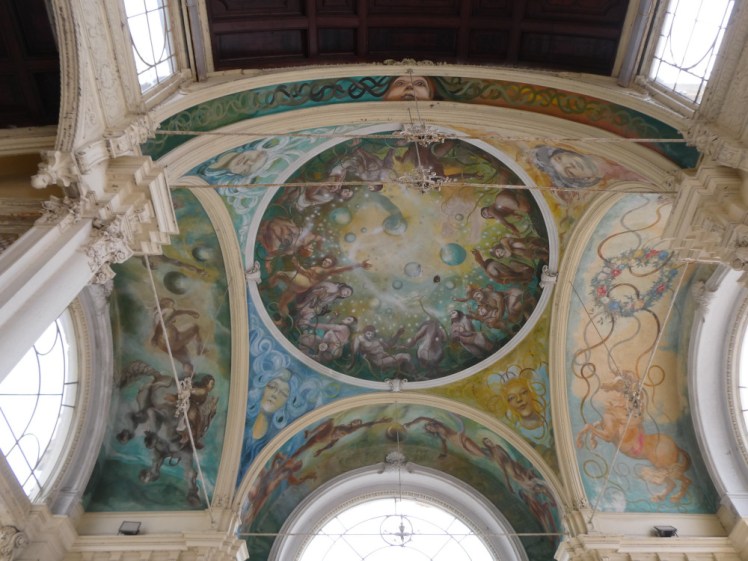
Below the pavilion are the famous Colonnades and they’re definitely worth a stroll. When you weren’t indisposed by the results of taking the waters, you’d stroll here, enjoying the health-giving fresh air (Mariánské Lázně is also recognised by the Czech Inspectorate of Spas as a climatic spa with health-giving air although apparently it’s “moderately polluted” beyond the maximum limit established for one year by the World Health Organisation) and perhaps having a drink and a piece of cake and showing your face as one of the well-to-do who can afford to spend time at the spa. To this day, there are a few shops in the Colonnades (get your cup here if you didn’t get it at the pavilion) and cafes and there’s a bandstand that probably has a band on it more often in the summer than in late March and early April. Make sure to look up – as well as being barrel vaulted, there are intricate, and slightly mad, murals at each end and in the middle. It’s not going to take up a lot of your time but you can’t miss the famous Colonnades.
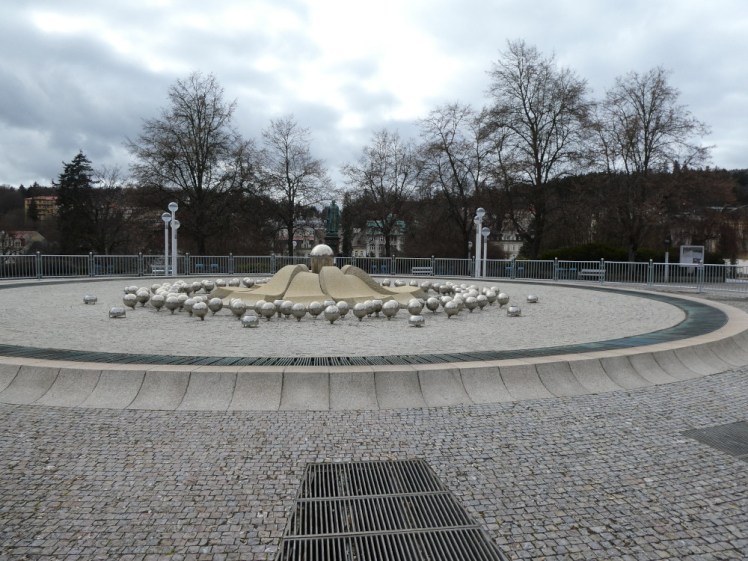
At the end of the Colonnades is the famous Singing Fountain, an elaborate fountain which also plays music every hour on the hour and lights up after dark – but only from the very end of April until about October. No Singing Fountain for me on 31st March or 1st April. Then there’s another smaller colonnade with a fountain at each end. These springs are repeats of the ones in the Pavilion, which is handy because they seem to be switched off in winter. And that’s about it for sights to be seen in Mariánské Lázně. Just wander around the park, enjoy having no responsibilities, nothing more to worry about ticking off a list. Go to a cafe and have a nice cake. You’re almost done.
The last thing to do is take a bath. Pretty much every building you can see is a spa hotel and most of them either have at least a pool and/or a sauna or are part of the Ensana group, which means you get to share their facilities if your specific hotel doesn’t have any of its own. I’ll go into that in detail in my next post but if you only have one in-water spa experience, make it the Roman baths at the Nové Lázně, which is the big yellow hotel covered in flags at the bottom of the hill. Yes, bathing in the spa waters is kind of a recent innovation compared to drinking it but I can’t imagine visiting a spa town and leaving without soaking in some hot water and these particular waters are rather good.
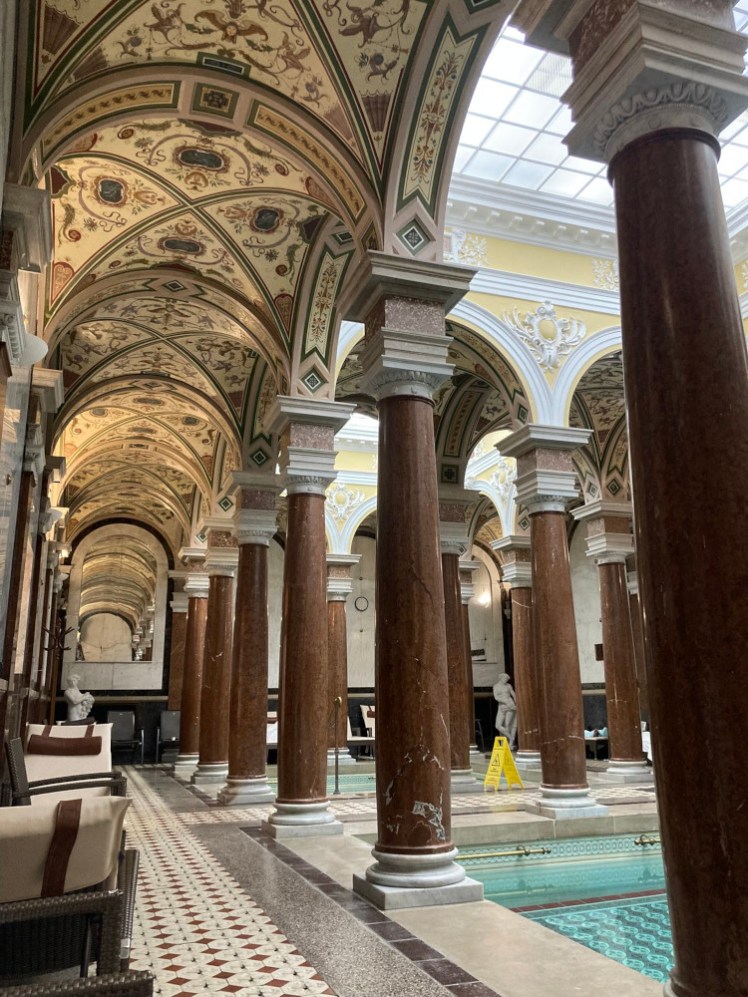
And that’s about it. You can cover Mariánské Lázně pretty comfortably in half a day. Taste the waters. Walk in the park. Have a Roman bath. And then jump on the train first thing in the morning and go and do it all again in the next spa town…
 I Am A Polar Bear