We all know that sauna came from Finland. I’ve tried out assorted saunas, in Finland and outside, at spas, pools and on beaches. I’ve even been to Helsinki’s big flagship public sauna. But this time, I sauna’d the way the Finns sauna, which isn’t at spas or flagship venues or even in small sheds on beaches. Finns sauna on average two or three times a week, either at the sauna at home, at work or at the public swimming pool. Since my hotel was the sleep equivalent of a vending machine and I don’t have a job in Helsinki, that left going to the pool.
Luckily, I love going to pools. If I leave my swimming stuff behind when I travel, it’s either because I’ve already filled up my itinerary and there’s no room for a pool in it or I’m travelling with a budget airline that doesn’t give me the space to take it “just in case”. This time I’d planned to take it – I had my sunrise swim at Allas Sea Pool booked and my visit to Yrjönkatu planned – but my trips to the pools were more spontaneous than not.
I went to three pools in Helsinki. Yrjönkatu was one but I also went to Töölö and Mäkelänrinne, which are operated by Urheiluhallit, a subsidiary of the City of Helsinki – proper public council-run pools that your average tourist would never think to even discover exist. If you want to soak in warm water while Helsinki freezes around you or do some non-load bearing exercise or find out what saunas are really like for ordinary people, this is where you go. And they were so easy! I walked approximately a minute and a half to the bus stop on the corner of my street, got on a direct bus less than two minutes later and got off after fifteen minutes another minute and a half walk from the pool’s door. Mäkelänrinne was a bit harder, in that I had to take the commuter train to Pasila and then walk ten minutes down a straight road.
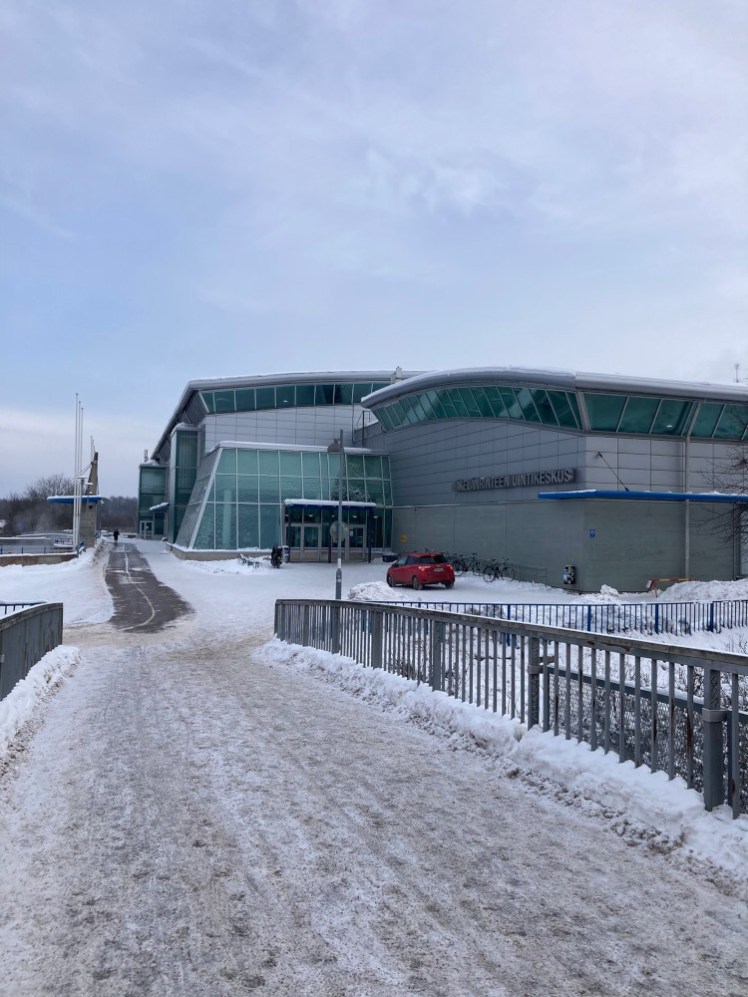
At both, I was greeted by a bustling cafe which definitely gives me the impression that either more people come here for the food than the exercise or that people spend longer in the cafe than in the pool because the pools were generally not over-bustling. You find reception, pay €6 for one adult at Töölö and €7.20 at Mäkelänrinne and you get given a plastic card with a pattern of holes punched in it. This card serves two purposes: it’s your entrance card at the turnstile (just hold it against the reader) and then it’s your “coin” for your locker – put it in the slot and then you can lock the locker.
As at Yrjönkatu, you’re required to shower and sauna naked. Yrjönkatu has single-sex days but everywhere else is mixed but has single-sex changing rooms so it’s not quite as public. No changing cubicles, or not that I noticed. There’s a sign up on the wall indicating that someone holding a particular badge is entitled to wear swimwear in the showers and the saunas; they call it a licence and you either wear it as a badge sewn to your swimsuit or as a silicone bracelet. I haven’t figured out exactly what qualifies you to wear it but it does appear that if you can dig deep enough in the Urheiluhallit website, you can just buy them for a couple of Euros. Anyway, I didn’t see anyone with a licence. Everyone in Finland is perfectly comfortable with this particular form of public nudity.
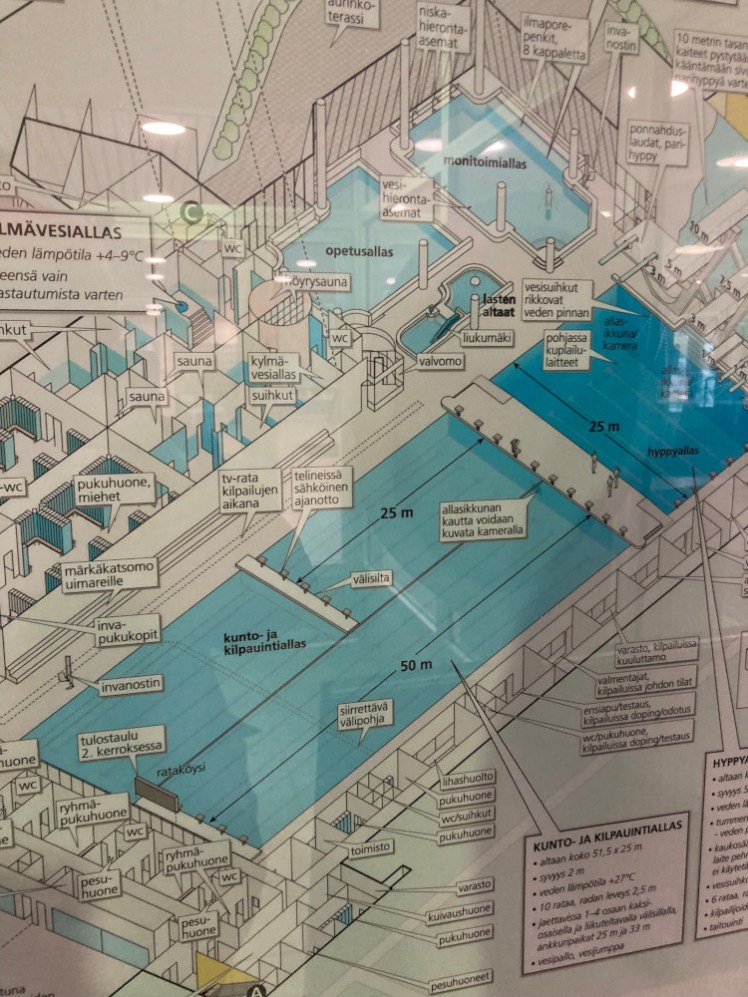
Mäkelänrinne seems to be Helsinki’s flagship pool complex. It has a 50m pool with viewing areas – it’s divided in an unusual way, whereby half the pool is the full 50m length and the other half is divided by a pontoon into two nearly-25m sections for shorter lengths and swimming lessons. There’s a 5m deep diving pool with 3 and 5 metre diving platforms, although that was occupied with an inflatable obstacle course and an aquajogging lane. A what? I’ll get to it!
Then there’s a little complex of warm pools. There’s a very shallow paddling pool for small children, a children’s pool for bigger children and a hydromassage & relaxation pool, all at 31°C and a cold plunge pool next to the children’s pool. The hydro pool has various bubble benches and fountains but what I appreciated most was that the entire corner of the building is floor to ceiling glass, angled so that snow had settled along the edges of all the window panes. If the pool was a bit warmer, like in Iceland, I’d have liked to be swimming outside but swimming in a greenhouse with snowy views would do the job.
Töölö is very different. It’s almost more clinical. It’s very white and bright and the only natural light comes from windows right up in the roof two storeys up. There’s a 25m pool with a shallow watersports pool (the watersports in question being various forms of aquarobics rather than, say, water polo), a small children’s pool and an inexplicably incredibly shallow raised paddling pool all running alongside it. At the end with the changing rooms and the lifeguard box is a cold plunge pool, which is sunken but with glass sides around the top to create a sort of infinity-esque effect and it’s illuminated with bright blue LEDs so that there can be no mistake whatsoever that this is a cold pool.
At the opposite end is the hydro pool which almost feels more like a cave, being sunken but also hidden under the aforementioned second storey. There’s a bubble bench, massage jets, a massage fountain and a wide waterfall fountain, each operated by a button and the waterfall fountain has ropes so you can hold yourself steady while the force of the water tries to knock you down. It was surprisingly quiet, both in terms of the number of people around and just the general volume.
I tried out the sauna in both pools. They’re pretty alike – and pretty similar to the ones at Yrjönkatu, except not visibly less than a fortnight old. The tiles, although impeccable, feel like they were chosen by tastes of a few decades ago, the lights are low down underneath the seating and if you try to imagine away the seats and the stove, you find you’re actually in a fairly small storage room. There are no signs outside requiring you to sit on a towel but everyone does anyway. You sit, people do actually talk albeit in low voices, people will probably ask before pouring water on the stove – and one person poured it with such artistry that I was blown away – and you just sit there until you get too hot. Either they’re actually not that hot or my tolerance has increased. Perhaps it’s the lack of an hourglass on the wall. At spas, they’re there to tell you not to stay longer than fifteen minutes, which automatically makes me feel that’s how long I should be staying and so I immediately get uncomfortably hot and despair of staying long enough. Finnish saunas don’t have timers. Finns start sauna’ing at a young age (and here’s where I’m not at all Nordic – under the circumstances, I find it very uncomfortable having children in the sauna, even though this is something perfectly culturally acceptable) and they don’t need any timers to tell them when they’ve been in long enough. Subsequently, I find myself not worrying about whether I’m leaving too soon or staying in too long. Just go when I’ve had enough. Sit when you want, leave when you want. I’m not yet brave enough to ask whoever’s sitting nearest to the bucket to chuck some more water on but I did have a go at doing it myself when I found myself temporarily alone in the sauna. Oh, I flung a ladelful from far too far away. No grace, no sisu. Just sat there and roasted gently until the door opened.
I stand by what I said last time, by the way. Sauna handrails and door handles get hot. If you’ve got a towel that you’ve been sitting on, you’ve also got an oven glove for touching those things. No one wears that classic sauna accessory either – there are no felt hats in Finnish saunas! Or not in the ones attached to pools that I’ve visited, anyway. Sauna covers, yes. Sauna hats, no. And there are no vastas or vihtas, the whisks made of twigs that you whip yourself with. It’s a bigger thing in Russia than Finland, although you’ll sometimes find them in private saunas and more often in Swedish-speaking areas than Finnish.
So that’s one thing. Go to the pool for a proper Finnish public sauna. But the other thing that goes on in Finnish pools that I knew nothing about is aquajogging.
Aquajogging is more or less how it sounds. You take a belt from the rack next to the pool – a big curved bit of foam designed to sit against your back and, if the belt is fastened properly, hold you upright in the water. Then you move your arms and legs as if you’re running and do laps of the pool. Whereas at home, old ladies in particular swim incredibly slowly and very badly (seriously, that half-hearted flick of your feet is doing nothing), in Finland they aquajog. The water needs to be reasonably deep, because you’re vertical in the water and you need to not touch the bottom, hence Mäkelänrinne putting it in the diving pool, and half the point of it is to be slow. I’m no Olympian but I’m a far faster swimming than the old ladies doing ponderous lengths at home but I can’t get any speed into aquajogging. When I went home from the pool and researched it, it turns out this isn’t just a Finnish thing and yet somehow I’ve never encountered it. Because it’s non-weight bearing, it’s a very good way of remaining active without putting any pressure on joints and injuries for people who can’t run on solid land and even for people who can, it’s a great way to vary their exercise programme. I’m not entirely sure what my local pool would make of it if I turned up with my own belt (£10.69 plus delivery on Amazon or £23 on Decathlon) and started aquajogging in the slow lane – because of how much effort there is compared to how little you actually move and the size of the float, I suspect they’d immediately assume I can’t swim and hoist me out of the pool before I could finish explaining that this is a Finnish fitness craze. Not a thing in the UK. But you go into any pool in Helsinki and you’ll see at least one lane reserved for this and either a rack or a rail of belt to borrow and a full lane of people making their slow, weirdly upright way up the pool and back down again. Yes, I had a go in every single pool. No, I won’t be investing in my own belt. It’s not my thing.
I’d love to tell you how I swam properly but at both pools I spent all my time either enjoying the hydro pool or sitting in the shallowish warm pool. I wish they were a bit warmer – in Iceland, they’d be 35°C at least but I’ll take 31°, especially when it’s minus ten outside and there’s a sauna and a properly hot shower in the changing rooms.
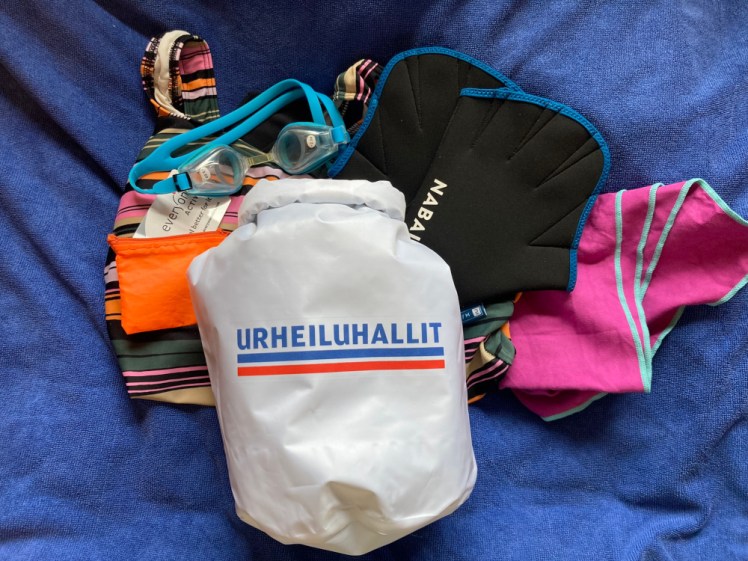
And finally, you dry off in the shower room and walk back to the changing rooms to get changed. You don’t drip on the floor in Nordic changing rooms. Take the card out of the slot in the locker and drop it into the slot in the turnstile. See, when I was handed it the first time, I asked what I’m supposed to do with it. I saw a man who had asked no such question who was on about his fifth attempt to exit by doing anything except dropping the card in the slot until someone came along and physically demonstrated it to him. But that’s how it works. And before I left Mäkelänrinne, I invested in an Urheiluhallit-branded little drybag because they’re cute and practical and I’ll absolutely be taking it to some beachside saunas this summer.
 I Am A Polar Bear