This was my third trip to Helsinki (if you don’t count the one evening I spent there before getting the train to the Arctic Circle via the train wash…) and I’ve already been over to Suomenlinna three times. The “castle of Finland” (or “of Sweden” if you use Finland’s other official language) is a more or less open air sea fortress sprawling across an archipelago of rocky islands in the harbour, nicely positioned so you can’t get into the city by sea without passing within cannon’s range of the fortress. These days it’s a UNESCO World Heritage Site, cultural treasure and open air museum and it’s a very popular trip out for tourists and locals alike, not least because the ferry is included in your Helsinki city public transport pass – or you can buy a ticket from the machine down by the jetty if you don’t have a pass.
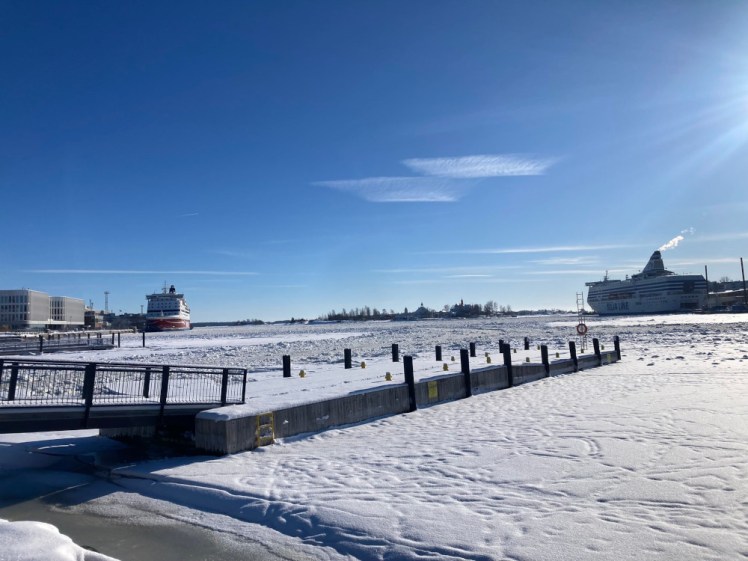
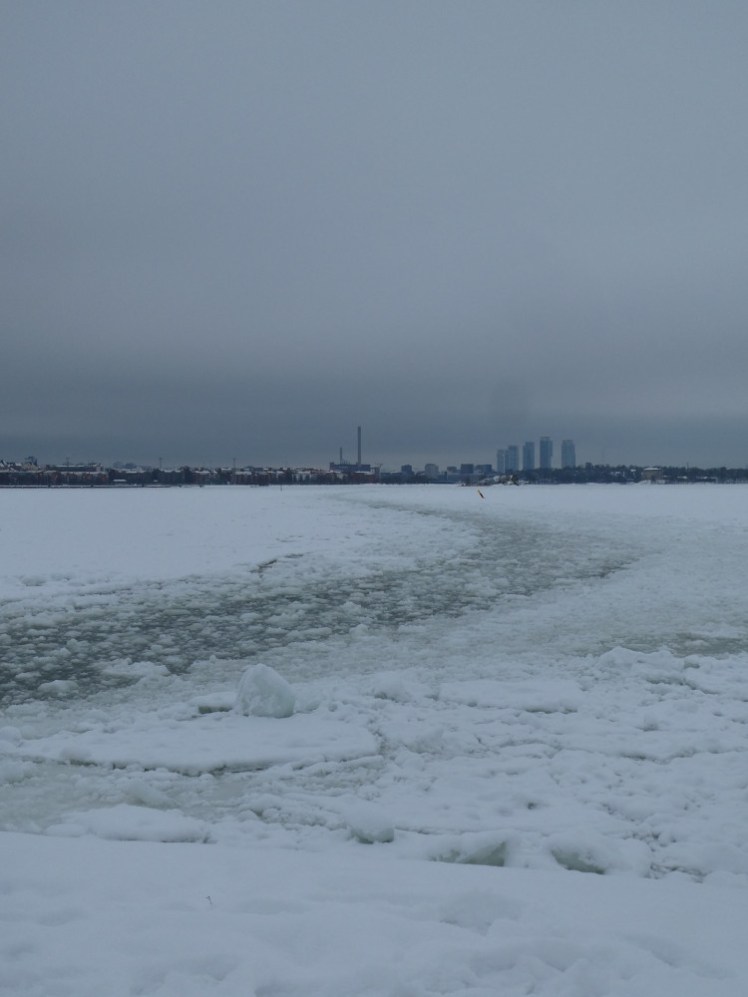
I’d decided I wasn’t going to go back to Helsinki and just keep doing the same thing I’ve done every time. No Suomenlinna this trip. Find something new to do. But then I got down to the harbour and it was frozen solid. I knew that there was a fleet of icebreakers moored just around the corner when I was there in May 2023 but for the first time, I really realised why Finland has a fleet of icebreakers – even this far south, the sea genuinely does freeze! It’s not just the northern parts of the Gulf of Bothnia; it’s huge parts of the Baltic Sea. It’s quite the novelty for me, it’s very beautiful, it gives Helsinki a whole different look compared to how I’ve ever seen it before… and there’s a visible “road” of churned-up slushie-like yellowish ice leading from the jetty out into the harbour. So obviously I wanted to out on that ice on a boat!
Now, the question I’ve spent the last week trying to answer is “Is Suomenlinna II, the ferry over to the islands, an icebreaker?”. What I’ve established is that it’s a 1A Super ice-class ship, which means it’s able to navigate in “extremely difficult ice conditions”, in ice of up to a meter thick, without icebreaker assistance. So, no, not an icebreaker?
But when I looked up Finland’s fleet of six full-size ocean-going icebreakers, five of them are 1A Super ice-class. 1A Super is roughly equivalent to Polar Class 6 which operates in medium first-year ice in relatively mild (by polar standards) conditions. Finland’s newest icebreaker, Polaris, is Polar Class 4 (the lower the number, the more capable) which can cope with thick first-year ice, over 2m but under 2.5m, so the ferry isn’t a million miles away from a proper grown-up full-sized almost-brand new icebreaker. And even RRS Sir David Attenborough, the Antarctic research vessel that was nearly named Boaty McBoatface, only has a Polar Class 4 hull with Polar Class 5 propulsion. As for the higher (lower?) classes, there are no Polar Class 1 ships in existence, the ones that can handle literally anything. Only one Polar Class 2 is currently serving, although half a dozen have been ordered. There are quite a big handful of Polar Class 3s, including 15 Russian LNG carriers and Finland’s two multipurpose icebreakers which are suitable for “a variety of offshore operations”. Eight Polar Class 4s, eleven Polar Class 5s and then we’re down at the 6s, equivalent to the little ferry. There are lots of those but there are maybe 40-50 ships in the entire world that are more ice-capable than Suomenlinna II and ships of its class.
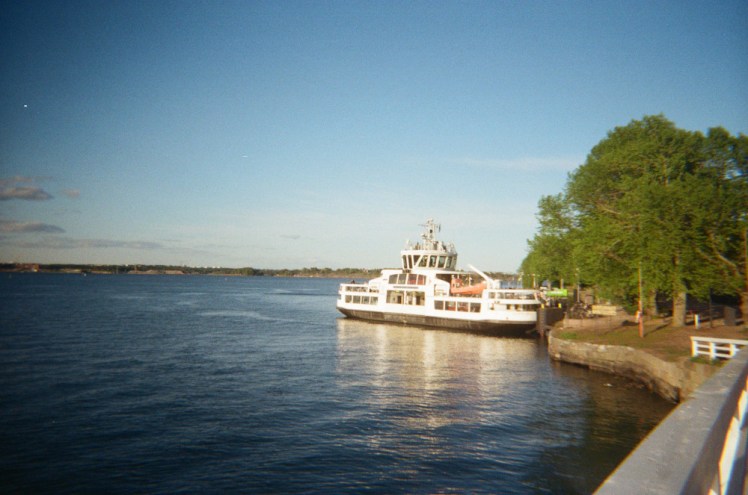
It took a ridiculously long time to figure out whether or not Suomenlinna II is an icebreaker. 1A Super ice-class. Same class as icebreakers but no one is using the word icebreaker about the ferry. Is it? Is it not? I was beginning to conclude that an icebreaker is a state of mind rather than a classification on a certificate. And finally it dawned on me! An icebreaker is a job, a ship that breaks ice for other ships. Suomenlinna II’s job is ferry, capable of breaking its own ice. It’s an icebreaker, adjective, rather than an icebreaker, noun!
So if you’ve ever wanted to take a trip out on an icebreaker and found your options limited and extremely expensive, it’s because icebreakers, noun, are highly specialised ships that have more important things to do than cart tourists around for fun. But the Suomenlinna ferry is a very good option for an extremely affordable icebreaking adventure.
I know from past experience that it gets cold out on the water of Helsinki’s harbour. It’s open and relatively unsheltered, so it can be windy and the wind is a lot colder than in the city and when the city is already averaging -10°C and the harbour is frozen, it’s going to be really cold on the boat, so just spontaneously jumping on and running over to Suomenlinna is a bad idea. No, I was going to have to make sure I came prepared with all my layers and my gloves. I mean, there’s indoor seating and the voyage only takes ten or fifteen minutes and if you’ve got any sense, you can just stay inside but I’m there specifically to watch the boat breaking ice. I’m staying out on the deck!
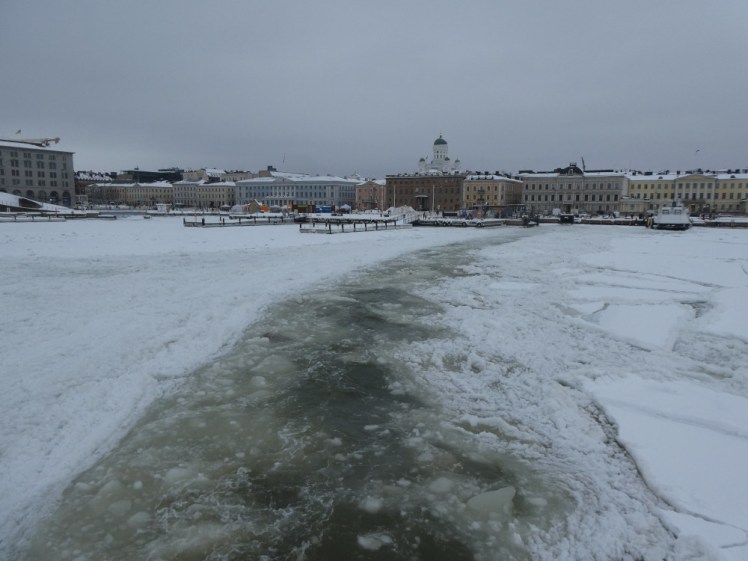
Of course, it was very, very cold so I was putting on my layers before we’d even started moving. Helsinki might be cold but a) I’m walking at as brisk a pace as I can manage in the ice b) there’s no open wind blowing directly off the Baltic. As long as I hung over the back of the boat to stare at the ice, it didn’t get any worse but it was beyond bitterly cold if I leaned over the side instead. In hindsight, I should have gone up to the front to watch the actual breaking but I didn’t realise that was an option, despite being well aware that the boat is symmetrical. But there was plenty of ice all around the boat and I enjoyed watching the chunks of ice that we’d already pushed our way through.
At that point, I hadn’t done the deep dive on what an icebreaker is, so I was studying the path we were cutting through the ice – or rather, the ice-filled fairway we were following, trying to figure out what was actually happening here. How thick is the harbour ice? A foot? How much of it is ice? How much is fresh-ish snow? How much is just the ice bobbing in our wake? Are we breaking off those big chunks or are we just running over them? It looks like a slushie from the shore but it looks like a giant slushie from the sea. Even if we’re not breaking that ice, we’re making our way through the slush, through pieces of ice big enough to survive the Titanic on, balls of ice the size of my head, chunks of ice big enough to completely ground a kayak. I mean, I wouldn’t be kayaking in it because if I capsized, I’d die within seconds of cold shock, but I’d also struggle to push past the floating ice, even in this ploughed-up channel, let alone the stuff that actually needs to be broken. I’d be skating, using my paddle to slide the kayak along on top of it. Actually, that might be quite good fun!
While it might be more spectacular to be on an actual icebreaker (noun), with the little ferry, you can get close enough to the water level to really see it, to hear it, to feel it. Because you can feel the boat juddering as it breaks through that foot or two of ice, or as it passes over a miniature iceberg. You can see the globules of ice resurface after they get pushed under the boat, you can see slabs of ice break off as you pass, you can hear it all crunching and splashing. And then you hear the note of the engine change and realise that you’re approaching the jetty and it’s time to disembark.

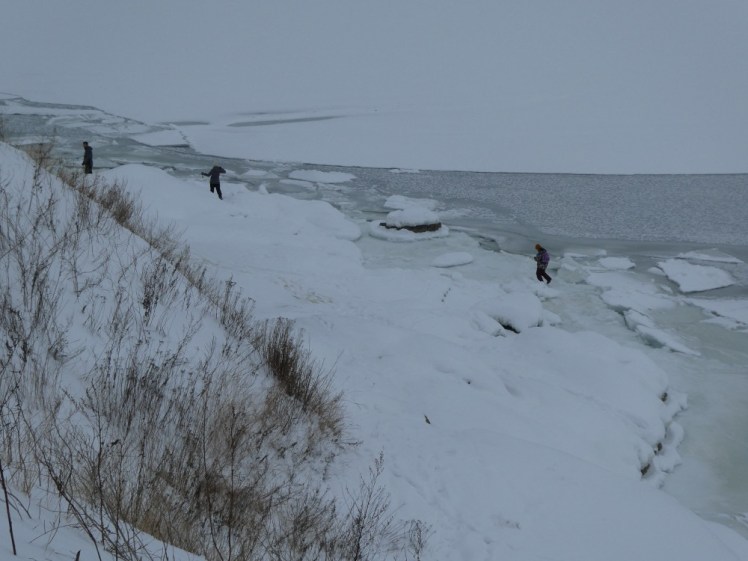
I spent a couple of hours walking around Suomenlinna, sticking to dry land, thank you. There’s a tiny bay that’s apparently very good for sea swimming in the summer which is completely frozen and there were plenty of people walking around on the frozen harbour around that area. I wouldn’t do it myself, which is probably an overabundance of caution, but on the other hand, there’s a difference between the thick, white undisturbed sea ice and the yellowish stuff nearer the shoreline and I was absolutely convinced that thinner yellowish stuff was going to break and dump the walkers into subzero ocean. Take a look at this picture and tell me you think they’re on the fairly thick, stable stuff.
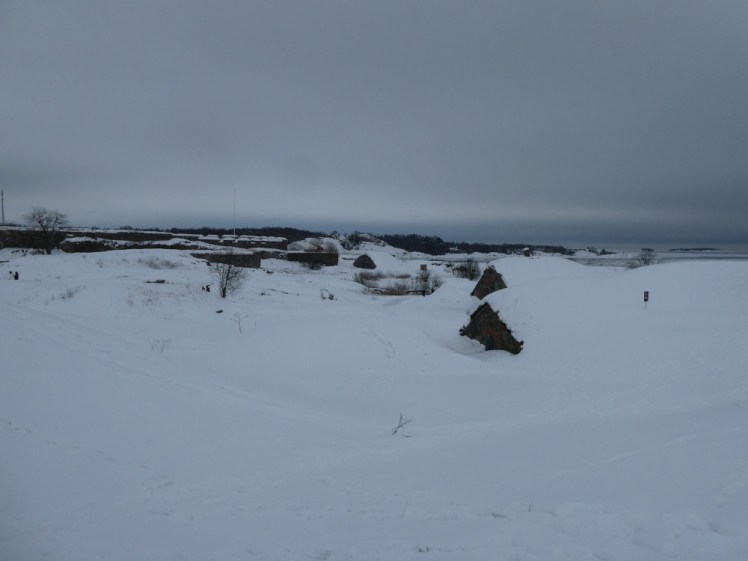
Beyond that is a labyrinth of old bunkers and walls, which looks a bit like Hobbiton or Tellytubbyland in the summer – all turf roofs covering rounded buildings. In winter, it looks like it’s made of marshmallows. You stick to the path in winter because you have no idea what’s a foot or two of snow on top of a turf roof and what’s a snowdrift that you’re going to fall straight into. Beautiful as it was, especially standing on the ramparts looking out over a frozen white nothing as far as I could see, it was very cold and I had to retreat to the cafe by the bridge between Iso Mustasaari, the island that ferry docks on, and Susisaari, the next island.
I know going to a cafe is a regular probably multiple-times-a-day thing for other people but it’s a bit of a novelty for me. I’d brought a lunch with me – well, I’d brought a drink and some bread and cheese – but there’s nowhere to sit and eat it in that weather, so I had a croissant and hot chocolate in an overheated cafe. Not objecting to the overheating, not when it’s the third day in a row of walking around Helsinki in -10° weather.

At last, I’d covered the entire blue route, drunk in the endless white views, got frozen half to death and I was back at the jetty, ready to get myself right up to the front to watch the ferry actually breaking ice on the way back to the market square. I want to see that! But you don’t really get to see that. The ferry is ploughing backwards and forwards along the same fairway every hour or so every day so it doesn’t really get time to re-freeze. Maybe the first crossing of the day, first thing in the morning, when it’s had the entire night to lie undisturbed as the temperature drops. So it really just looked much the same as the trip over but moving in the opposite direction. Now I could see the great slabs of ice being dragged under instead of popping back out, I could see the slushie stuff being pushed aside, I could see whatever was causing the juddering and I could see when we were approaching the jetty.
The Suomenlinna ferry may not be doing the job of icebreaking but it’s breaking ice for itself, at least in the mornings and at the very start of winter when all this first appeared, and taking the trip over is probably one of the most affordable ways on the entire planet to experience icebreaking – whatever your feelings about or interest in Suomenlinna, this is absolutely something worth doing if you’re in Helsinki in winter.
 I Am A Polar Bear