There, start with the spoiler! As a language student living in Switzerland twenty years ago, I made a flying visit to Chateau de Chillon, where I visited the Gothic dungeons underneath the castle and saw where the original tortured poet, Lord Byron, was imprisoned, chained to a pillar and left to rot (if you read that post, we apparently spent more time and I spent more words on our homewares shopping adventures in and around Lausanne and you were allowed to smoke on the train back then). Returning last weekend as a travel blogger, I discovered that I’d been utterly mistaken: as it says in the title, Lord Byron was never a prisoner at Chateau de Chillon.
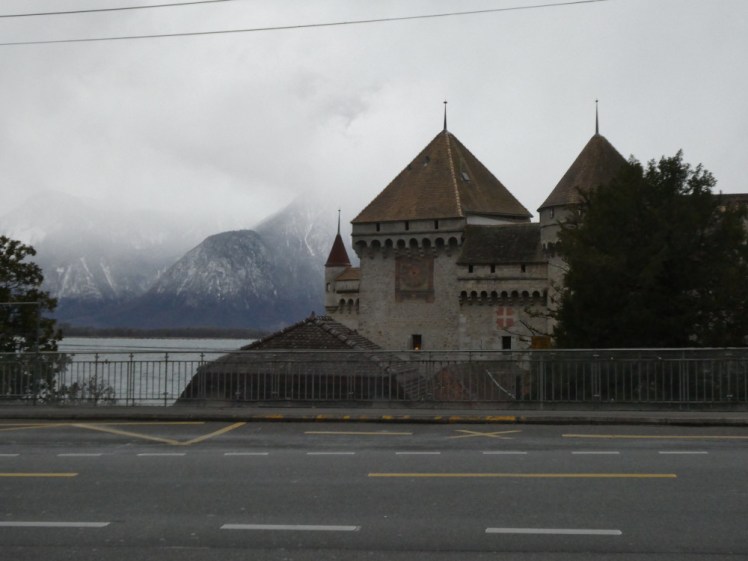
The history of the Chateau de Chillon could start thousands of years ago, with the Celtic Helvetii tribe that gives Switzerland its Latin name and its top level domain (.ch means Confoederatio Helvetica) but really it starts in 1150 when a square tower was built on a little island in the eastern end of Lake Geneva. The actual distance from the shore is short enough that a decent Olympic jumper could hop across with no problem but with the castle now covering just about every inch of the little island, you’d have precious little to grab hold of and according to my guidebook, it’s actually the top of a column 300m deep. If I’d known the lake was that deep even right here on the edge, I don’t know if I’d have walked over the wooden bridge to go into the castle.
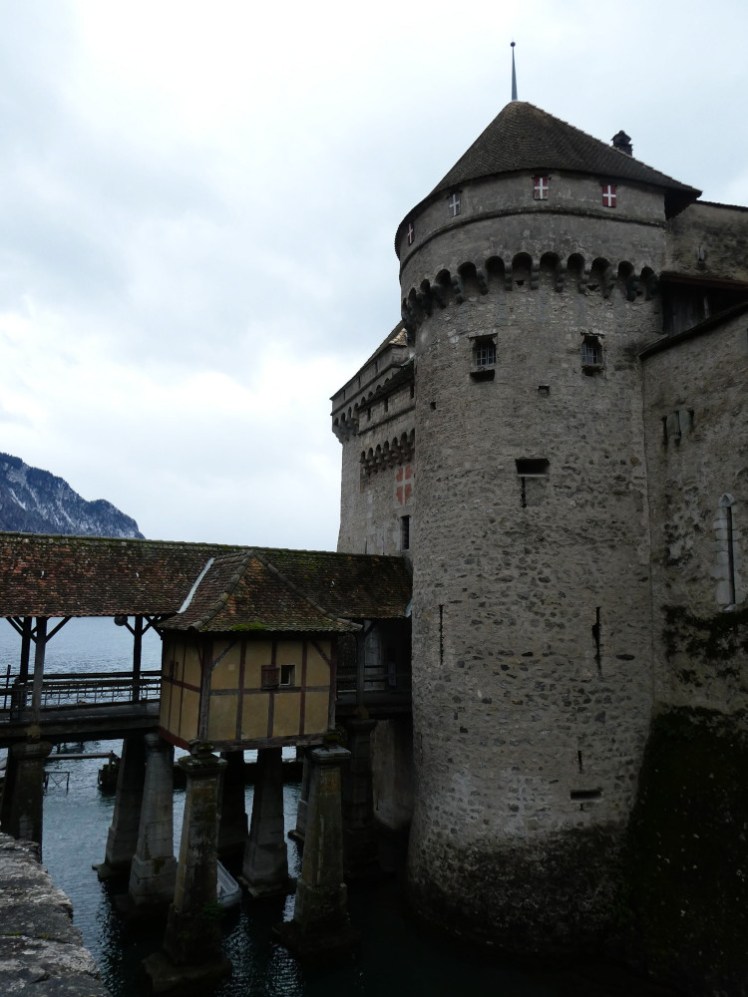
The original tower was built by the House of Savoy, an Italian-French line of aristocracy who occupied what was really a region of Burgundy at the time. Chillon was the northern part of Savoy – for this isn’t a story of France vs Switzerland. This pre-dates France by quite a bit and Switzerland by quite a lot. I don’t know much about French history but modern Switzerland, as per its Latin name, is a confederation, made up of 26 cantons who only came together in more or less current format in 1848. Various cantons had been joining in over the last few centuries and the 26th, Jura, only joined in 1979 (although both land & people had belonged to Switzerland before then as part of Bern canton).
The Dukes and Counts of Savoy gradually built up Chillon Castle. The side facing land was fortified, as part of Savoy’s northernmost border defences but the part facing the lake was largely residential, and quite comfortable. It was on the route south to Rome and therefore able to extort tolls and taxes from the many travellers using the road. Gradually, Savoy expanded northwards until some two-thirds of the current Swiss canton Vaud was Savoy territory.
After a while, the castle, which now pretty much filled the little island, fell out of favour. The Dukes of Savoy had to be seen by their subjects, so they spent weeks on end travelling from one residence to the next, in huge caravans with all the luxurious furniture they’d want for each stay – why furnished a dozen castles when you can have one set of furniture carried to whichever castle you’re headed to? I guess after a while, you either get tired of a life like that or you find yourself spending longer and longer in your favourite castles and skipping over your lesser favourites.
Enter Switzerland, or rather, enter Bern. Bern was busy capturing the northern parts of Savoy and in 1536, after a three-week siege, they took Chateau de Chillon. For over 250 years, the castle was home to the Bernese bailiff – not a bailiff as we know today but more a kind of administrative guardian – and then Vaud rose up against Bern and threw them all out. For a while the castle was an oversized store cupboard and a prison and then one Lord Byron came to visit, wrote a poem inspired by a Savoy-era prisoner and basically catapulted the castle to fame. Since then, it’s been protected and restored and spent more than 200 years now as one of the biggest tourist attractions in Switzerland.
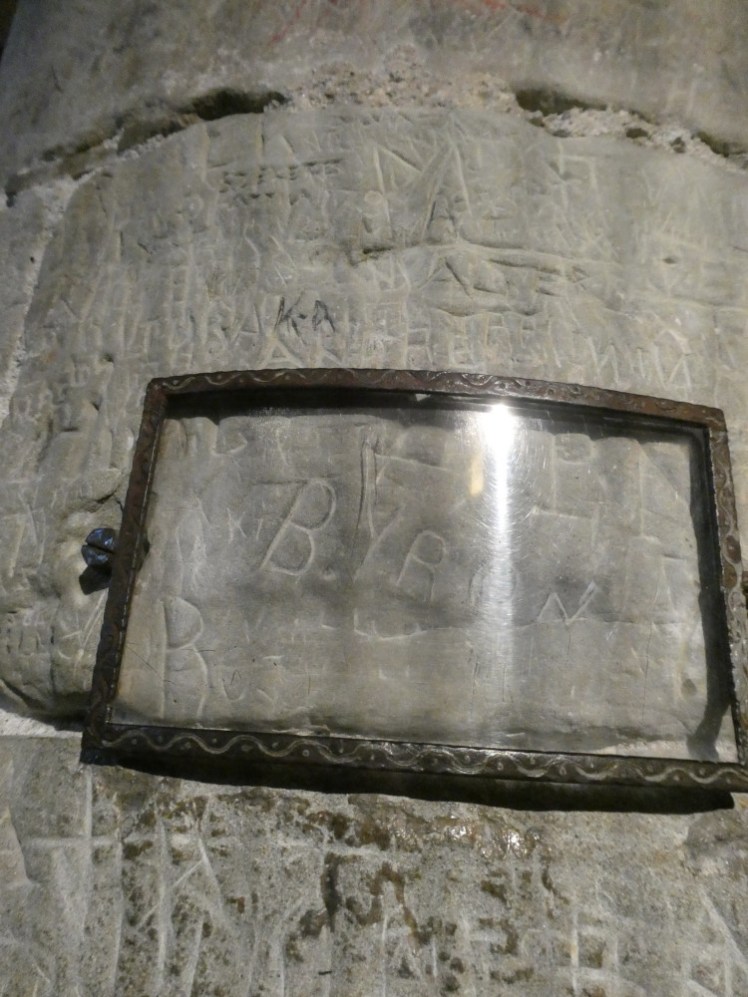
When you visit, you’re given a map with a recommended route, helped by numbered signs around the site and pretty much the first stop is the cellars. They’re not dungeons at all, they’re far too nice, although they’re very visibly built into the rock of the island and the lake sloshes and splashes right outside. I recognised this room immediately as the one Byron was imprisoned in – and discovered I’d been mistaken for twenty years. The man was famously “bad, mad and dangerous to know”. Of course he’d spent some time chained in a Swiss dungeon! But nope. We all know he spent time in Switzerland with the Shelleys (although they didn’t actually get married until six months later); it was on the shores of Lake Geneva during the wet miserable volcanic summer of 1816 that Mary Shelley started to write Frankenstein as part of a game of “let’s all write a ghost story”. Well, during that same trip, Byron visited Chateau de Chillon, pretty much as a tourist, just like me, and was inspired by the story of François Bonivard, a Protestant monk who was chained to a pillar here for six years for opposing the Catholic Dukes of Savoy. The Prisoner of Chillon was the result and tourists forever after remember Byron in the dungeon rather than Bonivard.
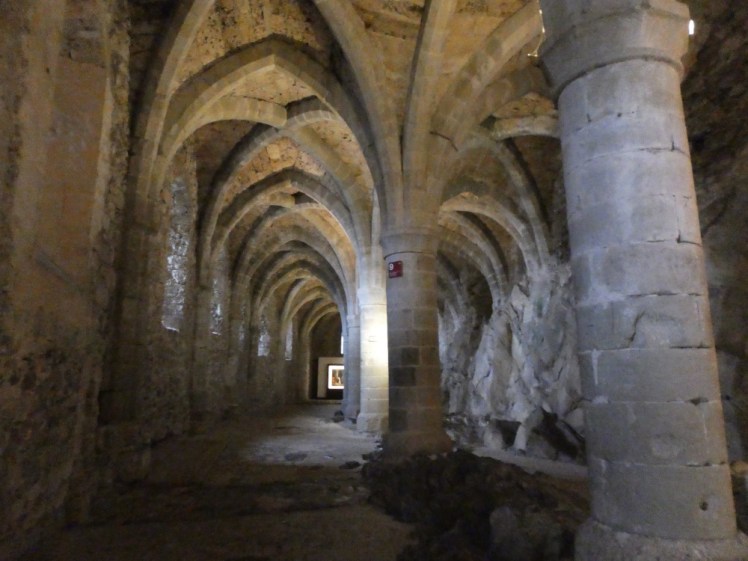
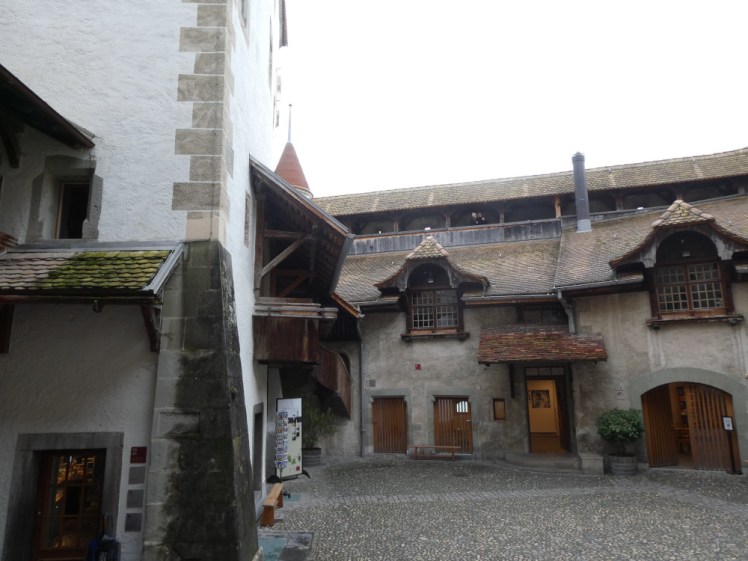
That’s not all there is here by a long way. There are 48 rooms, corridors, ramparts and courtyards on the tour and I know we didn’t visit them all as students because I’d remember a tour that long. The photos bear out that theory too – I have about six of the vaults, cellars and dungeons, one of a view over a courtyard, two of windows with the lake visible behind them and one of the medieval dining room. Ten photos, in the digital age. I took over 200 this time!
The trouble with laying out a castle like Chillon as a tourist attraction is that it has two major historical periods. Which one do you display? Chillon as a Savoy stronghold or Chillon as a Bernese prize? This is why I’m not a historian: my answer to “what should this castle look like?” would be “it should look like it used to” without thinking that it has looked different throughout its lifetime. To continue the vaguely Swiftian references I started in the first paragraph, this castle has had eras. History in general has eras, that’s where she got the name from in the first place, from history, and to just say “like it used to be” ignores that everything historical has had era after era layered on it. Which era do you prioritise?
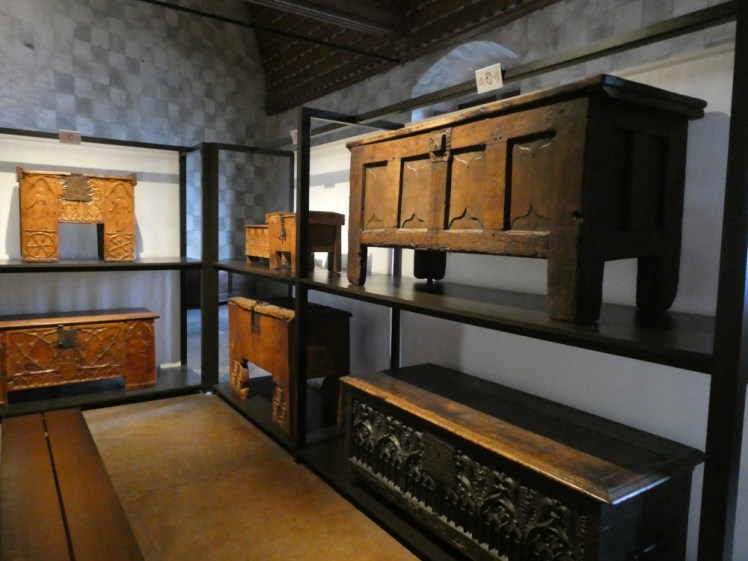
In Chillon’s case, it’s tried to do both. There’s one room (room 17, Peter II Room) where the upper part of the walls is painted in Savoy style (original or reproduced, I don’t know) and the lower part in Bernese style. An entire room is dedicated to Savoy furniture and chests, each glorious in its way but when you realise this is just part of what would have been carried for the Dukes of Savoy on their long winding journeys around their subjects, and in a pre-mechanised age, it’s mind-boggling. Some rooms have faded Bernese symbols and pictures, there to make it very clear that this is no longer Savoy’s property.
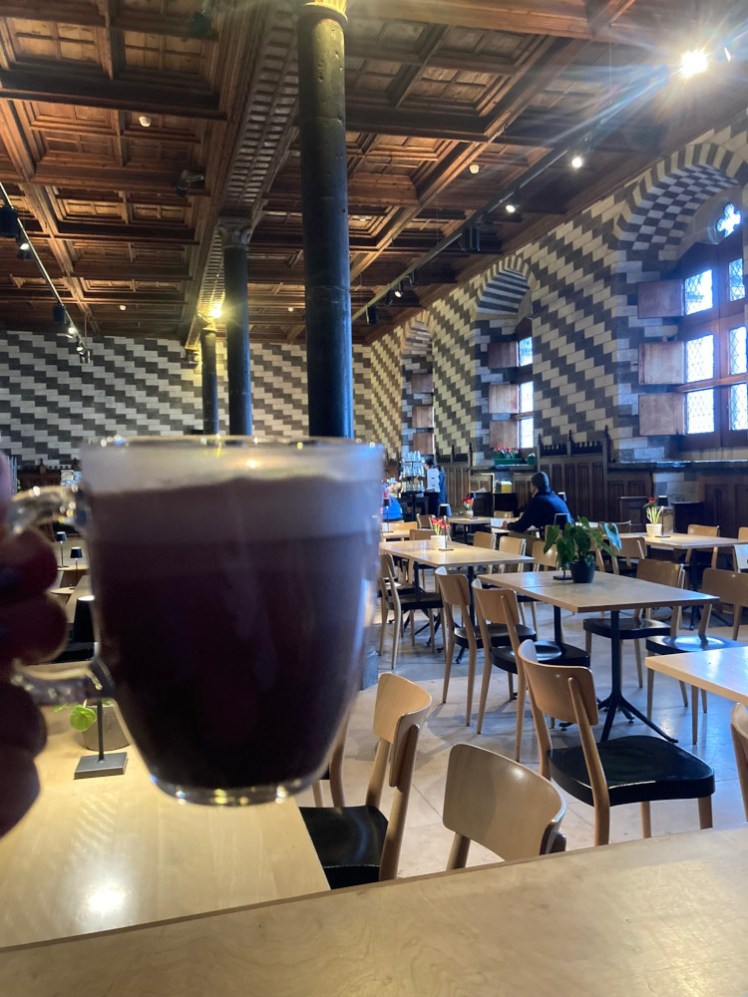
One of the most spectacular rooms is number 26, Aula Magna, a medieval dining or banquet hall from the Savoy age. Bern used it as a milling room, so Savoy was clearly the decision to be made in this room. It has 13th century windows and marble columns, a 15th century ceiling and chimney and it’s currently used as the home of the pop-up Byron Cafe, which means you can essentially use this room in the 21st century almost exactly as it would have been used over seven hundred years ago. The cafe itself is a bit of a mystery – turns out it’s self-service, so you really do just grab a cup and make yourself a hot chocolate before carrying it to the till but once you’ve got past the weirdness of helping yourself, you get to sit in a medieval banquet hall and drink Swiss hot chocolate to the faint soundtrack of waves breaking gently on the stone walls ten feet away.
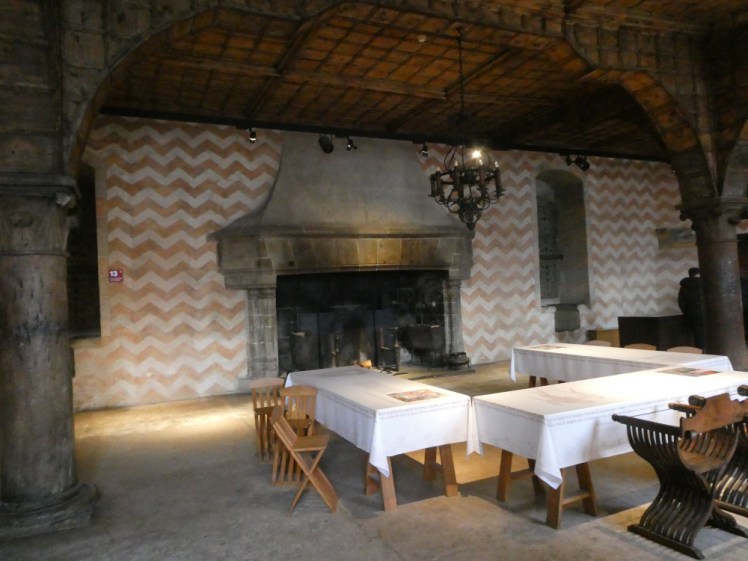
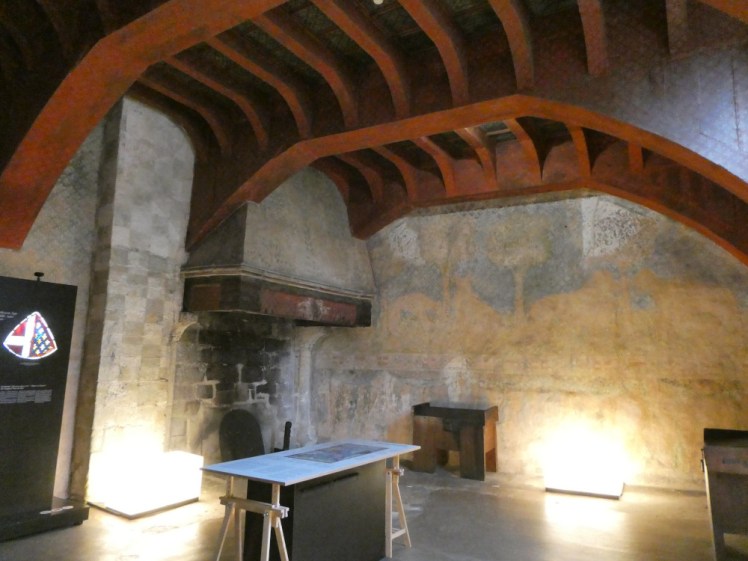
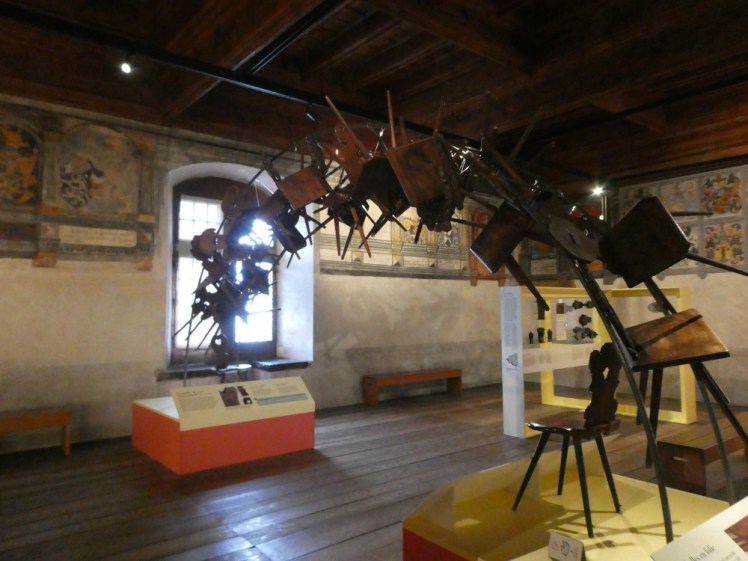
Favourite rooms: the Chapel (number 24), which has Gothic vaulting and frescos from the 1310s restored in the 1990s. The Constable’s Dining Room (number 13) which is another large room with a big fireplace and a large table in it, for observing only. This is a room I have a photo of from 2005 and the peach-and-white chevrons now cover the entire walls instead of just around the door, so visible restoration in the last 20 years! The Coat-of-Arms hall (number 18), again, very large and painted with the coats of arms of the various Bernese bailiffs who lived here, as well as an arch of old chairs, because Chillon bought up every old chair they could find before realising they had no conceivable use for so many old chairs. Aula Nova (number 14) which has an incredible tunnel vault ceiling and is where the collection of boxes is kept. And the Camera Domini (number 19), a bed chamber painted with 14th century scenes of animals, ranging from the kind you’d meet around the area to camels, lions and dragons.
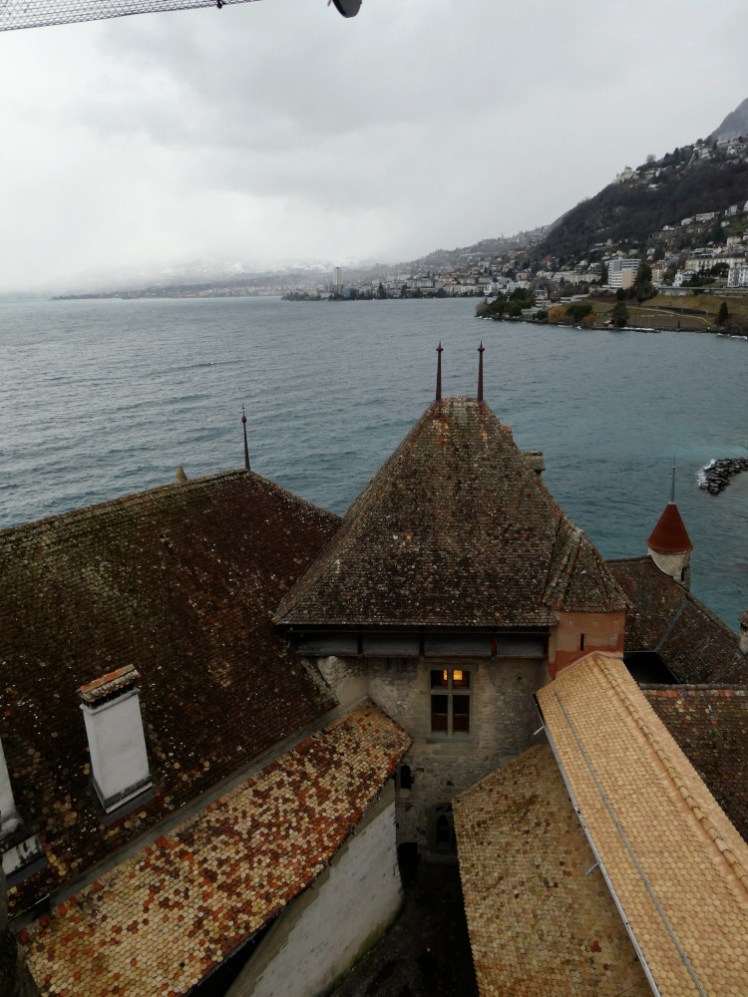
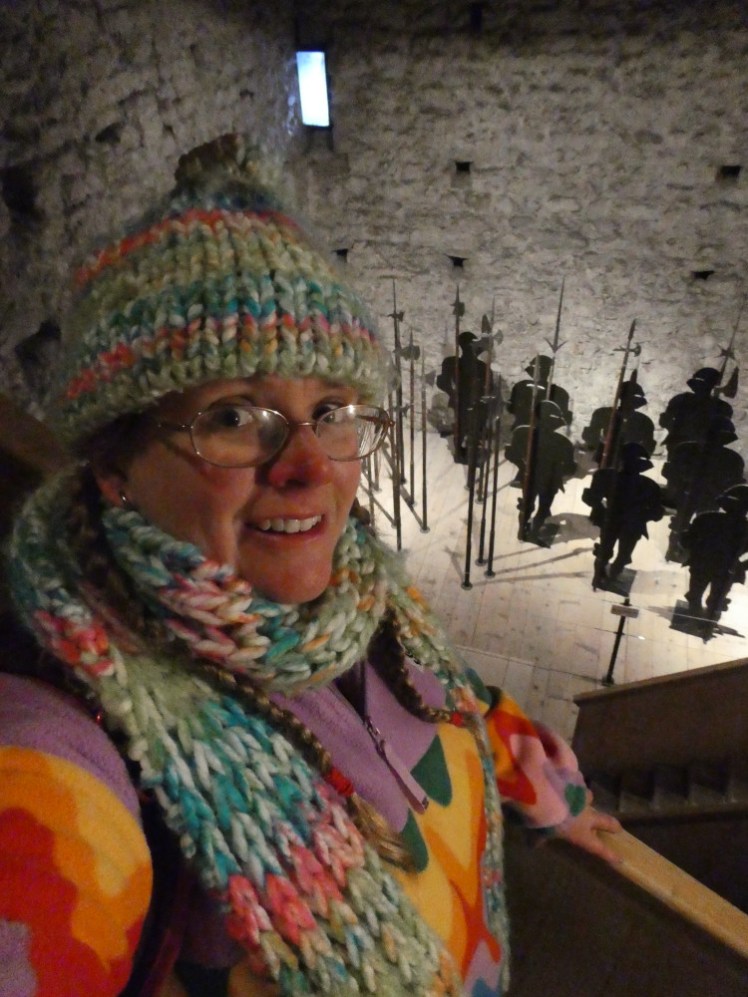
Taken as a whole, it’s a lot. It’s room after room after room and the most devoted historian couldn’t maintain their genuine interest for 48 rooms. But you get to go up the inner ramparts and look down on the courtyards and that’s always fun and the grand finale is the keep, where other than a field of spears and poleaxes and halberds and other tall weapons I don’t know about, there isn’t a lot to see until you get to the very top, where there are little windows looking in all four directions over lake, mountains and the road squeezed in the middle of them. Of course, everyone heads straight for the vaults because after hundreds of years of history, people are only interested in the celebrity who came here once it had already become a tourist attractions. Of course, if you’re interested in history, there’s plenty of it but if you’re just interested in views… well, there’s plenty of that as well.
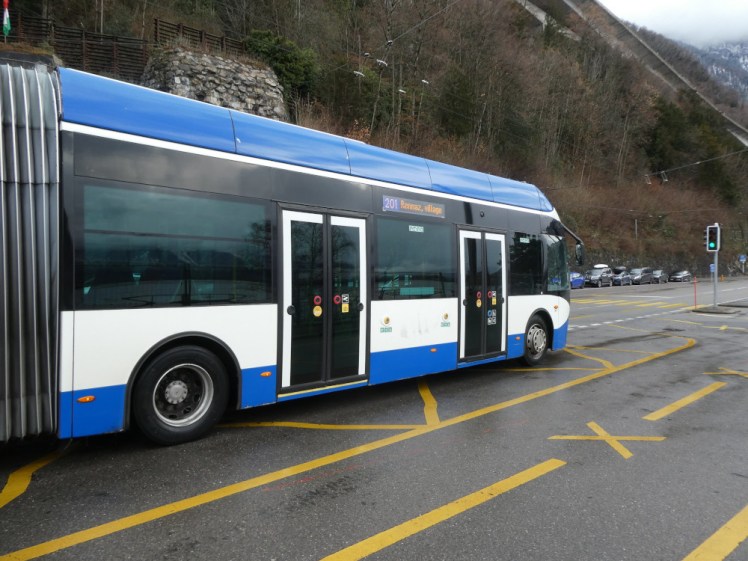
One last thing: getting there. Chateau de Chillon is one of a fairly small number of biggish tourist attractions that aren’t accessible by train, which seems weird for a country with such a great rail network. The best thing to do is to go to Montreux, go down the steps opposite the entrance to the station and there’s a bus stop on the opposite side of the road at the bottom. Take the bus 201 (direction Rennaz village but as long as you’re on the opposite side from the steps, you’re going in the right direction) for about ten minutes and get off at Veytaux, château de Chillon. It should be easy enough – Swiss buses have display boards that will tell you when you’re approaching Chillon but if you look out the window on the right-hand side, you’ll see the castle just before the stop. Also, the bus will almost certainly stop anyway because this is a popular place to go and there will almost certainly be someone on the bus who’s already pressed the STOP button to get off here. Just keep an eye out. When you buy your train ticket to Montreux, don’t get it to Montreux, get it to Veytaux, château de Chillon and it’ll cover the bus as well as the train. Strictly speaking, Switzerland’s train network and the variety of bus networks operated by local authorities as well as the national ones are separate entities but tickets bought from an SBB/CFF machine for the train are also valid for any parts of the journey required to be taken by bus. Easy peasy. When you come back, the bus stop is just outside the Secret Bunker tour on the opposite side of the road, I’m pretty sure it’s only 201s that stop there and when you get back to Montreux, there are escalators to take you back up to the station!
 I Am A Polar Bear
One thought on “Lord Byron was never a prisoner at Chateau de Chillon”