I know I’m probably the last person to have discovered this but you can go up the chimney at Battersea Power Station and pop out the top for amazing views over London.
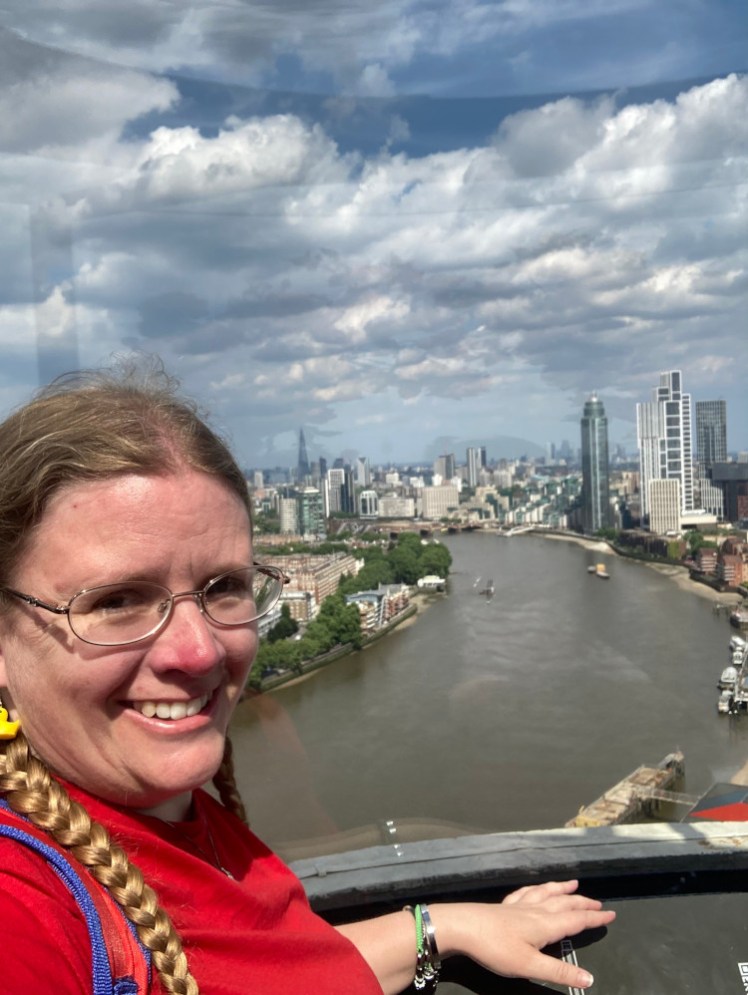
When Battersea Power Station finally reopened in October 2022 in its renovated guest as a shopping and leisure centre, it saw a lot of people on Instagram rushing to visit. I guess either I wasn’t paying attention or not understanding or it just didn’t stay in my mind because I had no idea, until I stumbled upon it, that the north-west chimney had become a London viewpoint. But let’s start at the beginning.
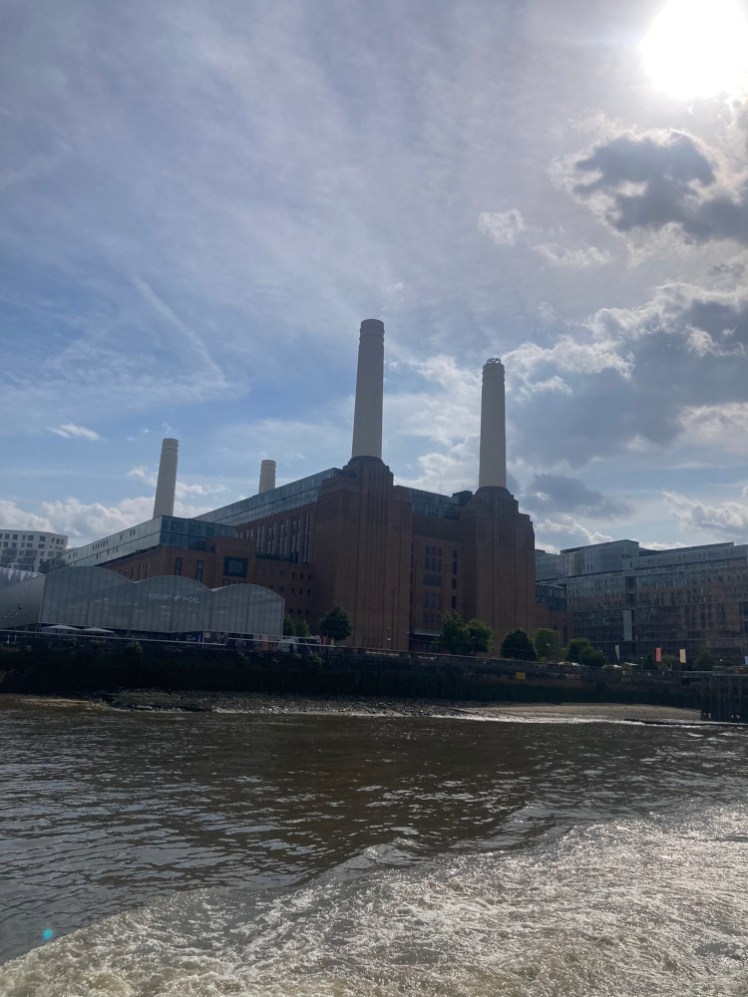
Battersea Power Station was built between 1929 and 1935. For those of us who can’t picture it as anything but a large rectangular building with a chimney in each corner, it’s actually two power stations joined together and for the first decade or so, it would have been largely a long thin building with a chimney at each end before the second half was built between 1937 and 1941. It was decommissioned in the 1970s and once empty, stood as a ruin for over thirty years while various companies tried to come up with a new use for a Grade II listed building that no longer served its original purpose. At one point it was going to be a theme park, then a combined retail, housing and leisure complex, then a biomass power station combined with shopping, park and museum and in 2012, Chelsea FC seriously considered converting it into a stadium. At long last, a deal was made to pretty much go back to the second plan and they spent a decade renovating the derelict power station and converting it into the current shopping centre and leisure complex, as well as extending the Northern Line to bring customers directly to its front door.
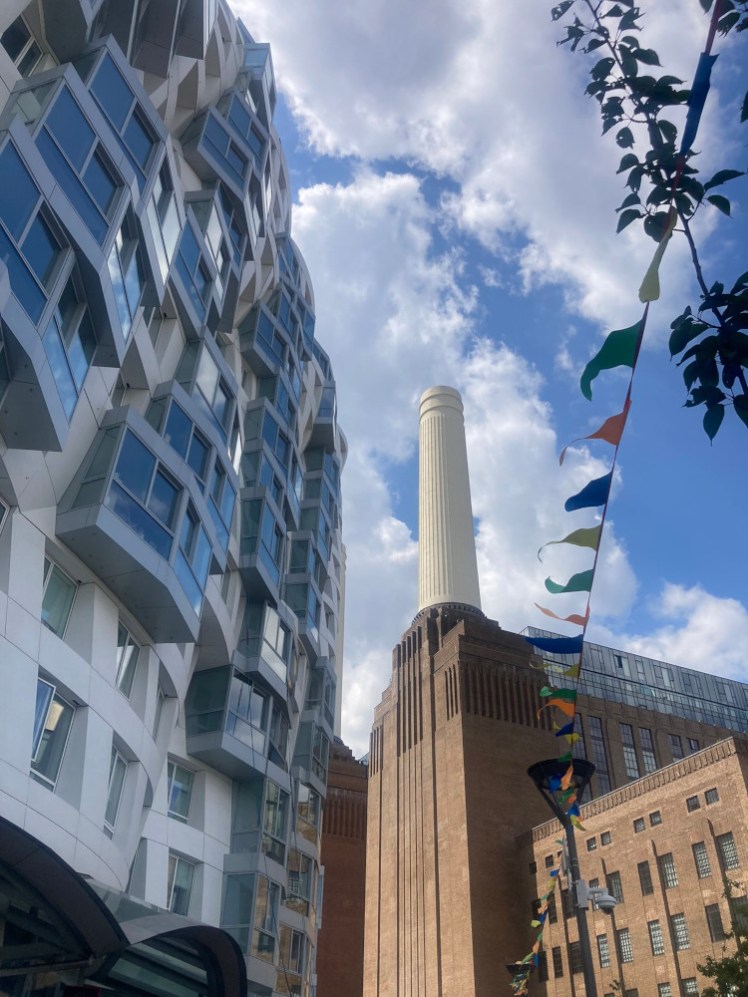
I went on a whim, having gone up to London a day early for an event and wondering what to do that I hadn’t already done thirty times. I’m a creature of habit. But I must have seen Battersea Power Station on a Tube map and decided to give it a go. I knew something exciting had happened to it and I knew lots of people, including people at work, had been to visit and therefore it seemed to be my turn.
It’s quite spectacular. While they’ve regenerated the power station itself, the whole project has been to turn the surrounding area into a vibrant new development so you feel a bit like you’ve stepped into a kind of San Francisco fairyland the moment you emerge from the darkness of the Underground. New towers on left and right, curving paths, green spaces leading up the door of the heart and soul of the area.
It’s like approaching a great Art Deco cathedral. I have Opinion, capital O, about cathedral architecture – namely that I love Norman and Gothic and especially when they’re messily combined, and I don’t like Baroque but it turns out I also like Art Deco. If society had the same call for religion it does for commerce, it would have made an excellent cathedral. You walk into the Boiler House, which is the bit in the middle, where you can go up or down to the various shops or restaurants or turn right or left into the two Turbine Halls.
I started in Turbine Hall B, which is the late 30s side. Its walkways on either side are linked by bridges with industrial machinery up in the rafters, including a glass box. The two stars of the show are the cinema, which is actually in the Boiler House but entered via escalators from here, and Control Room B, which dominates the opposite side – an Art Deco-industrial nuclear-inspired American diner-inspired cocktail bar. Actually, it’s a bit of a pain because you have to walk through it to either get to the walkways beyond or to get to two of the bridges spanning the hall.
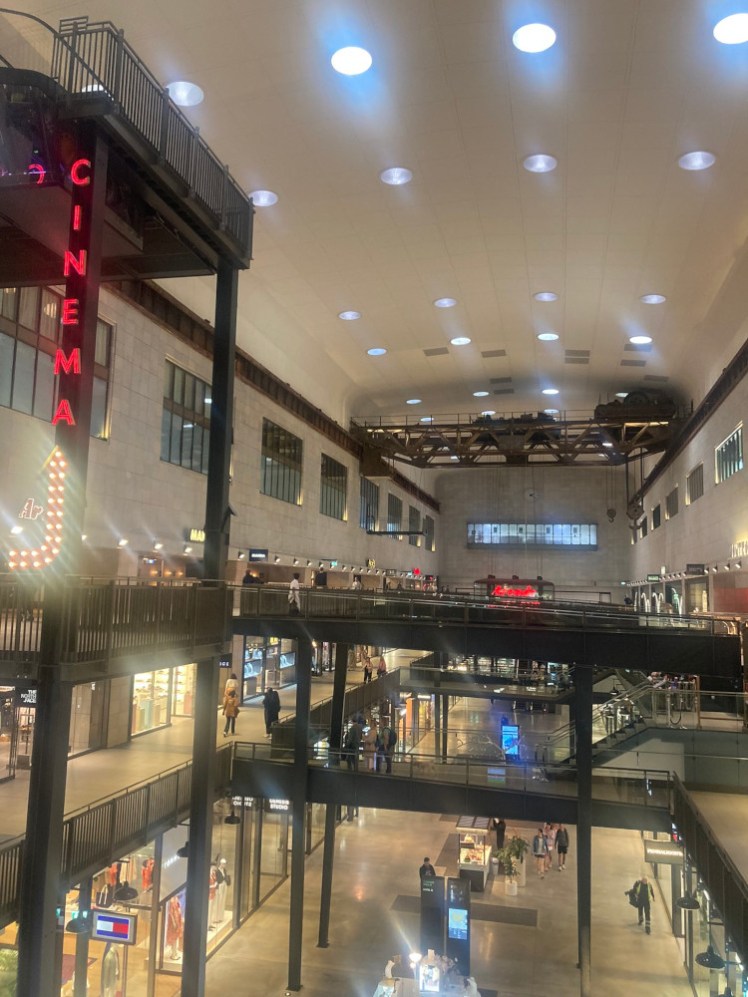
At the far end, you can walk through, past the big back doors, and into Turbine Hall A, which is mostly three levels of higher-end shops, each with their signs in nice shades of beige and black, no garish colour to mar this Art Deco elegance. If the outside looks like a cathedral, Turbine Hall A is the nave. It’s a bit of a pain to get about the three levels, with escalators being positioned at each end, forcing you to zigzag all three levels to get from bottom to top, although you can take the lifts in the Boiler House. Turbine Hall A also has a Control Room but it’s better hidden for private events, like weddings or conferences, accessed via the Directors’ Entrance outside instead of via the Turbine Hall. The walls are lined with restored switchboards and control panels and it can seat 200 in its restaurant form.
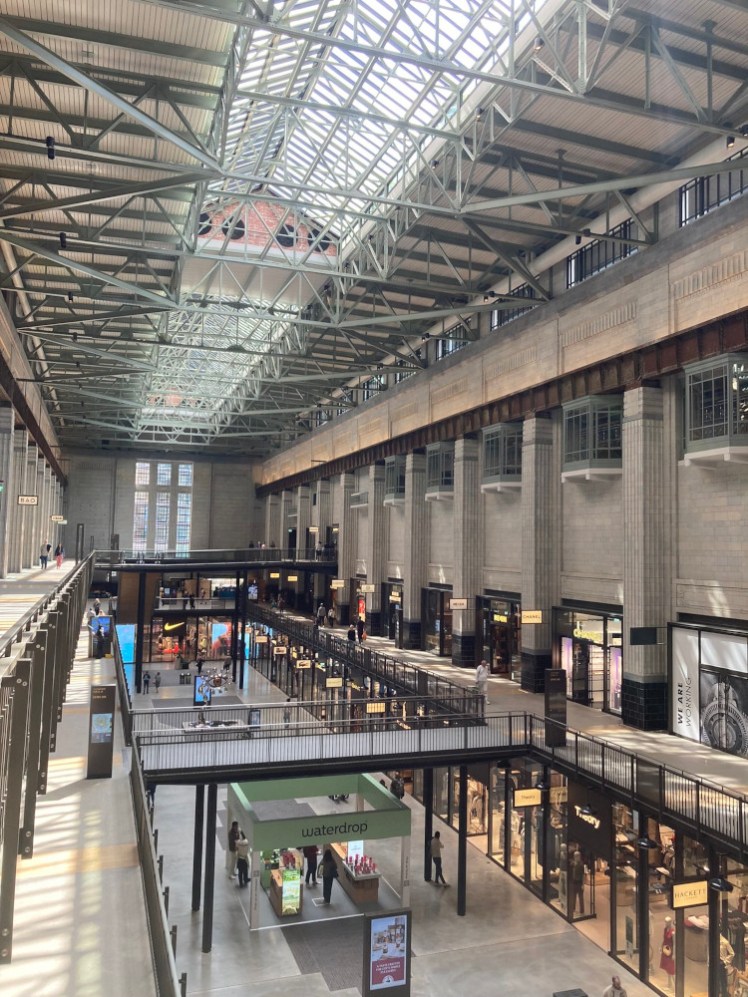
But the jewel of Turbine Hall A is Lift 109, at the north end, the river end, of the hall. Here you buy a ticket (£23 online for a timed ticket or £28 for an anytime ticket) and get barricaded into a small exhibition of the power station’s life, overlooking the vast hall, before being shepherded into a small room for another projected exhibition – this to make you feel like you’re doing something other than waiting for the lift. Then at last you go up some spiral stairs (being opened in the 2020s, it has an accessibility lift to bypass the steps) and enter the lift.

At first you don’t realise what’s going on. At least, I didn’t. The lift is a large circular space with a very Instagram-friendly flower arrangement in the middle and seating but when you’re ready to go, they switch the lights off in the lift and switch the lights on in the chimney. Even at this late stage, I’m not sure what I expected. You rise among spirals of red and orange lights and blue-tinted metal lift infrastructure and then you pop out the top of the chimney. I guess I knew it was a viewpoint but I never expected to see the view from inside a glass lift. Later on, down below, you can look up and see the lift sticking out the top of the chimney but I don’t think you’d notice unless it had occurred to you to look.
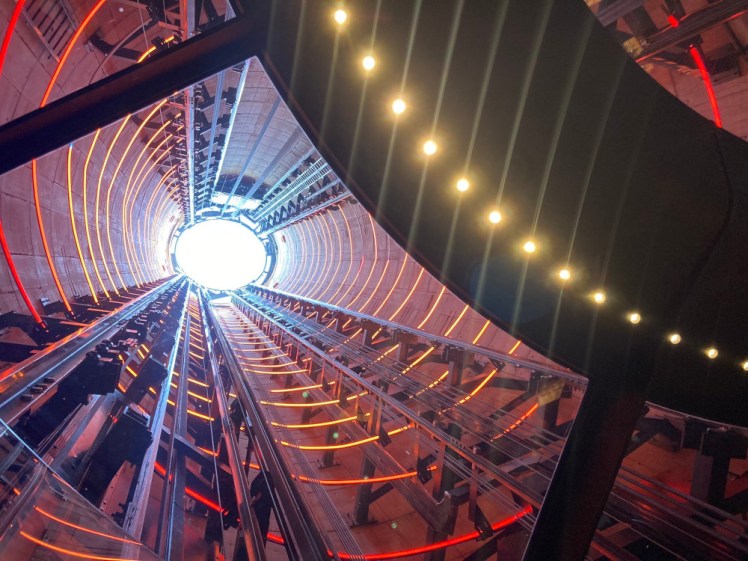
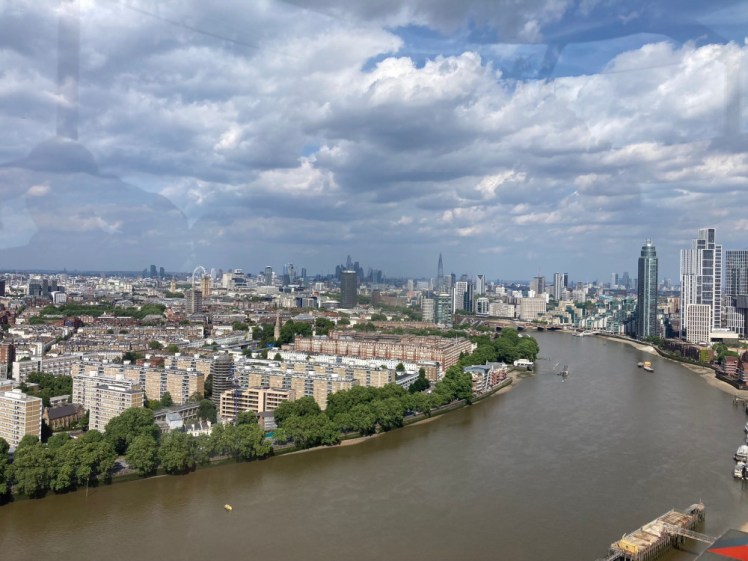
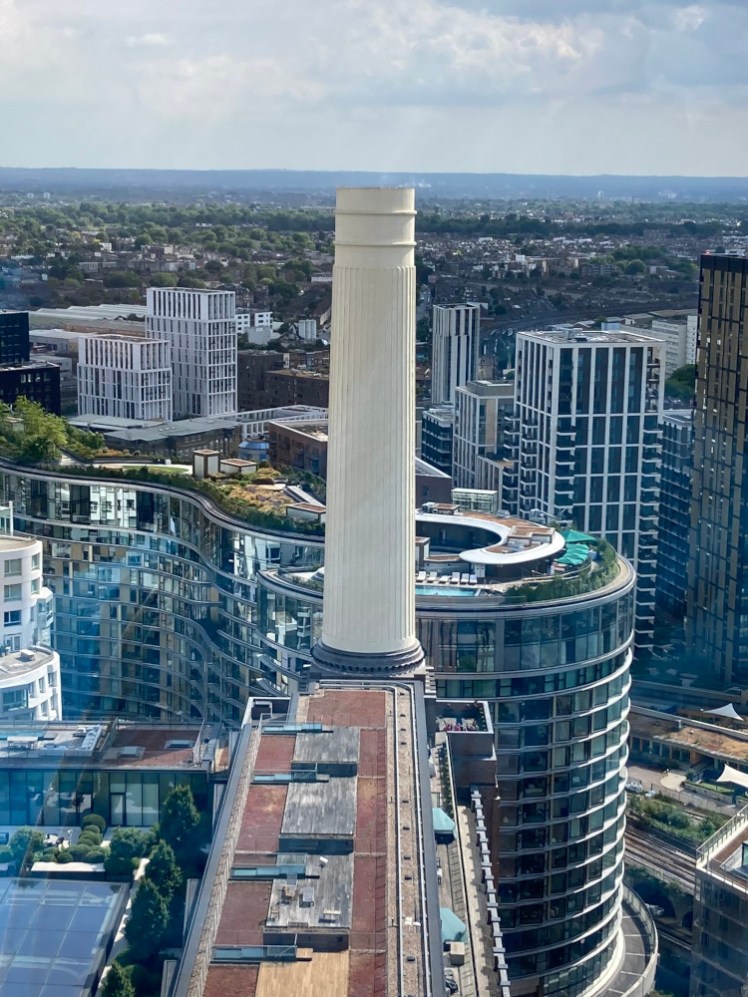
Circular glass lift equals 360 degree views of London. You get to look along the length of the Power Station until you spot the rooftop pool in the new buildings beyond it, up and down the river, pick out your favourite landmarks from among the rooftops, assisted by panels around the sides of the sphere showing what’s where and also boil half to death. You’re up there some 15 or 20 minutes, which is plenty of time to enjoy the views but on sunny days, a glass elevator is an absolute sun trap and it’s excruciatingly hot. If you walk around the perimeter, you’ll find a couple of places where air conditioning blows out, admittedly a little feebly, and that makes it a lot more tolerable. Other than that, just bear in mind the temperature and take off as many warm layers as you can before you get in the lift.
Back down at the bottom, you exit through the gift shop, of course. Staff will offer to take your photo on a greenscreen before you enter the lift and you can buy your photos here, or all kinds of brick- or chimney-related souvenirs. No cloth badges, unfortunately – I scoured the shop for them and even resorted to enquiring but no, if you want a 3D-printed chimney, they’ve got them in a dozen colours but no badges.
I finished my day in the same way I always do in London: I left the Power Station, having had my fill of views and Art Deco and not buying a bright orange down jacket, and went to the jetty outside to catch the Clipper, or Uber Boat by Thames Clipper as I should probably say. They’re high-speed catamarans, part of London’s commuter network but a really fun way to get around. If you want to do it as budget as possible, it’s far cheaper to only go one stop than the entire length of the route and that one stop hop should be North Greenwich to Greenwich. You’re beyond the central zone speed limit and as you come round the o2, it really opens up the engines and you just do not know what it feels like to zoom through London until you’ve experienced that. They put the hammer down for about twenty seconds as you depart Battersea Power Station but after that, you’re stuck with the speed limit. It’s still the coolest and most efficient way to get back to central London from Battersea.
I don’t think you want to spend an entire day enjoying the delights of Battersea Power Station unless you’re really into power or Art Deco or planning to indulge at one of the many restaurants, but it’s absolutely worth a detour and two or three hours if you’re in London.
 I Am A Polar Bear
One thought on “Up the chimney at Battersea Power Station”