This is an exciting Christmas activity that I saw Sandy Breitmeier, aka sandymakessense, do a month or two ago and the moment I saw it, I knew I had to give it a go. It’s a lampworking workshop, where you use a blowtorch to melt and twist glass to make a Christmas tree ornament. I admit, while most of the reason for booking it myself was that I love to try out interesting new things, especially involving working with glass, part of the reason was that Sandy felt like she’d struggled a bit with it and my brain instinctively goes “I bet I could do better”. But then, it was her first time doing anything like this and it’ll be my first time doing anything like this and I’m also very inclined to lean more towards “I made this and I’m really proud of it and pleased with my work even though it’s not an award-winning sample of the work”, so as long as I don’t end up wrapping molten glass around my own hands, I’m almost certainly going to come home with something that makes me happy.

SONG Art & Craft appears to be a workshop rather than a craft company. It runs various classes for beginners and intermediates, in various lampworking projects, kiln-formed glass (what you’ll probably see elsewhere as “fused glass”) and stained glass, as well as metalworking, which is mostly making rings at the moment. If you already know what you’re doing, you can join as a member or with a day pass and just come and do your own thing there. It sells a few bits and pieces of completed work but mostly, it seems to be a place for making rather than selling.
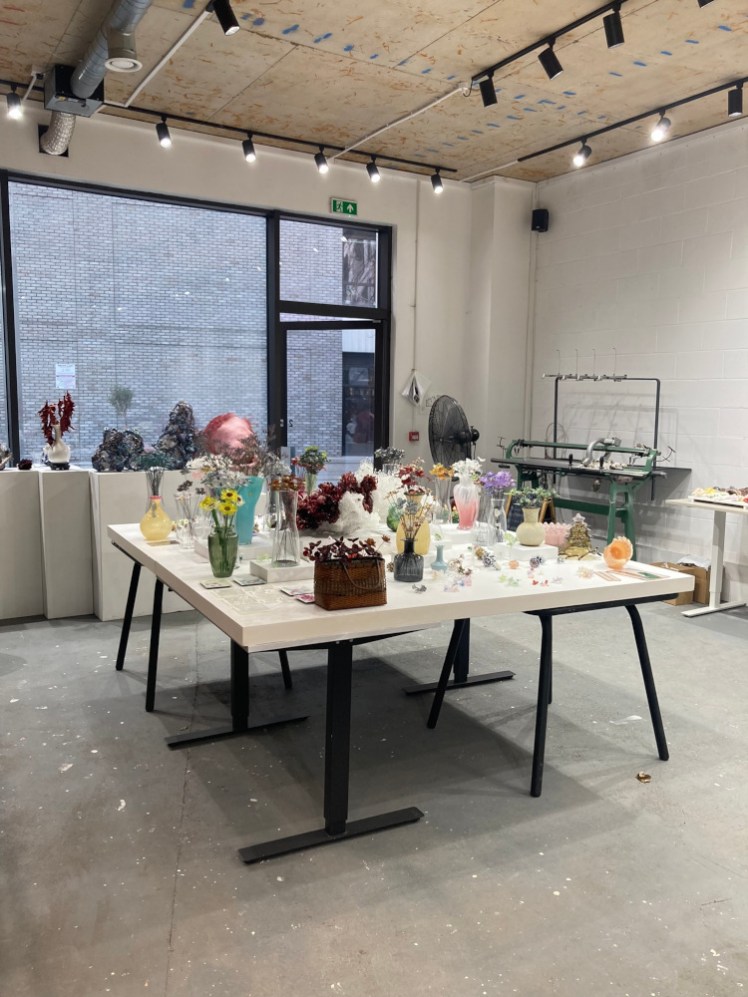
The lampwork Christmas tree workshop costs £120, lasts about two and a half hours and appears to run throughout the year, with classes available every day through the rest of December, even on Christmas Day itself. It’s at Gorsuch Place, just a short walk from Hoxton station. Go in the left-hand door, the right opens right onto the hot shop and I’m sure they’d rather you didn’t walk straight in on a dozen blowtorches.
I was the only person making a Christmas tree which meant I did get 1:1 tuition from Flo but it took a while to figure out where I was meant to be because I got swept up in a group making lampwork flowers. Flowers are an easier introduction to lampworking but once you’ve figured out the art of stretching glass threads, there’s nothing more to learn, it’s all in the practice.
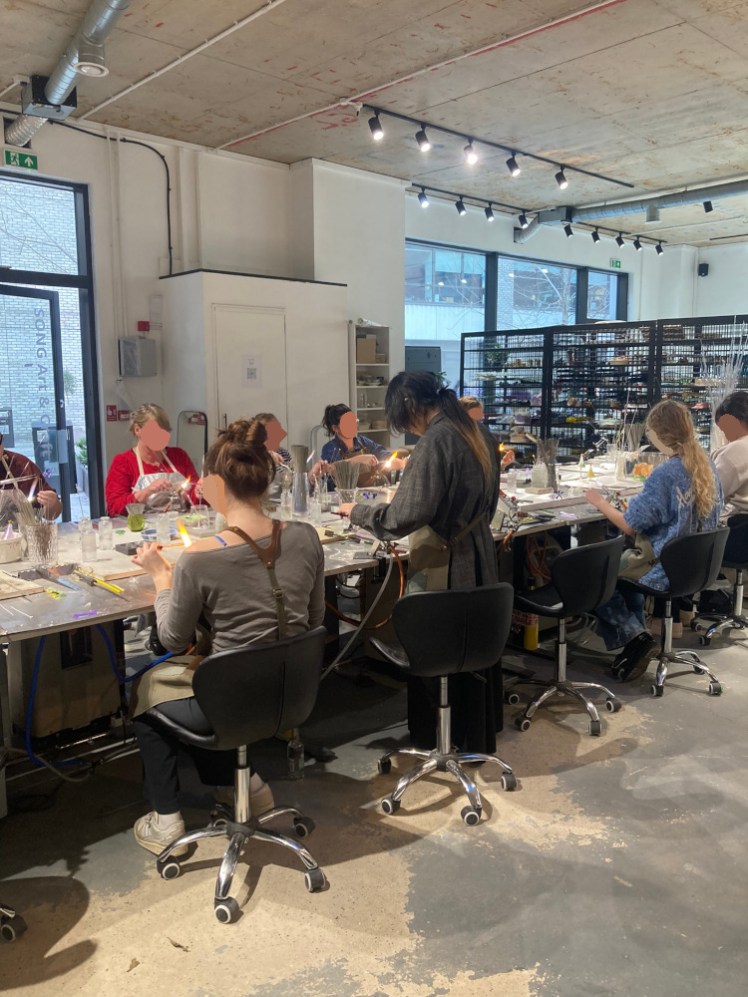
So, there I am wearing a silver apron and violet glasses so I can stare into a blowtorch flame without damaging my eyes. I didn’t quite catch what gas the blowtorch uses but there’s a canister under the table which lasts about two hours and it mixed oxygen with the gas to make a really hot flame. The oxygen is extracted from the air so the doors are left open more to provide plenty of oxygen than because the flames make it hot in there. You don’t touch the blowtorch – if you need it lit or turned off or turned up or down, one of the pros will do it for you. I was quite happy with that.

We started off with the safety talk – how to lay down my equipment so I could get at it without putting my hands too near the flame, to only cook one end of my glass rods at a time, to never sweep anything away with my bare hands, to always pick things up with the big tweezers and so on. Don’t get burned, don’t get cut. And no electronic devices near the blowtorches, which I assume is because if you’re focusing on taking photos, you’re not focusing on the fire rather than because either phone or torch will be affected by the other. That means I have woefully few photos. I don’t even have a selfie in the silver apron and purple glasses.

Then Flo showed me some pre-made Christmas trees. It’s basically like candy floss, just wrapped around and around until your threads bulk out enough to resemble a Christmas tree. Most of it is done with clear glass (because it’s easier to work with than coloured but also presumably because it’s cheaper) and when you’ve more or less got the shape, you can add colour. We could talk more about the colour later but there were glass rods laid out and you could help yourself to whatever you fancied, plus I suspect they had a lot more colours hidden away for if you wanted something special – I’m pretty sure some of the reds and yellows that appeared later weren’t on that table.

So, you hold a glass rod in each hand. The one in your dominant hand is the one you’re going to form the tree on, the right in my case. In your other hand is a glass rod which you hold in the flame until it melts. Touch it to the tree rod and it sticks and then just pull away ever so slightly so that the glass stretches into a thread and turn the rod to begin wrapping the glass thread around it. That’s all there is to it. Of course it’s not as easy as that. If you twizzle the rod too slowly, your threads will end up sticking out at odd angles. Those can be reasonably easily fixed by heating the tree-to-be over the flame and rolling it on a graphite plate to push it into place. Flo did a lot of reshaping of my tree – I’d kind of started in the middle instead of the bottom and then made my top too thick and lots of bits stuck out at bad angles – but on the whole, it wasn’t too bad for a beginner. My major problem was that everything started to feel good as my glass rod got shorter, so by the time I was settled into some good melting and twirling, I was starting to get hot fingers and had to start again with a new rod.
Someone else got me started on having the base of the tree where it needed to be so I spun and threaded and attempted to reshape and eventually, I had quite a good-looking tree. Now we added colour. Obviously, I picked some green, a proper bottle green. Dark but translucent. The darker the colour, the harder is generally is to work with but also, the more opaque, the harder it is to work with, and it also looks just a tiny bit weird on a finished tree. Flo had warned me that the coloured glass would feel very different to the clear and she was absolutely right – like spinning with golden syrup instead of water. It felt thick and it took a lot more melting before I could get started with pulling it. I gradually built up layers, it went into weird angles, it didn’t actually stick to the tree and although I’m pretty happy with the result – as predicted – I know it’s incredibly fragile. I wish I’d touched one of the example trees rather than just looked at it. Is it correct for mine to feel like I could unravel the whole thing? Should I have spun it more tightly? Could I have spun it more tightly?
For finishing touches, we added a star, a holly leaf and some dots. Flo did most of that. She showed me how to sculpt a star and a leaf and I utterly failed to do it. For the star, you melt a big blob of glass and then hold the rod up so it begins to slide back down, becoming round rather than vaguely tear-shaped. Then you take the shaping pliers and pinch it in three places. Keep heating and pinching to shape the blob into the top three arms of the star. Then stretch the half-star off the rod with a pair of tweezers, turn it around and melt the top point back into the rod so you can heat and pinch off two more points. Keep heating and shaping, then melt it back off and stick onto the tree. I made four stars and every single one of them looked more like a T-Rex than a star except the last one, which I didn’t even stretch off, so it stayed looking like a giraffe. The star that ended up on my tree is Flo’s. What with the failure of the stars, I ran out of time to even try a leaf so those are hers as well.
We had some trouble with the red glass for the holly berries so another instructor came in to do them and to put some red dots all over my tree and then finally, she melted off the “trunk”, the end of the glass rod to get it down to a good size. I’d seen that all the trees were standing on wine glass-like bases and I wondered how on earth we were going to make that when we’d already gone over our time but it turns out those are pre-made bases and you just pop your tree into it.
The other thing I’d been a bit concerned about was annealing, cooling the glass in a kiln to prevent it cracking as it cools. I’d had to wait for my paperweight and bauble from my glass blowing class to be annealed and then posted to me but somehow, no one had mentioned anything similar here, even though the internet said that lampworked glass almost always needs to be annealed. Well, apparently not. My tree did sit in a tray of cooling sand, which was more like a really fine glass shingle, for five or ten minutes, mostly to cool the cut-off end rather than the tree itself. Apparently the sand gets caught in the fine threads. Finally, it all got wrapped in bubble wrap and put in a box and I just had to get it across London and then onto a train home without smashing it. It wasn’t until I got home that I could take it out and touch it and discover how very candyfloss-like and fragile it is.
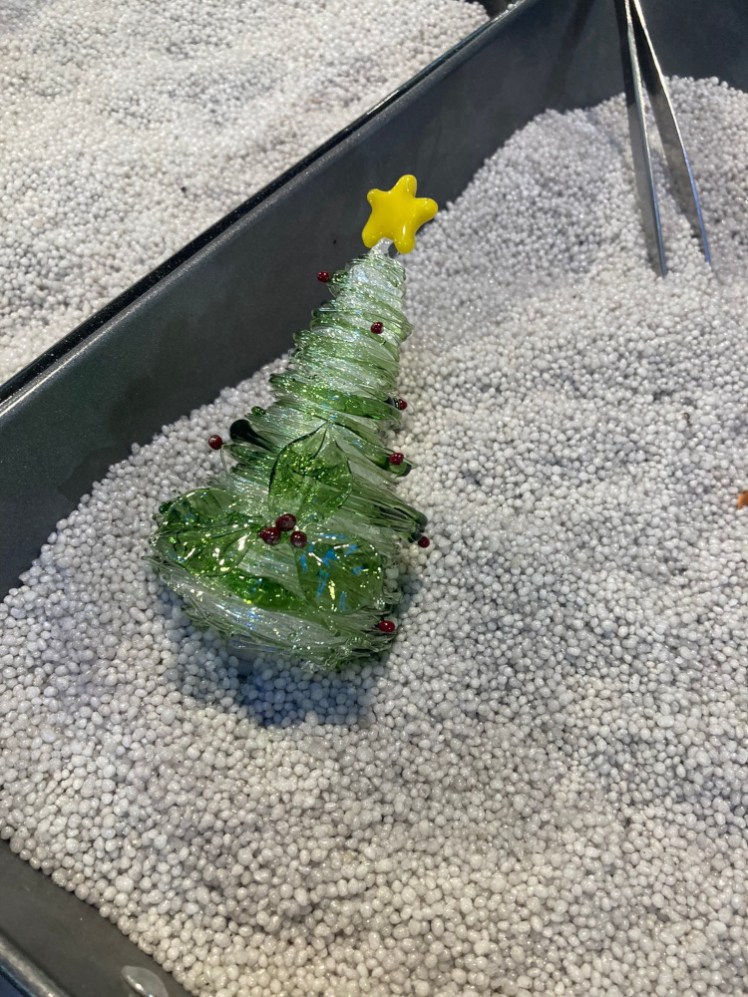
So no, not a star example of a bit of lampwork and certainly not as good as the ones Flo makes. But I am indeed delighted with it, I think it looks great and part of the reason I think that is precisely because I made it!
 I Am A Polar Bear