I’ve seen a lot of people go all the way to Bucharest to go to the Therme but very few – actually, none at all come to mind – spend any time in the big city a few kilometres south of it. But although Europe’s biggest spa was a lovely bonus, I actually was in Romania to visit Bucharest.
Like many of the less obviously touristy cities (and indeed some very obviously over-touristed cities), you could spend months uncovering the secrets and joys of Bucharest but you can at least scratch the surface in a day or two. There’s a fairly well-established to-do list of sights and plenty of places to just sit. The one thing you need to know in advance is that Bucharest is bigger than you think and everything is further apart than you think. I walked from the Arcul de Triumf to Free Press House, which is one roundabout up the road and very clearly visible and Google Maps told me it’ll take twenty-five minutes to walk – yes, I’d learned by then to check distances before I committed to walking them.
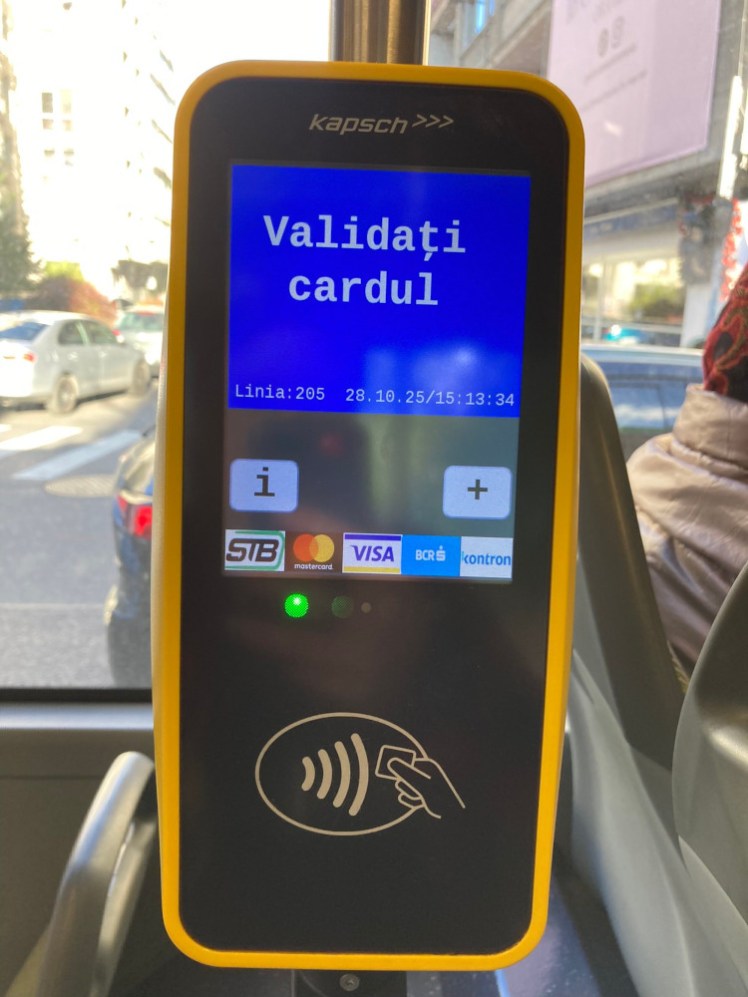
Because everything’s so far apart, you’re going to want to get around by public transport. Metro line 2, the blue one, is great for connecting the sights in the north of the city to those in the south and the buses will fill in the gaps. For the metro, you can buy a magnetic card and load either a specific number of journeys on it or buy a week pass (buying & loading are done as one operation) but, honestly, you’re probably best just using your contactless card or phone on the turnstile if you’re not planning at least ten rides. The metro is very easy – at each station, there’s a sign showing which direction each train is going on each platform and there’s an electronic board telling you which station is coming up next. For buses, you can buy a similar reusable card from the kiosks near major bus hubs but they do have a habit of closing early in the afternoon, and again, it’s probably easier to just tap your card on the orange reader. Buses vary; the front and middle readers usually accept contactless cards but sometimes the one at the back doesn’t. Unusually, metro and bus are two totally separate systems; there is no pass that allows you to travel on both.
Day 1 – northern Bucharest
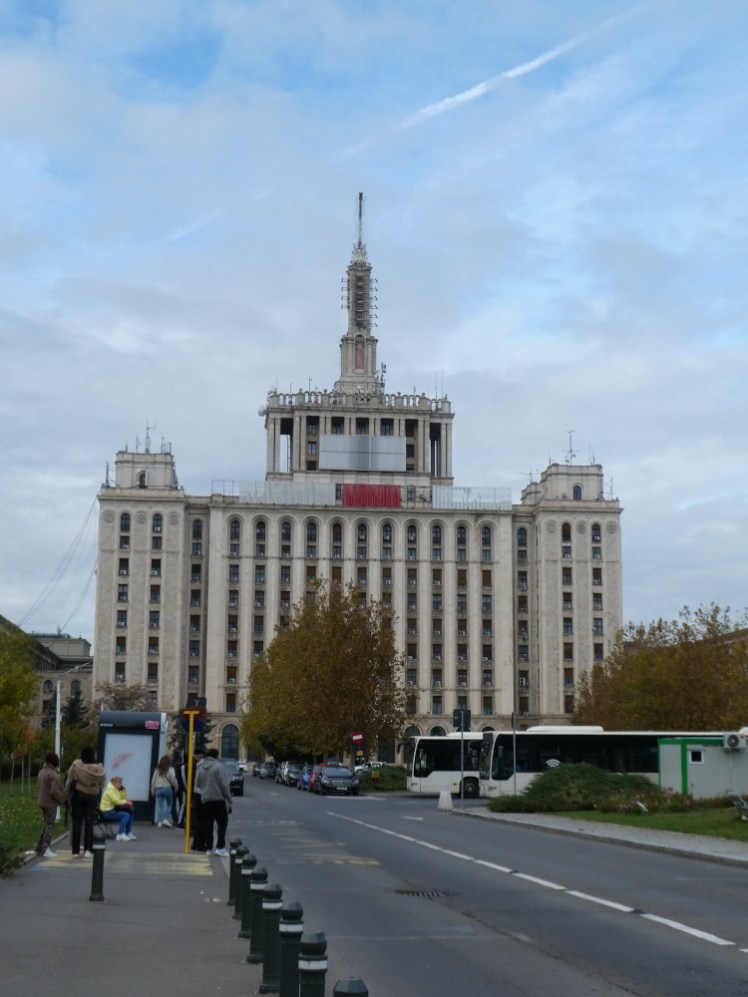
Start in the north of the city with Free Press House, a sister (half-sister?) to Stalin’s Sisters, seven skyscrapers in this style dominating the skyline of Moscow. There are another half-dozen around ex-Soviet and ex-Communist countries, none quite so big or majestic but recognisably in the same style and this is one. Once upon a time, this was home to Romania’s not-at-all free press and was called Casa Scînteii, The Spark House, after the Communist newspaper of the same name based there. Now the newspapers remain (and the Romanian stock exchange) but the communism is gone. If you’re not there on a Sunday afternoon, I believe you can take a tour of the building, although the reviews I’ve seen aren’t great.
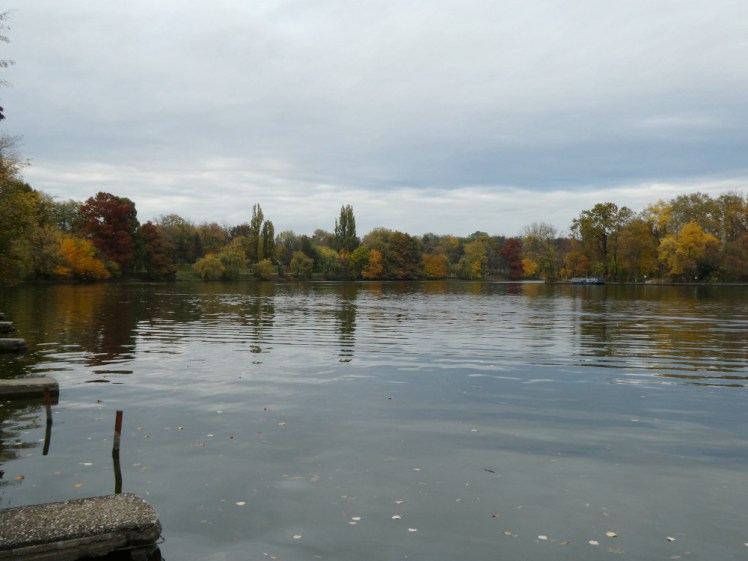
There are two important things right outside. One is a major transport hub – this is where you get the bus to Therme București via the airport or out to Snagov. The second is the massive Parcul Regele Mihai I, King Michael I Park, still more often referred to as Herăstrău Park. It’s huge. If you’re after a bit of nature away from the noise of the city, come here. In October it’s a bit of an autumn wonderland and the huge lake has boat trips; just about the only one you’ll find in a city that doesn’t revolve around a major river. Herăstrău Park is also where you’ll find Bucharest’s open air ethnographic museum, which has an entry fee but looks very much worth it to explore Romania’s rural past. I don’t believe you can currently visit it but Elisabeta Palace, official royal residence of Margareta of Romania, Custodian of the Romanian Crown. Her father, from whom the park takes its name, was the last king of Romania, forced first into exile and then to abdicate in the 1940s. Margareta therefore isn’t queen but half the population according to a 2017 referendum prefer a monarchy over a Republic, so she’s the first in a line of Custodians until the day Romania either reinstated the monarchy in full or does away with it altogether.
Halfway down Herăstrău Park is Bucharest’s Arcul de Triumf, which you’ll recognise if you’ve ever seen the one in Paris, although Paris’s is much bigger. Romania’s version commemorates Romania’s victory in World War I – not quite single-handed – and the coronation of King Ferdinand I in 1914. Day to day, like in Paris, it’s the centre of a chaotic roundabout where traffic pretty much just crosses its fingers and hopes for the best but on Great Union Day aka Romania’s National Day, 1st December, it hosts the enormous National Military Parade.

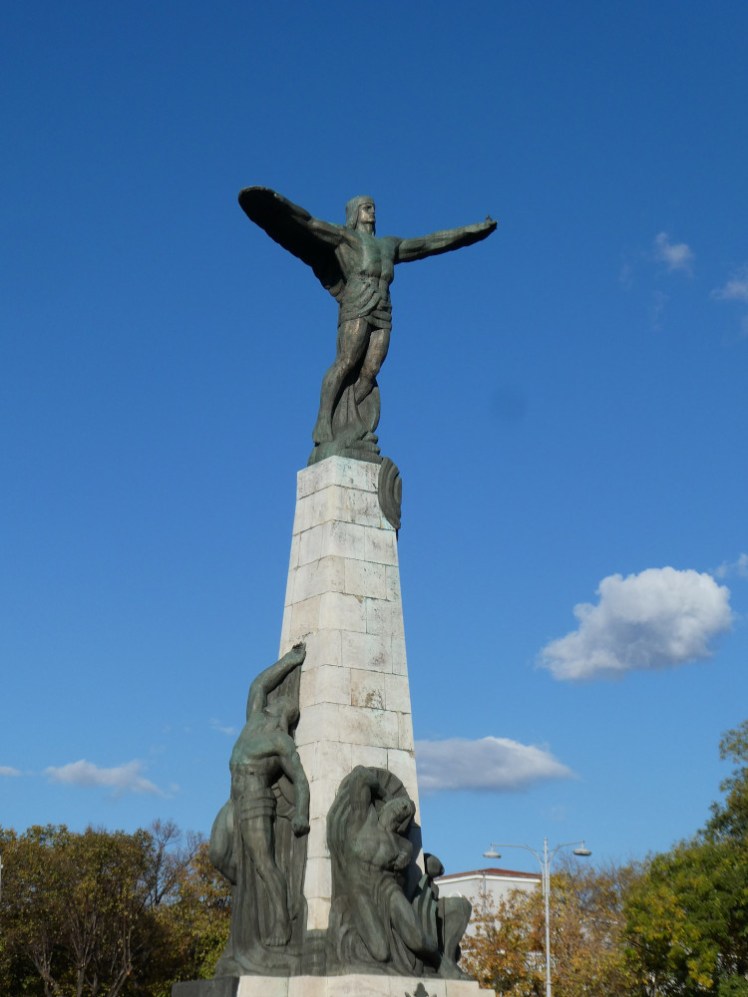
If you follow the road east across the bottom of the park to Aviatorilor metro station and then walk down to the next junction, you’ll find the Monument to the Heroes of the Air, which I was convinced was Icarus but is in fact an aviator with a shawl hanging from his outspread arms. It commemorates the Romanian aviators who died in the pursuit of developing flight and in various aerial fighting during World War I. It’s also in the middle of a busy junction so the best you’re going to be able to manage is a photo of it from the pavement during a split-second of paused traffic. Perhaps it’s not that interesting as monuments in big cities go but it’s such an unusual-looking one that I can’t resist seeking it out.
The next square down is Piața Victoriei, Victory Square. Wikipedia is vague about what victory it refers to, claiming that it was named in 1878. These days, you should pause there to take in Victoria Palace, built in a style that feels typical of Bucharest, in that it looks very solid and heavy. It’s a variant on Classical style with all the ornamental details removed, a kind of hybrid Classical and Brutalist. It’s now the office of the Prime Minster of Romania but it was originally built as the home of the Foreign Ministry. Opposite is the National Museum of Natural History, apparently one of the best natural history museums in the world. If museums or natural history is your thing, you really should try to make time for a visit. But for me, I was hunting down a certain statue and moved straight on to Piața Romană.
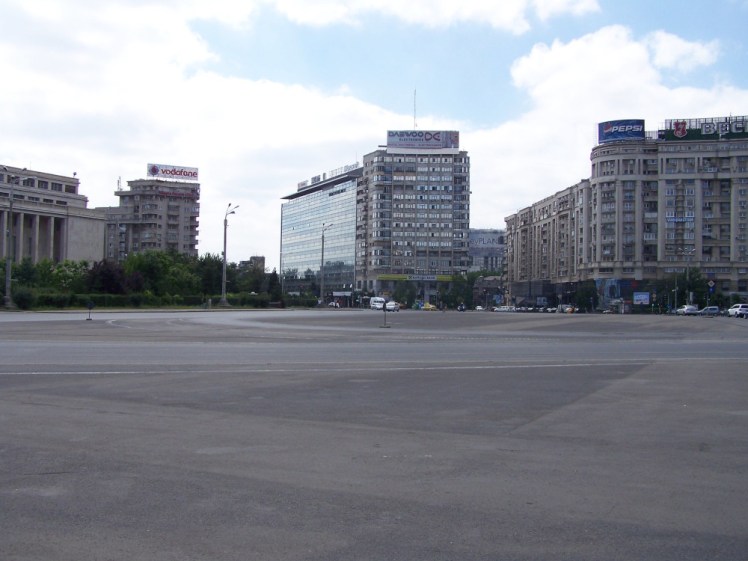
This square got a mention in Blood and Chocolate, the terrible werewolf movie that inspired me to come to Bucharest in the first time, so I tend to overestimate its importance. It’s surrounded by interesting buildings of the Belle Époque and inter-war times but there’s nothing in particular to see here, except the Lupa Capitolina which has been moved over a kilometre and a half south at some point in the last sixteen years. I’ve checked my photos and I’ve checked the internet. It was here, at Piața Romană and now it isn’t.
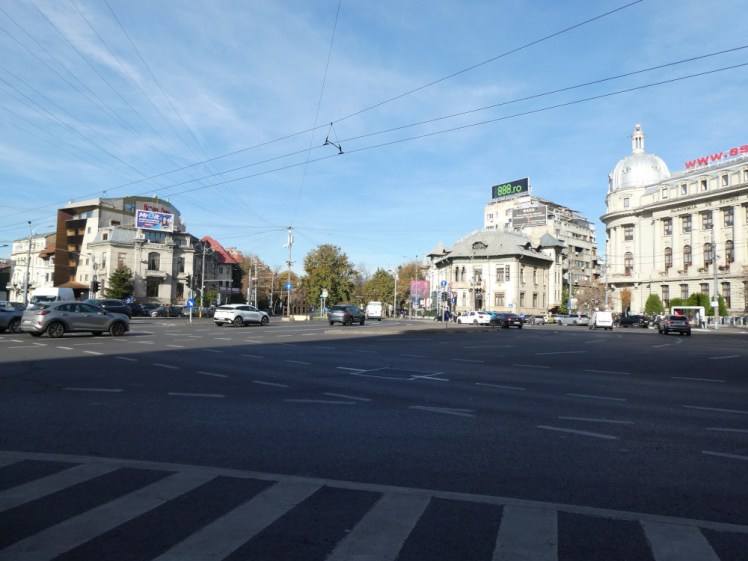
We’ll finish today here – we’ve covered quite a few of the major monuments of the northern half of Bucharest and even with the help of public transport, we’ve probably ended up walking quite a bit of it, so time for a rest.
Day 2 – southern Bucharest
We’ll pick up a little way south of where we left off yesterday, at the southern end of Calea Victoriei in a square rammed full of large and significant buildings. The first, the one you’ll probably see recommended most often is the Romanian Athenaeum, which I completely misunderstaood as the Roman Athenaeum. I was slightly surprised that a fairly significant Roman edifice was pretty much still standing all the way out in Bucharest but it all made a lot more sense when I finally noticed the extra letters. Romanian. Basically, it’s Bucharest’s equivalent of the Royal Albert Hall, a prestigious concert venue with a domed roof and columns out the front and, when I was there, a crew setting up for an event, including laying out a red carpet. If you’re organised enough, you can absolutely attend a concert there.

Back out on the main road, you’ve got the Royal Palace of Bucharest opposite, an enormous ornate ex-royal residence (the current semi-royal family still get to use it when they want, and it’s used for royal funerals) now serving as home to the National Museum of Art. The original 1810s Neoclassical palace was destroyed in a fire in 1926 and the current building rebuilt in the 1930s.

Across the road, the possibly even more massive building is the Central University Library. If you’re hoping for just as much spectacle inside, a lot of the building has been converted into something more like your typical underfunded academic library, although it does have a few rooms that almost verge on Dark Academia vibes. Honestly, though, if you’re after aesthetic pictures, this isn’t the library for you.
The square separating the two buildings is Piața Revoluției, Revolution Square, formerly Palace Square. It’s not just named after the Romanian Revolution of 1989 that ended the monarchy, Communism and the reign of Ceaușescu, it’s where Ceaușescu gave his final speech that, far from emulating his speech of 1968 on the same spot which pretty much brought him to power in a Romania free from the Soviet Union, more or less triggered the revolution. There had already been protests and riots in Timișoara, in the western corner of Romania, but this speech brought it right into the capital. Barely 24 hours later, he was helicoptered out and within four days of that initial speech, he’d been tried and executed.
My personal favourite thing in this square is just a tiny bit further south, just past the Royal Palace and it’s the tiny brick Kretzulescu Church. You’ll find a lot of these around Romania, these red-brick churches with octagonal towers and painted floor to ceiling with colourful murals. As a general rule (see the stickers on the front door), photos are ok as long as they’re without flash and as long as you take them quietly and respectfully. In fact, unlike other Orthodox churches of my experience, Romanian Orthodox churches are quite openly welcoming even when you’re clearly a tourist rather than a member of the congregation, as long as you’re quiet. There’s not even any requirement to cover your hair, although people who come to pray here do. I stumbled across this church in 2009, the first thing I’d found that was pretty in a city I knew nothing about, and I was delighted to stumble across it all over again 2025.

Now we’re getting towards the Old Town, where the streets become narrow and suddenly there’s a pavement cafe round every corner, alternating with souvenir shops, and a great place to just spend a couple of hours wandering, finding rooftop bars and enjoying not looking at oversized monuments before I take you to the biggest of them all.

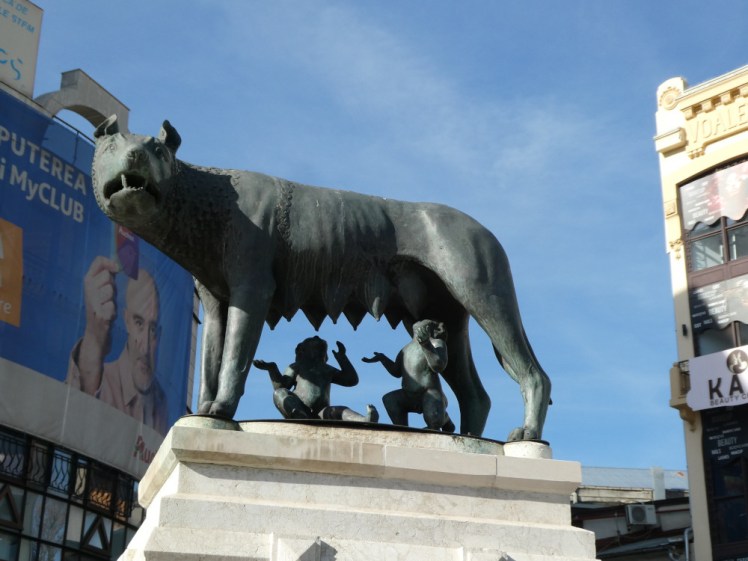
Off to the east, where the Old Town runs into the main road running south from all the monuments in the north of the city, you’ll finally find the Lupa Capitolina, a bronze replica of the statue of Romulus & Remus being suckled by a she-wolf. The original is in a museum in Rome, I think. Romania’s name ultimately derives from the Latin for “of Rome”, which appears to date back to the 16th century and presumably refers to the fact that the Romanian language is a descendant of Latin, a cousin to French, Spanish, Italian and Portuguese. Yeah, the language gap isn’t as big as you might expect. This statue, linking Romania to Rome, used to be in Piața Romană but I suppose it makes sense that it’s been moved to Piața Roma.
Off to the west is Cismigiu Gardens, a lot smaller than Herăstrău Park but with the same atmosphere of a haven from the city. My favourite thing about this particular park is that you can hire boats from the cafe in the southern part of the lake and go off for a row all by yourself. I didn’t do it myself because I had all my luggage with me and I know I almost certainly wouldn’t have capsized the rowing boat but if I did, everything I had brought with me would be either lost or ruined. Had I stumbled across it on one of my other days, I probably would have done it.

Just across a couple of roads from the southern end of Cismigiu Gardens is Parcul Izvor, the gateway to the two biggest things in all Romania, two things you can’t miss. Walk through the park and turn right and eventually you’ll come to the entrance of the National Cathedral. You can’t miss it, it’s a huge gold-domed cathedral set in a huge gold-roofed courtyard. It’s the biggest Eastern Orthodox church building in the world, by height, by volume and by area. Not just that, it’s the tallest domed cathedral in the world and the tallest non-Gothic cathedral in the world and it has the largest mosaic collection/interior decoration in the world.
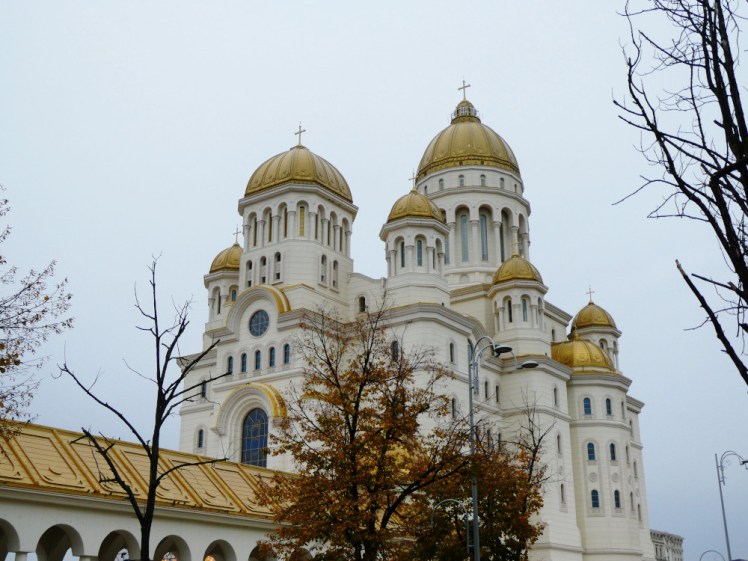
It was built between 2010 and 2018 and the day I was there, it was having a ceremony to consecrate its artworks and celebrate its official opening. It meant you couldn’t get near the place. Half of Romania had turned out to witness it, mostly from big screens placed around the grounds. From those screens and from what I saw on TV over breakfast at the hotel, the inside is even more gold than you could possibly imagine.
It’s so big that from this angle, it absolutely dwarfs its neighbour, the Palace of Parliament. That’s quite a feat because this is the heaviest building in the world and the largest civilian administrative building in the world – the Pentagon is bigger but it is a military administrative building. The Palace of Parliament comes in at number 11 in the the list of buildings around the world by volume of usable space, behind factories, hangars, cruise ship dry docks and London’s O2, which certainly doesn’t have nearly as much presence as the Palace of Parliament. It is astoundingly big. I mean, it’s very typical of the buildings we’ve meandered past on this two-day tour of Bucharest – breathtakingly ugly, concrete and unnecessarily big but this one is so unnecessarily big that it’s just astounding. Apparently there’s even more of it underground than above ground – eight levels, a nuclear bunker and presumably some of the biggest foundations in the world to support its weight.

Despite being called the Palace of Parliament, it’s only housed the full Parliament since 2004 – the upper house, the Senate, used to be held in the HQ of the Communist Party. Before that, it was the People’s House or the House of the Republic and existed because Ceaușescu wanted a big imposing socialist realism civic centre inspired by North Korea’s Kumsusan Palace of the Sun rather than because he really needed a gigantic admin building. If you’ve read the Vorkosigan Saga, it reminds me of ImpSec Headquarters in Vorbarr Sultana, except the Palace of Parliament has windows. I can just see Simon Illyan sitting on the hill opposite watching it sink in great satisfaction.
Yes, you can take a tour of this enormous building although I’d bet you only get to see a fraction of it. Tours cost about £10 per person and about £12 if you want to include the basement and last about an hour. You’ll need to bring official valid ID, which basically means passport and it takes about half an hour to check in and go through security.
And I think that concludes my tour of scratching the surface of Bucharest. Walk up Bulevardul Unirii to see how massive the Palace of Parliament looks even from a distance and then jump on a bus or the metro at Piața Unirii, which is a major transport interchange but also the largest square in Bucharest and one of the largest public spaces in Europe. It’s got a big shopping centre and department stores on the opposite side although the massive fountain in the middle is currently closed as building works of some kind are going on, which means to get to Metro 2 or the shopping centre, you’re going to have to go the long way around the square.
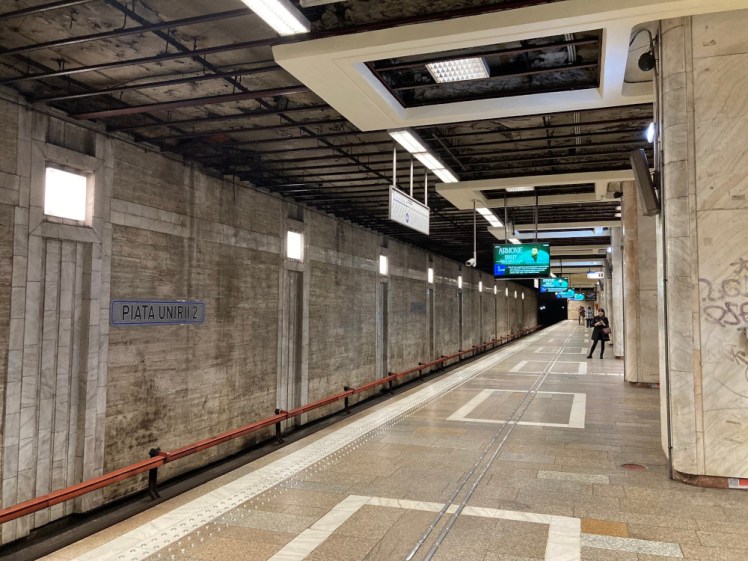
There’s still so much more to see, do and discover in Bucharest but if you’re just doing a short trip to visit the Therme and then doing your travel duty by crossing off Bucharest too, I think that’ll do you.
 I Am A Polar Bear