Well, this wasn’t something that was in my initial plan for things to do while I was in Bucharest. I was quite contented with the massive spa, getting to know the city and succeeding in getting the train to Brașov. In the course of figuring out how to get to know the city, by reading my guidebook, I stumbled across a recommendation of a place called Snagov and further investigation revealed that it’s an hour or so north of Bucharest, has a monastery on a lake which you row over to and in the grounds of that monastery is a grave that is not 100% sure to be Vlad’s but is about 90% likely. So that went on my to-do list.
In some ways, it’s actually not so easy and in some ways it’s much easier. It’s not so easy in that the direct bus goes from some way further north in the city than I was staying, which meant a two-leg journey, but it’s easier in that they’ve built a bridge over to the island since my guidebook was published, saving me having to hire a rowing boat from a local and row myself over. Not that that doesn’t sound like the most romantic, Mary Shelley-esque way of doing things but I’ll give you this blog post for an idea of my rowing skills (and I had another go at the beginning of September, so I know things haven’t improved). So I was relieved to find I could merely stroll over. I also looked into tours but the reasonably-priced ones either weren’t running the days I was there or they wanted a minimum of two people. Several of them were not reasonably priced, especially as they don’t even include entry fee to the monastery or the photo fee.
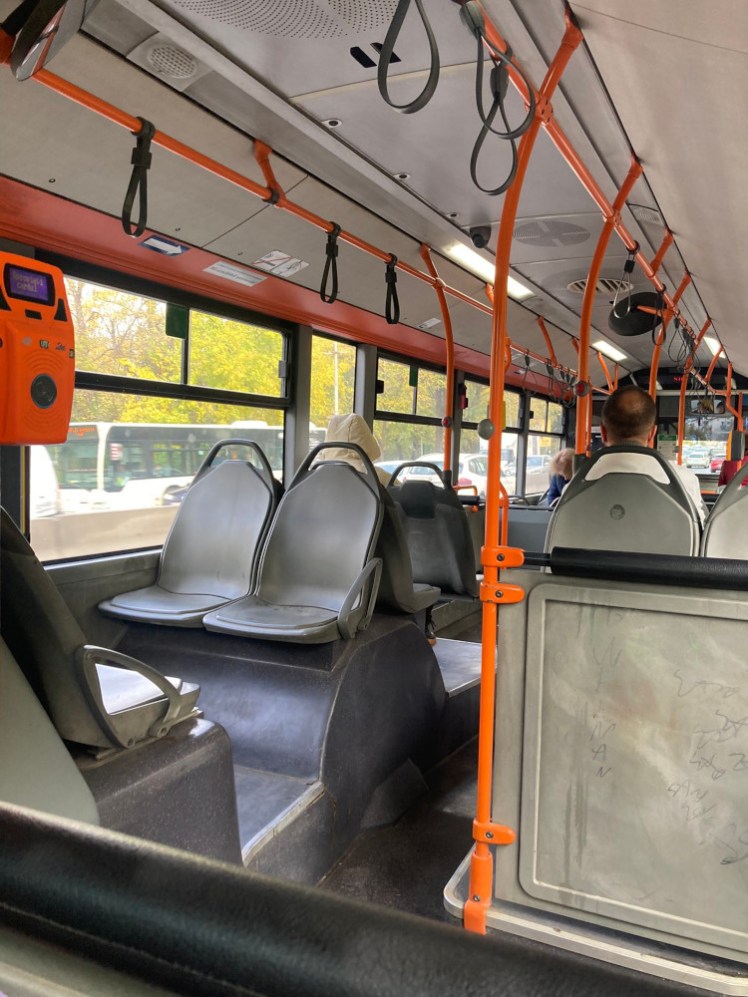
So here I am at 9 o’clock in the morning, walking half a mile from my hotel door to the bus stop. The 205 took me to Gara Baneasa towards the northern outskirts of the city where I waited about ten minutes for the 446 which would take me past the airport and Therme București and then through mile after mile of rural nothingness into Snagov village. It’s then a walk of about a kilometre walk down a lane through the village to the bridge, which takes you over to a small wooded island. And when I say small, I mean that it’s 400m from one end to the other and about 160m wide at its widest.
I was slightly concerned about the walk, because it’s an unpaved road through a small village that might not be especially welcoming to strangers, but I forgot that it’s a village with a tourist attraction, and a village within the capital city’s bus network. It’s pretty rural – I liked the three-wheeled vehicle offering the biggest cabbages I’d ever seen, the miniature shop/bar, the mix of small old houses and newer bigger houses that looked like they might be holiday homes and I noticed that every house had a wall and gate and any metal gates were backed with corrugated plastic as if to keep something out.

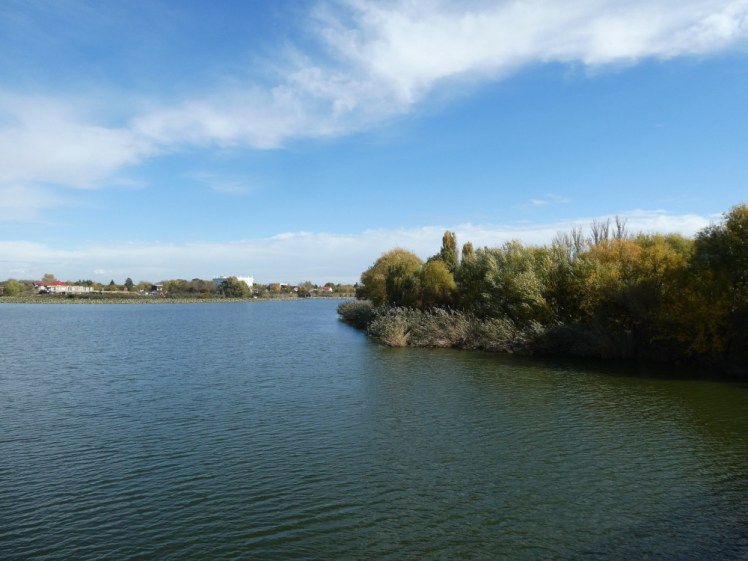
At the end of the street was a large memorial and beyond that, the bridge to the island. Oh, so much easier than sweet-talking a local into giving me a rowing boat and finding a suitable spot to moor and get tied up without falling in the water. You definitely get a different image of Snagov from the bridge than from the road. It’s clearly much bigger, the lake is almost completely surrounded by trees and there were quite a lot of large houses with their own jetties – and a helicopter that buzzed very loud and very low over the trees for my entire trip to Snagov.
The first thing I saw on the island was a small child feeding goats in a small enclosure. Large goats. The second thing I saw on the island, in the same enclosure, was an ostrich. Not the sort of thing you expect to see on a tiny smallholding on a tiny island in a village in the Romanian countryside.

From there it’s a walk of a minute or two to the monastery. First there’s a big brick bell tower with an arch underneath, plus a couple of urns that I suspect contain holy water, although I can’t read the Romanian. The monastery itself today is a tiny brick church, which dates back to the 14th century, although I don’t imagine there’s much, if anything, left from those days after 7-ish centuries. I was immediately caught at the entrance by a man who requested 20 lei as an entrance tax, which I was expecting because I did the reading. I’d got the cash out the day before and broken it down from 100 lei into 10s, 20s and quite a few 1s in case change wasn’t an option. I also asked “And I heard it’s another 10 to take photos?” since he hadn’t mentioned it, there were big “no photos” signs plastered all over the door and I’d seen the fee during the same research that had told me about the entrance fee, but since he hadn’t mentioned it, it felt like trying to offer a bribe. But he took it and I watched him write both payments very officially in his ledger book and I went off to investigate.

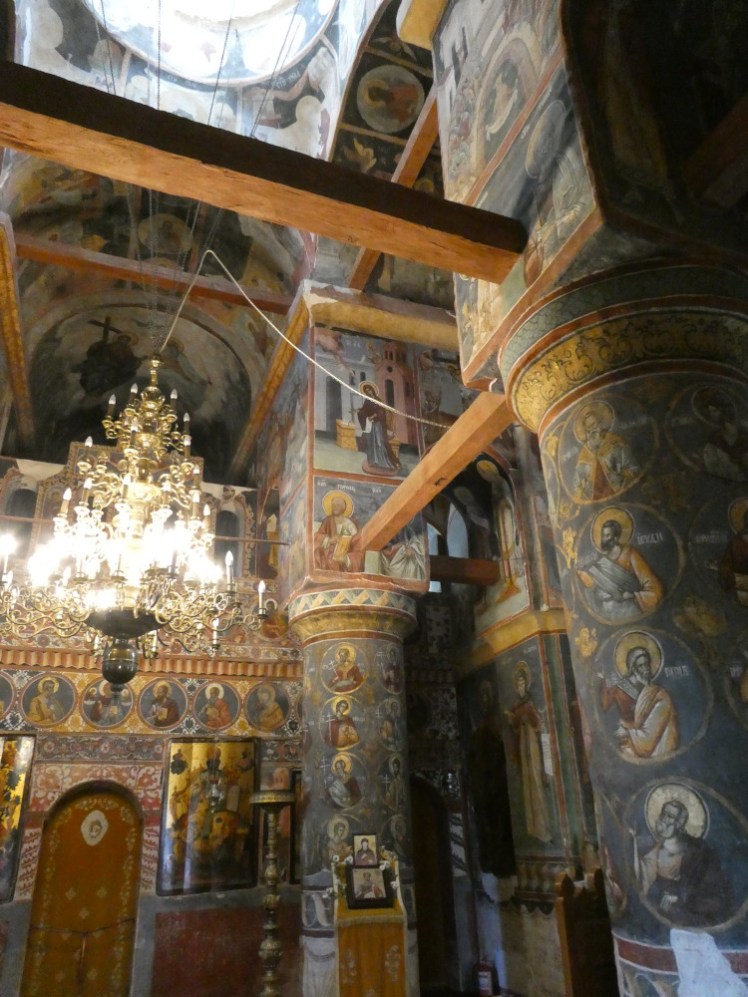
Like every Orthodox church I’ve ever been in, this one is painted from floor to the top of the lantern dome in saints and Bible scenes in vivid colours and lots of gold and lettering in an angular semi-Cyrillic font. How Romanian people walk in and quietly start worshipping astounds me – I walk in and stand there open-mouthed for at least five minutes in awe. I just think they’re so beautiful and I don’t often have (paid) permission to take as many photos as I want.
But I was here for a reason and that was the slab set into the floor. That’s the alleged grave of Vlad Țepeș, better known as Vlad the Impaler. The slab is completely plain but it’s got a little vase of flowers, a candle and a portrait on it. Minor issue: Vlad isn’t actually underneath it. Not that there’d be much left of him; he died in 1477 or even 1476 and even if his bleached bones were here, his head was supposedly taken to Mehmed II of Turkey to be impaled in Constantinople, the two having spent most of Vlad’s reign warring over Wallachia not bowing to the Ottoman Empire. But even without the head, there apparently is nothing under the slab but horse bones.

So I took my photos of the grave and the photo, selfies as well as pictures and tried to imagine a proto-vampire, or at least a cruel & vicious moustachioed 15th century prince. This tiny church certainly wouldn’t have the income it does if it put a big sign up by the bridge that said “NO VLAD HERE!” and I don’t begrudge £5.17 to take part in the story. Besides, it’s a really pretty church and it feels quite good to do something different that most tourists to Bucharest don’t do. Most non-Romanian tourists, I should say. Almost everyone I’ve seen in the travel creator world who’s been to Bucharest has gone from the airport to Therme București (and I did that, it’s the next blog, coming Monday) and straight back without even stopping in the city, let alone the grave of Romania’s most famous figure.

That’s about all there is to do on the island. I strolled out the back to enjoy the expanse of garden out the back and the intricate brickwork of the church – these Romanian-style churches are just as beautiful outside as inside and they’re stunning inside – but there’s not much island and everything but the church and the path seems to be fairly private land where it feels rude to just walk through fences and push past trees. There’s a very large house-like building behind the monastery, which looks very much like a recently-built house, whose owners probably don’t appreciate tourists walking up and peering through their windows.

But it’s nice to just spend a little while out in the fresh air, away from the noise of the city (if you ignore the constant drone of the helicopter), enjoying a pretty church and a legend before walking back across a bridge with views of an autumn wonderland and then taking the bus back into the busy city.

 I Am A Polar Bear
One thought on “I visited the grave of Vlad the Impaler”