There aren’t many secrets in Paris. With 30-50 million tourists coming to the city of love each year, there’s very little left that hasn’t been discovered, dug out and paraded on social media. But I have found one thing that I’ve never seen anyone else do, that I didn’t even know existed – the Ballon Generali de Paris.

Actually, my boss added it to my to-do list last time I was in Paris. I didn’t have time to do it then but I did this time. It’s a tethered balloon that rises up to 150m above the rooftops to give views you can’t get anywhere else and Wikipedia says it carries 50,000 visitors a year, which is only 136 a day. It flies every day from 9am to 7pm, so that’s less than 14 people an hour – which makes me wonder how it’s financially viable but it also means you’re not going to be crammed shoulder-to-shoulder like sardines in the balloon. There’s a similar balloon in Budapest and they take 30-40 people up each time, whereas there were nine of us on my Paris flight.

It’s in Parc André Citroën in the 15th arrondissement right down in the south-western corner of Paris, best accessed from Pont du Garigliano RER station or a stroll of half a kilometre along the Seine from the RER and metro stations of Javel/Javel-André Citroën. That means it’s only a mile and a half from the Eiffel Tower and while I admit that there are some buildings that cut off the lower half of the Tower, it’s still the closest place to see it from on high.

It costs €20 from the unimposing little kiosk on the north side of the park, at the end of the boardwalk that links the balloon, in the middle of the park, to the boardwalks that run around and across the grass. Then you take a seat in the waiting area and you’ll probably only have to wait until the balloon descends before it’s your turn to board. There are precious few places you can enjoy in Paris without a queue; this is one of them.

The “basket” is actually a circular gondola with two gates, a solid floor, solid walls up to about waist-height and a mesh up to well above your head so you can enjoy the views both outside the balloon and through the hole in the middle without any fear of toppling out, or children climbing out. The balloon is attached to the gondola by a lot of cables that come down into the middle with the steel cable coming right down to the winch in the landing pad and backup ropes running from the outside of the gondola up to the middle of the balloon.

You’ll go into the balloon and the pilot may move you around for balance as you take off, which is when the cable is let out. The balloon is filled with helium and it really, really wants to fly, so it’s locked down to the ground. Once you’re in the air, you’re free to move around to see the view from all angles. Now, I admit, the day I was there, it was quite windy. The balloon rotated quite happily all by itself so you could just stand still and the view would come to you, but for safety reasons, it doesn’t fly on really windy days. I suspect we were pretty much at the top end of what it can operate in, so it’s almost certain you won’t have it quite as breezy as I did.

150m is about the height of the second floor of the Eiffel Tower and Paris has a height restriction on new buildings of about 37m so as a general rule, you’ll be well above the rooftops. There are a few exceptions – the skyscrapers of the La Défense business district just west of the city, some residential buildings in the 13th arrondissement in the south-east of Paris and, unfortunately, the Front du Seine development of the 70s, right between the balloon and the Eiffel Tower. They don’t entirely block out the view of Paris’s most famous landmark from 150m but they certainly cut off the bottom third of it. Still, there’s more to Paris than the Eiffel Tower. It’s quite a surprise to discover Paris has gentle rolling hills around most of its horizon and how green it is, especially along the riverbank.
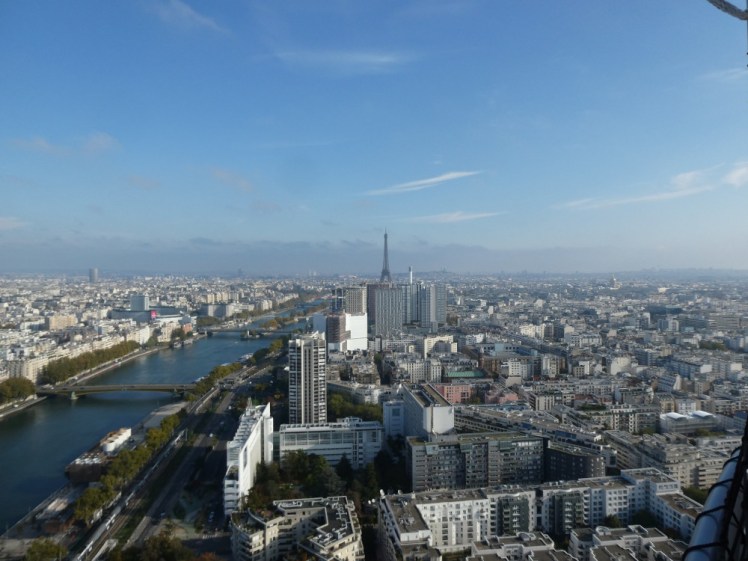
For scientific flights – because this isn’t just a tourist viewpoint – the balloon can get up to 300m, which would make it the second highest point in the entire city, just 30m lower than the top of the Eiffel Tower, but I’m not sure tourists get to go on those flights. It calls itself “a veritable flying laboratory” which measures atmospheric pollution and greenhouse gases. Apparently it’s an “excellent tool for raising awareness of environmental issues” but given that I’ve never heard of it and how few people are using it, I wonder how much awareness it can be raising. Maybe I’m just being hideously Anglo-centric and the entire rest of the world, or at least France, is very aware of this balloon.
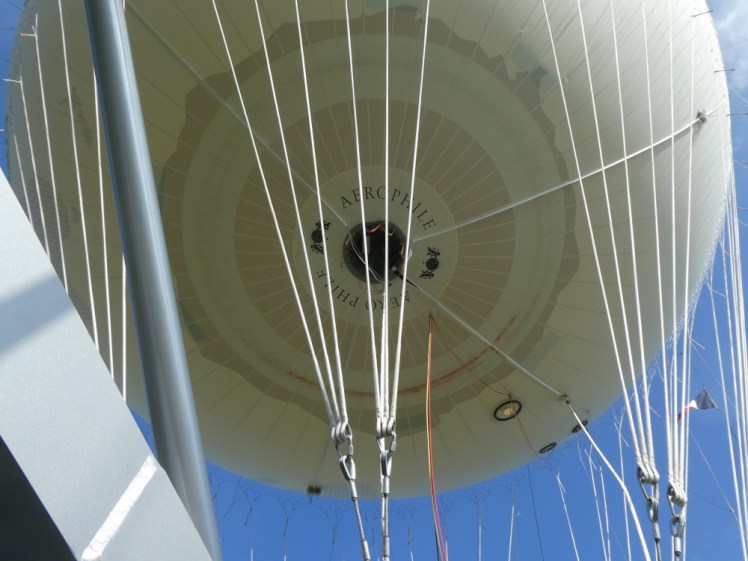
It takes about 20 minutes and it descends so slowly and gently that at first you have to look at things like the Eiffel Tower to realise you’re beginning to see it from a different angle. Landing for us was quite uncomfortable – as I’ve said, it was breezy and the balloon was being blown off its direct downwards course. The landing pad is a kind of flat-topped cone and it has wheels all around the gondola so it doesn’t crash down onto solid ground, but you’ll want to be hanging onto something when it touches down. For us, it touched down on one side while the other tried to lift up and away and it took quite a bit of pulling from the winch to get all the wheels down. If that sounds unnerving, stand and watch a landing before committing to a ticket and come back on a calmer day if it looks a bit bouncy, but if it’s truly too windy to be safe, the balloon just won’t fly. The French are pretty safety-conscious.

And on a calm day, I don’t think there’s a better way to see Paris from above.
 I Am A Polar Bear
One thought on “The best kept secret viewpoint in Paris”