Now, this is a hidden gem in Kraków, if you’ll excuse the cliche. The Owls’ Cave is Kraków’s newest attraction, having been there less than seven weeks and not only is it a great way to escape the rain, it’s also a fantastic thing in its own right. The owner, Michael, is an experienced falconer who’s been running these kind of shows and educational experiences out in the countryside for years but now (let’s be honest, for financial reasons) he’s bringing it to a bigger audience in the heart of the big city.
The Owls’ Cave is on Stolarska, just a three minute walk from the main square, perfectly positioned about halfway up the street on your left if you arrive by tram at Plac Wszystkich Świętych. It’s an unassuming place hidden away underneath the street, a literal cave – or rather a cellar, which makes it ideal for birds with sensitive hearing but it’s very easy for human passers-by to miss. There’ll be a sign in the doorway, you go in and down the stairs and you’ll find the Cave at the bottom.

I don’t know if the setup I witnessed was the everyday set up or if you’ll find something slightly different, especially as it gains traction. One cell-like room has been converted into an aviary for a pair of African Spotted Eagle Owls, so they can fly around or sit around as they please, when they’re not being presented. In the main cave, a barn owl, a kestrel and a Harris hawk sit on perches and then a second Barn Owl and a Peregrine Falcon live out of sight around the corner in what will be the gift shop, when Michael has any gifts to sell. The two barn owls don’t particularly get on – the four-year-old male is intimated by the six-month-old female, as female barn owls are dominant, so it’s less stressful for him to keep them out of sight of each other.
In case you’re concerned about them being tied to perches, birds of prey don’t spend their entire life hunting. For conserving energy, they very much prefer to sit and wait for food to come to them and although Michael brings them food, even in the wild they’d spend far more of their time sitting than flying. They get flying time and they get exercised but if they were loose here, that would be dangerous to both birds and visitors – not least because there’s a hierarchy of birds and they would literally kill each other if they could get close enough.

Michael has a presentation, in English, that lasts somewhere between 45 minutes and an hour, introducing the birds, talking about each particular bird in turn as he brings them out, the species, the art of falconry, and if the birds are in the mood, you get to hold them. Falconry is an ancient art and sport – people have been using birds of prey to hunt for about as long as they’ve been hunting. Once upon a time, there were even rules about which people could own which bird – sparrowhawks for clergy, merlins for ladies, buzzards for baron and all the way up to Golden Eagles for emperors. If you’ve ever read The Sword in the Stone, the first book in TH White’s Once and Future King, you might remember the scene where the Wart spends the night in the falconry in the form of a merlin, learning about all this.
If there are two things you should take away from Michael’s presentation, the first is that he really knows and respects these birds. If a bird isn’t in the mood to be handled, it’s not handled. They’re looked after well and most of them adore him – see the way they interact with him compared to strangers. The second is that, no matter how cute the barn owl, birds of prey make terrible pets. It’s kind of a rolling presentation, in that if you walk in right in the middle of it, you just start from there until it gets back to wherever you walked in.

In an ideal world, the true presentation would be if you were to walk in and find the Cave empty and Michael waiting for you and it would start with a barn owl. As I said, there are two. The British barn owl is the older male, who is the white owl you’ll probably be familiar with. The younger female, Payton, is a European barn owl and she’s a lot more orange-tinted around the front. She’s also quite like a cat. She’s been raised in Michael’s house and is used to hopping around on tables and sofas and hiding under cushions with the kids so although she’s quite happy to be held and stroked, when she sees a table, she wants to fly down and hop around. She’d recently learned the art of hunting, so she wanted to show that off with the gloves and demonstration feathers on the table and just generally made herself adorable like a half-grown kitten. The demonstration feathers are to show the physical differences between a barn owl feather and feathers from other birds, to show how and why they’re so silent in flight but by the time Payton’s hunted them a dozen times, there’s probably not much of the feathers left.
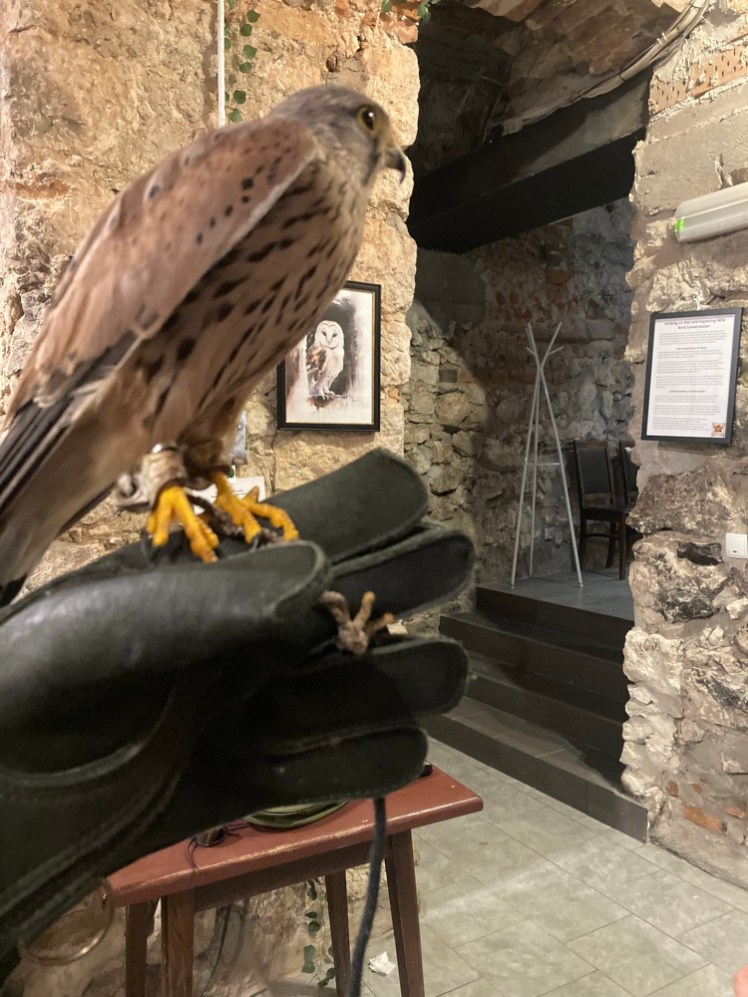
The second bird was Stockton the kestrel. He’s small for a male kestrel, small enough that he probably wouldn’t have survived in the wild. Not that any of these birds know anything about the wild – it’s illegal to take birds of prey from the wild, since about the 80s as far as I can see, so they’re all bred in captivity. Reputable breeders should sell only to people who know what they’re doing with the birds and have a suitable place to hold them, so I couldn’t go and buy one even if I wanted to. I asked, with a particular figure in my brain, how much it would cost to buy a bird like this and he said that in the UK, you could buy a barn owl for £80. £80 is unhinged. No wonder the Harry Potter fans in the early 2000s all managed to get owls before realising that they’re not quite like hamsters. I was expecting several hundred at an absolute minimum. Don’t go and buy an owl! Michael has ten birds – the others are at his house in the countryside and I don’t know exactly what they all are but one is a Great Grey Owl, which looks enormous but is mostly feathers and has a permanently scandalised expression. I’d been trying to imagine the sums of money involved in acquiring ten birds of prey but apparently it’s nowhere near as bad as I expected, although the website does detail how much it costs per month to feed each one – about 50zl (£10.24) to feed a barn owl and 150zl (£31) to supply all its needs. Multiply that by ten birds, most of which are bigger than the barn owls and it’s not a particularly cheap hobby. Not for the average, inexperienced person.
Stockton is the one bird Michael doesn’t entirely trust and who doesn’t entirely trust him. He has days when he’s as friendly and amenable as Payton but he also has days when he hates everything. While the other birds are allowed to go off and play at hunting in the fields (they know where their food is coming from, so they’ll always return to Michael), the kestrel is strictly an indoors flyer. He’s perfectly content to stand on your hand but unlike the owls, you can’t stroke him. Just stand there and look at him and be amazed that the bird that can hover and then dive is as tiny as this.

Up third was LeBron, the Harris hawk. LeBron is the biggest of the birds and in the last couple of weeks, he’s been moody. It might be moult or it might be that he’s a little heavier than his ideal flying weight, which apparently makes birds of prey bad-tempered. He’s always been a perfectly affable chap before that but when I was there, between his size and his moodiness, Michael decided that children weren’t to hold him today and adults should have a think about it before deciding they want to. So I had a go, as long as LeBron was willing to do it. If that enormous bird had shown any signs of reluctance to step onto my glove, I’d have backed off but he didn’t mind, in a slightly scowly way. He’s a terrifying bird up close, especially when you’re warned to not look him in the eye. He tightened his claws on my hand, which you can’t feel through the glove but you can feel the pressure and you really remember that birds of prey kill using their talons and they just use the big curved beaks to tear the prey apart, another thing they point out in the Sword in the Stone. I have no doubt LeBron could do me some serious damage if he wanted to. He’s utterly magnificent and very intelligent. He uses his off time, on his perch between presentations, undoing the knots that hold his jesses onto the perch. Most of the birds get tied with one knot but LeBron can undo one and a half knots so far, so he’s triple-tied.

Fourth up was Malone, the peregrine falcon. This is another terrifying one, much bigger than you might expect for a bird known for being the fastest animal on the planet. Imagine this thing dive-bombing you at 200mph! Malone was a little twitchy, which is why he spends the day out of sight of the presentation and the other birds but falcons can be calmed in an amazing way by being hooded. I’m not sure I’d immediately go calm and placid if something was put over my face but it seemed to work for him. When he’s unhooded, he looks around in a sort of disinterested way, where he’s no doubt taking in every detail of the room.
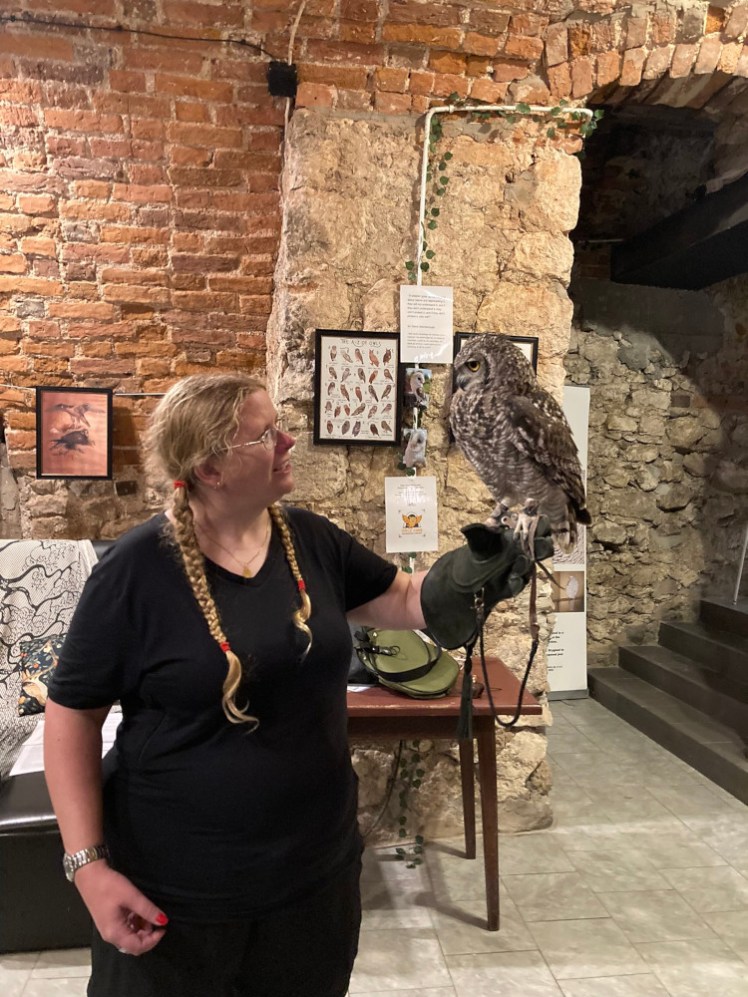
The last bird was actually my first one, because I walked in right at the end of the presentation, and it was the African Spotted Eagle owl. Michael has two eagle owls, Hakeem and Mutombo, and this was the less friendly of the two, which I think was Mutombo, who needs to be socialised, to meet new people and learn not to be scared of them. A family with two children came in during my turn at the presentation and as I was leaving and sticking my head into the aviary, Michael came to collect an eagle owl for them and opted for the more friendly one this time as more appropriate for the children. The grumpy one was a little inclined to hiss and click at me but if he’d pecked at me, it would have been a fairly painless nibble – as I said, the beak isn’t the main weapon of a hunting bird. The owls were ok to be gently stroked but the eagle owl, in four years of educational visits, had never encountered painted nails and was deeply dubious about my bright red ones. He’s a large owl with huge scary eyes but as long as he’s just staring and hissing and not actually attacking the red nails, I can cope with that. Another reminder that these things don’t make good pets. Payton the barn owl was adorable. I can see why people would want a barn owl but people, stick to hamsters and cats. You don’t want to be feeding dead mice to your owl or trying to exercise it.
So that was the show. I daresay it would work better and Michael would like it if there were set times and people came in at the beginning but I know that if I’d seen “show starts at x o’clock”, I’d have looked at my watch and sighed and decided that I’d be on the other side of the city by then or would need to be on my way to the airport and I’d have missed out. So it’s currently a rolling show as and when people wander in. It’s a great activity in its own right, and if Google Maps hadn’t been a bit vague about what it actually involves, it would have been on my list of things to do in Kraków right from the start instead of stumbling across it towards the end of the weekend. But it’s also a good thing to do if it’s pouring with rain – as I know from experience, if it rains and you want to do anything other than shelter in a cafe, you’re a bit out of luck because everything is outside. Well, come to the Owls’ Cave, get to know a bit about the falconer’s art, meet the birds and if they’re in the mood, you can even hold them!
 I Am A Polar Bear