I went to Kraków on a bit of whim because there were cheap flights from a nearby airport rather than any pre-existing desire to go to Kraków but it didn’t take a lot of research to discover that it’s just up the road from an enormous salt mine which you can visit. I’m absolutely a dwarf; I love being underground, I love the dark and rocks and the moment I saw that mine, I knew I was going there.
You can buy tickets at the mine, either from the machines or from the ticket desks but in this day and age, it’s always wiser to buy online in advance. In my case, I’d decided to get there early. Of course, 10am by the standards of Wieliczka Salt Mine is not early at all – the mine opens at 7am and the earliest tours I can find are at 8.30am. There’s a bus which goes straight to the mine door and happens to stop a three-minute walk from my boat hostel or if you’re up in the Old Town, there’s a direct train.

The tours run in eight languages and about ten minutes before your tour is due to start, you go and join the queue by your flag under the marquees that protect staff from the weather as they hand out audio guides. Each tour can take up to about 35 people and it’s hard to gather that many people closely enough around a tour guide to hear, so the tour guide wears a microphone and the group wears a receiver. The bright green LCD channel number also functions as a group identifier – the groups could be just five or ten minutes apart and so it’s useful to know that you’re with group 33 and not group 32 when they inevitably meet in the same chamber. Apart from “the mother” who scared our tour guide by wandering off with the wrong group at the snack stop. Snack stop? Oh yes, you’ll see…
I booked my Tourist Route ticket before noticing the website claims there are 800 steps to climb, which seemed at odds with reassurances that you only need to be of average fitness and that you’re returned to the surface by an elevator. Reading reviews fairly frantically, it turned out that you descend those 800 steps and that they’re scattered throughout the three-hour tour so that you don’t feel like it was that strenuous.
Well, you start with 320 of those 800 steps. Straight through the door and straight down 320 steps. You descend 40 floors of 8 steps and a 180° turn at each, so the number of steps is less a problem than the fact that you’re spiralling round and round for forty floors. It’s definitely the most strenuous part of the tour and someone like my mum wouldn’t manage it but it’s a lot easier than climbing those 320 steps and after that, it’s mostly a gentle stroll.
At the bottom of those 320 steps, you reach Level 1. The tour takes you through three of the thirty-ish levels – apparently to explore the whole mine would take about nine months and I suspect, even for a speleophile like me, it would get a bit samey. Tourist Route tours visit about 3km of the total 300+km of mine passageways. A certain amount of it is plain corridor, supported by wooden pillars, which are constantly being repaired and replaced. There are a couple of sections where the wood dates back to the 17th century but there was also a corridor where the wood had been replaced just a fortnight earlier and smelled brand new. The mine doesn’t operate anymore, not as a mine, but with literally thousands of tourists coming through every single day, it’s more important than ever that the mine remains safe. Another part of the safety protocols is the system of ventilation doors, where you can’t open the second one until the first one has been closed. “Ah, you mean an airlock,” I thought. But it’s not as simple as that – when one of the doors is open, some kind of ventilation system of fans hums loudly behind the other. I don’t entirely understand how it works but it keeps fresh air flowing in a way that I’m sure it never did in the majority of its mining years.

Those are two of the three major hazards of salt mining – collapse and lack of oxygen. The third is hazardous gases, which can cause explosions. Experienced miners willing to take their life into their hands for their fellows used to go along with flaming torches to burn off the gases but now that the mine isn’t operating, and is open merely as a tourist attraction, I assume any existing gases are long gone and there’s nothing happening to release new ones, so I’m going to naively assume that that’s a hazard we no longer have to worry about.
Between the passages are the two things of real interest – chambers and chapels. The chapels exist because mining was so hazardous that the miners needed places to pray and be prayed for and some of them are incredibly elaborate. They all have massive chandeliers made of salt crystals and those crystals need to be replaced regularly – the humidity in the air means that the salt crystals dissolve fairly quickly. The chapels generally have carvings and decoration – they’re not just chambers with chandeliers and a cross and the biggest one on the Tourist Route is used for Mass every Sunday at 7am – you arrive by elevator rather than expecting worshippers to hike down 320 steps and an hour of passageway first thing in the morning. I did not opt to be up quite so early on Sunday morning, although I bet it’s quite a sight.
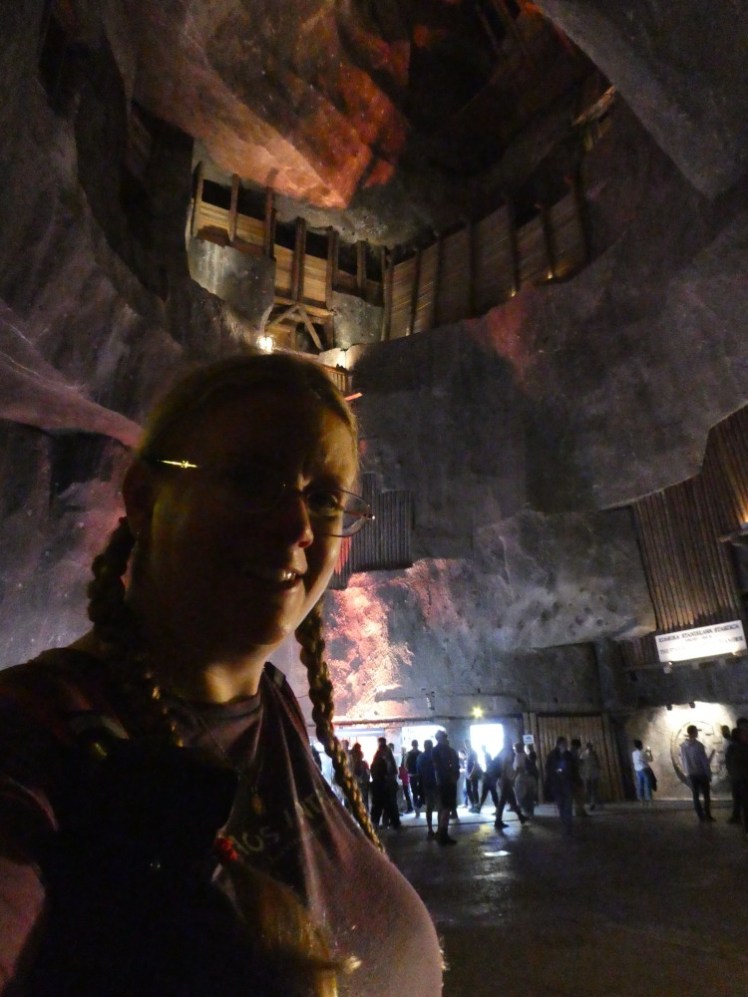
The other stopping places are chambers, large areas, often two or three storeys high, where enough salt has been removed to create a large room. Our tour guide pointed out at least twice that chambers are carved out from top to bottom, which seems logical, when you’re starting from ground level and working downwards towards the bowels of the Earth. It’s not that these are less interesting but they’re less elaborate. They’re literally just places where the salt has been dug out. Some of them have staircases carved up the side, although we didn’t climb up any of them.
Three of them have salt lakes. They’re deceptively deep – one of them looked shallow enough to stand in but was apparently eight metres deep. Not that you need to worry about drowning in it; we were told that if we wanted to taste it, we could (other than that there’s no way you can reach it unless you had the forethought to bring a jug and a string) but it’s really salty, which means you’re not going to be able to do anything other than float, and it’s also dirty. The salt, in the upper levels of the mine at least, is dark grey. That’s impurities – mud, rock, general dirt. Probably not helped by decades of tourists passing through. We were told we could lick anything we liked as long as it’s not electrical but although some of us dragged our fingers along the ceiling and licked that, we all opted not to lick random walls. “Salt is antibacterial” is not strong enough evidence to want to lick a wall that millions of people have been licking for hundreds of years.
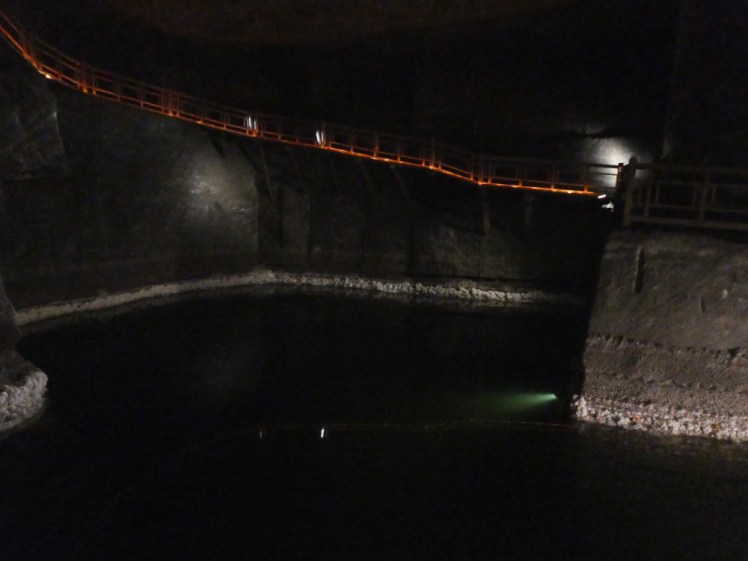
Those lakes are curiosities now, their deceptive depths reflecting lights in a very tourist-pleasing way, but water was another massive hazard back in the mining days. Water dissolves salt, so it was another major collapse risk. There were miners whose entire job was to pump water out. There’s a lot more to mining than just strolling around with pickaxes, whistling as you work. Even now, when the mine is no longer mining, it still employs nearly 400 miners. A void that size underneath a town takes maintenance, especially when it’s a) one of the biggest tourist attractions in the area and b) on the UNESCO World Cultural and Natural Heritage List.
One cavern – well, probably many but we only saw one – was a stable. Mines use horses and because the only way in is to be lowered down a shaft on a harness, this was only ever inflicted on a horse once. On the other hand, the way to avoid winching a horse up and down every day was for it to live down here. In the days before heavy mechanisation, horses turned capstans to raise and lower heavy things and pulled carts full of heavy things. Not a great life for a horse. The mine ceased mining in the mid 1990s but the last horse remained down there for another decade. Whether this was because it was less traumatic than hoisting her out or whether it was because there was still work to do, I don’t know. As of the mid 2000s, there are no horses in the mine and the miners manage without them.

There are two highlights on the Tourist Route. The first is St Kinga’s Chapel, a cathedral among underground chapels, the one where they hold a weekly Mass for anyone who cares to turn up, with a gallery and carvings around all four sides and a salt sculpture of Pope Jean-Paul II, a local boy who came to the mines during his time as Bishop of Kraków. Any celebrity of any kind who comes to Poland ends up visiting the mine. This is the bit that the tour guides are most excited to show off – after walking through wood-supported corridors and vast empty chambers, this is an incredible thing to walk into. I am not the sort of person who shrieks and cries but even I said “Wow…” out loud as I looked down at it – you approach it from “upstairs” so you get the full effect immediately.

The second highlight is actually after the tour ends and it’s the restaurant 135m below ground. It’s not the only opportunity for a snack; there’s a chamber about halfway through which houses a souvenir shop, small event space and a kind of miniature convenience store, but it’s the most impressive. It’s really just a kind of cafeteria, not unlike the restaurant inside most Ikeas, but it’s still an amazing thing to have a proper hot meal and a beer this far below the surface. And then you think again and you realise that while it’s a great novelty to be eating down here, an industrial kitchen at this depth is actually the impressive bit. Supplies being brought down, the plumbing to run the dishwasher, the fire safety risk assessment must probably be seen to be believed, the venting of steam and smoke, all at the depth of the London Eye if it was turned upside down and placed in the ground. Actually, when you look at the London Eye, you suddenly feel as if you’re not as far below ground as you thought you were.

Next to the restaurant is the large event space, a ballroom with lots of tables and a salt-carved stage apparently big enough for a symphony orchestra. That’s all roped off to the general public; you can just stick your head in as you head to the lift.
Oh, the lift! Yes, it’s nice to be carried the 135m to the surface but it’s still quite a trek from the meeting point to the lift – at least another 20 minutes of walking, and with whichever tour guide is handy and no audio transmitter. You pass by/through the museum area and then we got caught up apparently with a group descending, even though I could swear both that tour guide and that group were queuing with me for the lift. When we did finally reach it, there were 8 of us too many for it, despite having been counted through the gate and the guide had to send the lift at capacity and wait downstairs with us, since tourists can’t just be left unsupervised in a mine.
There’s another gift shop at the top – exit through the gift shop, obviously. I invested in a tub of bath salts and a little bag of rock salt, although I had to buy them from the kiosk back at the start with cash after the entire card system suddenly failed.
If you want a slightly different, slightly less conventional, view of the mine, there’s the Miner’s Route, which is shorter than the Tourist Route, during which you wear overalls, a helmet and headlamp and a carbon monoxide absorber, which sounds slightly terrifying, and you get to do a little bit of gentle mining work, like shovelling, reading maps, weaving ropes and measuring methane concentration – I take back my earlier naive assumption that there are no explosive gases left in the mine. This is something I’d like to do if I find myself back in Kraków but for a one-and-only trip, I think doing the big Tourist tour is a better way to get to know the mine.
The second part of my tour was a visit to the Graduation Tower, which is a three-storey tower and a two-storey wall enclosing a courtyard. The wall is covered with blackthorn and a system of troughs and locks lets saltwater drip down through it. It’s supposed to create a salt mist in the courtyard, which is good for mind and body. As someone who’s always lived within twenty miles of the sea, the so-called mist was decidedly underwhelming, although I enjoyed the views from the tower and the walls. I probably wouldn’t pay the extra for it next time.

I’ll leave you with my top tips for visiting Wieliczka:
- Arrive as early as you can
- Book online in advance
- Wear shoes you can comfortably walk 3km and descend a lot of steps in – there’s a lot of walking
- It’s not actually very cold in the mine – the ventilation system ensures it remains the same temperature all year round but on a hot sunny day in September, I went in just a t-shirt and I’d removed the legs of my hiking trousers to make them shorts and I was never cold.
- Figure out how to turn off your flash before you try to take photos
 I Am A Polar Bear
One thought on “Exploring Wieliczka Salt Mine”