It’s been a while since I added a new instalment in the Journey to Paddlesport Instructor series and that’s partly because there’s been no major step forward for a while and partly because I have an entire separate paddling blog now (I’ll admit it at last: I’m plotting to become one of Paddle UK’s #ShePaddles ambassadors). But this blog also exists and this series exists on this blog and today I want to talk about it.
I did it in Portland Harbour – the original Portland, the island “carved by time out of a single block of stone” off the south coast of Dorset. Portland is an extraordinary thing, a kind of teardrop shaped island which visibly slopes steeply away from the highest point at the landward end until it slides away into the water at Portland Bill, attached to the mainland by Chesil Beach, a massive bank of pebbles that stretches around seventeen miles to the west, enclosing the Fleet Lagoon behind it. I spent a lot of time on Portland as a graduate, because I had nothing better to do and Portland has a network of caves especially around its Westcliff area. But I’ve never really been near the sea – well, in as much as you can “never go near the sea” on an island four miles long by a mile and a half wide. The most obvious place for a tourist to encounter the sea on this sheer-sided rock is at the Bill, and Portland Bill is famous for its lighthouse which is there because of the incredibly dangerous tidal race, so you’re not going to get in the sea down there.

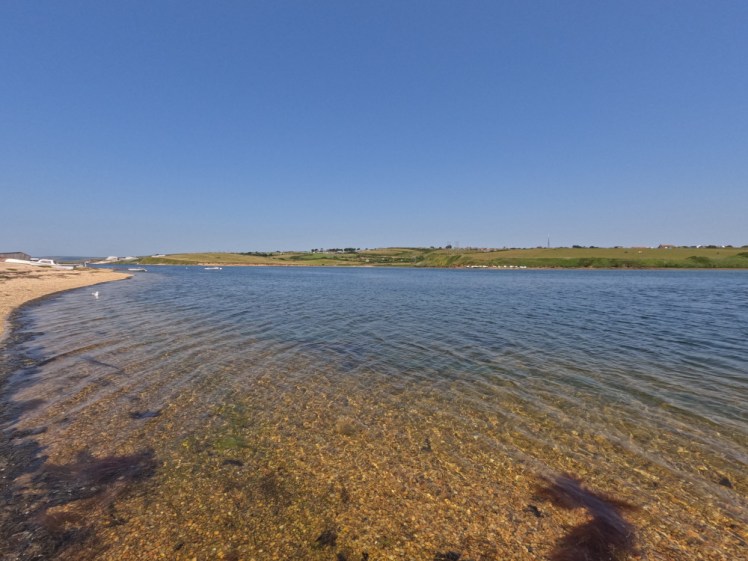
However, there’s a bit of a curve between the land, Chesil Beach and the causeway road on the east side, where breakwaters block out a large area of fairly tranquil water at the Harbour. This is where the Olympic sailing events were held in 2012 and there are half a dozen outdoor activity providers on and around the edge of the harbour.
So there I was at 9am on a Wednesday! This was last week, as the heatwave began to gear up, which is a good time to be on the water but maybe not such a good time to be wearing a wetsuit on dry land. Our instructor Paul started with the land-based theory – talking to the group in the guise of being friendly while actually ferreting out previous experience and transferable skills, looking at kit, introducing us to the boats we’d be using for the next two days, doing the safety briefing and then, eventually, launching into the harbour.

I’m doing this with a vague and fuzzy idea of one day being able to run our boat club sessions. Paul’s session started with all of us launching and then him testing our pre-existing skills by playing some games. For me, this is utterly alien and impossible: many of the Guides simply do not have pre-existing skills. We would start a session by seeing who freaks out on the water and who starts going round in circles and teaching skills by playing games is something we might achieve by the end of the session, not the beginning.
Paddle UK’s qualifications continue to bemuse me. This one feels like a qualification that’s easier to achieve than Paddlesport Instructor or Coach, which were the ones I looked at initially, and yet this one also feels like a higher level qualification. Then I had a look at Girlguiding’s paddlesport requirements – which are not the same as Paddle UK’s, the governing body! – and they had a pdf linking the old qualifications to the new and updated versions. As far as I can see, Paddlesport Leader is basically a new name and tweaked syllabus for Touring Leader, so it’s going in assuming a certain amount of competence on the part of the group and a certain amount of experience on the part of the leader. Is it the ideal qualification for teaching ten-year-old not to paddle in circles? Literally probably not but at the same time, it doesn’t hurt to possess it and I believe Girlguiding would consider it a high enough qualification that it’s absolutely definitely fine to run the boathouse with it.
But that’s all in the future.

We spent two days paddling mostly around Portland Harbour practicing leading and practicing incidents. Paul had a route and a plan but we were given a turn to lead the route and he threw incidents at us as we went around. There’s positioning – if we’re taking the group through the Mulberries, which is a pair of concrete blocks meant as part of a wartime harbour to be towed over to France (many of the Mulberry project blocks did make it over there and are still there but two of them are in Portland Harbour), does the leader go through the narrow gap first or last? Which side of the group do you paddle as you’re crossing to the harbour wall? Where’s the best place to see potential hazards but also see everyone in the group? Then there’s hazard perception – during my turn, I found myself narrating everything that moved on the horizon, even if it was just “there’s a yacht coming towards it but it’s so far away that we’ll be long gone by the time it gets to where we are”, which shows Paul that I’m aware of potential hazards and he doesn’t have to worry about whether I’m just saying nothing because it’s irrelevant or whether I’m oblivious.
As for the incidents, I think the first one was Paul smashing his head open on a gangway as we paddled into the marina. This meant we could practice supporting an incapacitated paddler, various tows, emergency calls and knowing exactly where we were. Leading a quick run across the harbour entrance, where slow-moving kayakers don’t want to be straggling when a motorboat comes flying or or out, he lost his paddle. On day two, he got caught against the stanchions of Ferry Bridge – we knew that one was going to happen because freeing a trapped boat was on the syllabus but the harbour has virtually zero flow to get trapped in and if it was going to happen, it was going to happen under the bridge. On another of my leader segments, he got one of the group to jump out and then pushed the kayak away. We’d covered rescuing a paddler and getting them back into their boat but this was a paddler separated from the boat. Rescuing the paddler was fine – I’ve done this on a few occasions at the boathouse (“hang onto my kayak, swim around to the front keeping hold of it, then hang onto the front like a koala”) but the rescue back into the boat was a little more complex in that we were already pretty close to the beach and we had an onshore breeze. In real life, you’d just go to the beach and get back in the boat on solid ground but for the purposes of training and assessment, you have to be able to do it in deep water, so we had an anchor tow from one of the other group members to keep us in water barely deep enough to stand up in.

What other incidents did we have? Well, we paddled into the Fleet Lagoon via the aforementioned bridge, where Paul became dizzy and ill from lack of water and too much sun, whih was a variant on the head injury but without a marina right there, so support, tow and call the coastguard rather than the ambulance. We had a paddler capsize just as the first half of the group was going under the bridge – a tricky place since it’s the only place with flowing water on the entire training.
You get the picture. On day two, we were all given part of the job of getting the day started – I had the warmup, someone else had the safety briefing, someone else had personal kit, someone else had leader kit, we ran a few skills-testing games and then we headed out on our journey to the Fleet Lagoon.
But on Wednesday afternoon, we did some rescue practice. Paul had brought a canoe and a SUP so we could practice rescuing each of those but I was stuck with self rescue because it’s something I can’t do! It’s deeply frustrating, that I can’t get myself back into my own kayak without being bodily hauled back in. We tried a few methods – the heel hook just doesn’t work and neither does slithering up and over the back deck, or even swimming up the back end like a frog. It’s a pretty key skill – an instructor who can’t get herself back in her boat is a liability. I’m already wary of going for assessment on all the stuff I can do, but until I can consistently and comfortably self rescue, assessment is unthinkable.
I did finish with a couple of surprise triumphs. Paul produced a padde float, which is an inflatable bag you put over your paddle. You then put the other end through the decklines on your kayak and it acts as a stabiliser (and potentially a ladder) to be able to climb back on without tipping the boat over. Sure enough, I didn’t tip the boat over – but I didn’t get back on it either. Paul used my sling to tie a complicated improvised rope and footloop and that didn’t really work either and we called it a day when I scrambled back up with his assistance. Not “hauled in by my buoyancy aid” but not 100% by myself either. About 70% by myself. Meanwhile, he was also teaching “Hand of God” to the rest of the group – that’s flipping a kayak with an unconscious paddler hanging upside down underwater. I tried and failed miserably on my Paddlesport Safety & Rescue course a couple of years ago, utterly miserably, and many, many times. But this time, perhaps with a little more effort than is ideal, I managed it first time. You lean over, push down on the closest side of the casualty’s kayak and pull the furthest side. Of course, once the closest side is under the water, you need both hands to pull the other way (or at least, I do – a proper action hero makes it look as quick as a karate chop) and that nearly slipped and took longer than ideal. But it worked. Then Paul had me back out of my boat and trying it from the water, because sometimes leaping out of your kayak and doing it from the water is the best way. So I tried the method of basically throwing myself across and pulling backwards and that worked ok. Paul prefers the method of pushing and pulling simultaneously so I tried that too – kind of like jumping on it and jumping across it at the same time and he was right, that worked a little better.
Was it because Paul was using a long thin sea kayak for this practice rather than a relatively short wide one like we had on the river on my last course? Or is the buoyant sea water helping me here? Or is it – as Paul suggested with that certain grin – that I had a better instructor? I don’t know, but after failing time after time after time last time, I succeeded three out of three times. It’s now Sunday and this happened on Thursday afternoon and I should be over the moon about it and I think some part of my brain just doesn’t entirely comprehend that I did it – or maybe that part of my brain just isn’t capable of being as loud as the part of my brain that’s shouting “yeah, but you can’t get back into your own kayak!!”.

The next steps… well, I told them about it at the boathouse on Friday. We have our own tame instructor and it turns out he runs regular pool sessions so when I’ve got a Saturday or two free, and when I feel a bit less dented both in muscle and in mind, I’m going to email him and go along to the pool and practice self-rescue in nice warm, clear, clean pool water. Being able to do a thing in controlled, pleasant conditions is a good start to being able to do it out on the sea. That’s how I practiced just plain capsizing, which is still something I seriously do not love, being in the water and especially being in the water upside down.
Am I going for assessment one day? Oh, I don’t know. The one thing I keep wondering out loud is “why am I making it my problem to get qualified?”. There are two people at the boathouse who are far more experienced than me, who come and help far more capably than me and they’re neither qualified nor have any intention of doing so. Why can’t I simply be one of them? Yes, we need someone else who can run the sessions: why am I taking it upon myself to be that person? Why can’t I just enjoy what I’ve got?
Well, because getting trained is a good thing – upping my own skills is a good thing, seeing what other people and other instructors do is a good thing, getting official updates is a good thing. But taking that to assessments and qualifications? Well, we’ll see.
 I Am A Polar Bear