It’s that time of year! My beloved outdoor pool is open again for the summer season and I’m going to swim – my primary semi-formal exercise of the year!
I’m not a gym girlie and never will be. I’m not a “girlie” of any kind, come to that. But no, I don’t go to the gym. I walk at least 2km a day every day (not missed a day since 1st May 2020!) and in the summer – when I’m not too busy with Guiding and kayaking – I swim. For a few years, I swam twice a week for as long as the outdoor pool was open, then I started losing two nights a week to Rangers and Brownies and irregular nights to boat club and was lucky to manage once a week. This year, I’m having a go at twice again.
The kit
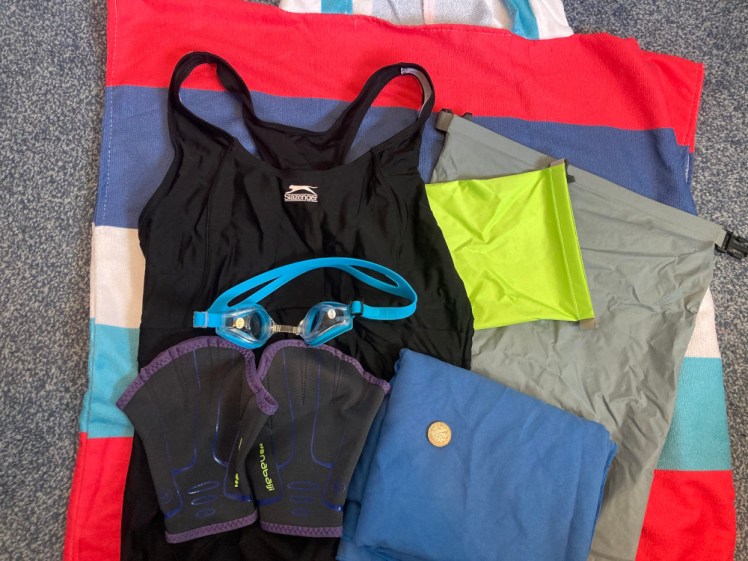
There are five things I use for swimming, only one of which is really necessary.
A swimsuit
That’s all you need, really (unless you come to my pool between 7pm and 8pm on a Tuesday…). Mine is from Decathlon and it’s the first swimsuit I’ve had in years that has survived a single season. They tend to get stretched out and go thin and see-through. Good suit or is it the new chlorine-free filtration system?
Goggles
Depending on how your eyes cope with water and what your eyesight is like, you might or might not want goggles. I rarely actually use mine: they spend sunny evenings on the edge of the pool while I wear sunglasses and they spend more time on my head than on my eyes when I do wear them, because they fog up really quickly. On the bright side, they’re prescription, which is a game changer for those of us too shortsighted to see the far end of the pool.
Training gloves
These are the equivalent of the flippers/fins you wear on your feet; neoprene gloves that give you proper webbed fingers and make it feel like you’ve shifted your arms into fifth gear from the second you get in the water. You absolutely don’t need these but I’m an upper-body swimmer and they make me feel like a shark.
Watch
I care about how many lengths I’ve done and I’ve spent years carefully keeping count. But it’s very easy to lose count and it’s very difficult to think about anything else. I’m not ready to invest in a smartwatch or a GPS sport watch so I dropped the princely sum of £10 back at Decathlon for a waterproof watch with a stopwatch and a lap button and spent six months learning to remember to press it at the end of every length. Getting better at that!
Kickboard
Or as we called it back when I was having lessons, “a float”. My legs don’t like joining in the swim so I bring a float along to ensure they have no choice. Most pools have a pile you can borrow.

The routine
My delightful local outdoor pool runs hour-long lane sessions. Whether you actually get that hour depends on how long it takes to get people out after the previous session and whether the idiot lifeguard can recognise a massive knot in the lane ropes before they start dragging them up the pool. After a few years, I know roughly what I can swim in that time – dependent, of course, on whether there’s anyone in your lane going annoyingly slowly and refusing to let you pass at the end of a length where you’ve almost been hanging onto their feet.

I’m out of practice right now because it’s the beginning of the season but in a week or two, I’ll be able to swim a mile in around 50 minutes. That’s a little over 70 lengths of my 25-yard pool – yes, not working in metric is hard for someone who cares about their distance! Since I can’t swim 0.4 of a length, it’s effectively 72 lengths (I’m not getting out at the deep end after 71!) In previous years I’ve cared deeply about whether I manage a mile and whether the season’s average stays above a mile but now I’m trying to just enjoy a good swim for as long as the time available.
The reason is that I’m really petty. My boss is a Serious Swimmer, who swims year-round in an unheated outdoor 50m pool. A few years ago, we were talking about my swimming and he asked how many lengths I swim. Around 70, I said. I heard his brain do the mental maths and then the mental readjustment of his idea of my swimming ability and then he said “So, about a mile. I did a mile yesterday and I was exhausted afterwards”, which meant it was my turn for some mental readjustment. Anyway, ever since then, I’ve made a point to hit a mile every time while not being exhausted. Not brought up the subject since but I know.
So, what do I actually do? I swim sets of ten lengths without pause. I used to get tired enough to need to rest after 20 or 30 lengths but either my stamina has improved or my efficiency because I can swim 72 lengths with no pause longer than grabbing or dropping the kickboard or wiping my goggles.
I swim up the pool on my back, using an unrecognised stroke that’s a kind of sculling motion with my hands while my legs trail behind. I come back swimming either breaststroke or a kind of arms-only doggy paddle. Oh, I’m not winning awards for style or discipline. It makes me a good upper-medium lane swimmer and one that doesn’t either make me out of breath or puffing out water like a whale on every stroke. Is it good exercise, that I can breathe entirely normally? I honestly don’t know, but I can swim behind someone putting in a huge amount of effort huffing and puffing at medium lane-speed while barely even flicking my hands enough for visible movement but getting annoyed at the slowness. Feels like I’m being absurdly efficient.
Eight of those, flipping over onto my back if my arms get tired or I want a bit of extra speed. Then I grab the kickboard for the 9th and 10th length. Breaststroke legs, I’ve found. Kicking like it’s front crawl means coming to a stop a third of the way up the pool. Yes, I know, my legs have far bigger and more powerful muscles than my arms but whether I’m climbing or swimming, my arms just know how to do the job better.

Repeat until you either reach 72 lengths or run out of time. Eight alternating front and back, two with the kickboard. The thing is, swimming with my arms stretched out on the float makes them ache far more than actually using them, which is why the first length after putting the float down is the backwards sculling.
There was a time, 2018 or 19, when I estimated a mile to take around an hour and six minutes – one minute per length of a normal 25-metre pool, which is 64.4 lengths and therefore in practicality 66 lengths. Now 50-55 minutes is more than enough. I tried to get it under 50 minutes last year but I just can’t get the extra speed, let alone when I have to share my lane, as I often do. But this year is about swimming for the joy of it and for the movement and while I’ll keep up my routine and I’ll always want to do 72 lengths, I accept that sometimes I won’t manage and that is neither the end of the world nor something to be made up for next time.
 I Am A Polar Bear