The Brijuni Islands are a gem off the south-western coast of Croatia’s Istrian peninsula, a maritime National Park that includes more water than land within its boundaries (78% of its total surface area is sea) and it’s just a short drive up from Pula, making it an ideal day trip, although with two hotels and a variety of rentals, you can also stay over there.
The boat from the mainland comes from the small town of Fažana, which is around a 15-minute drive from Pula or around 30 minutes on the bus. The bus is easier, in that Brijuni is car-free and parking didn’t strike me as a particularly easy thing in Fažana. Bus 21 leaves Pula at most irregular times (twice between 7 and 8am but not at all between 10am and 12pm for example) so make sure you check the timetable before heading either for the main bus station or your local stop.
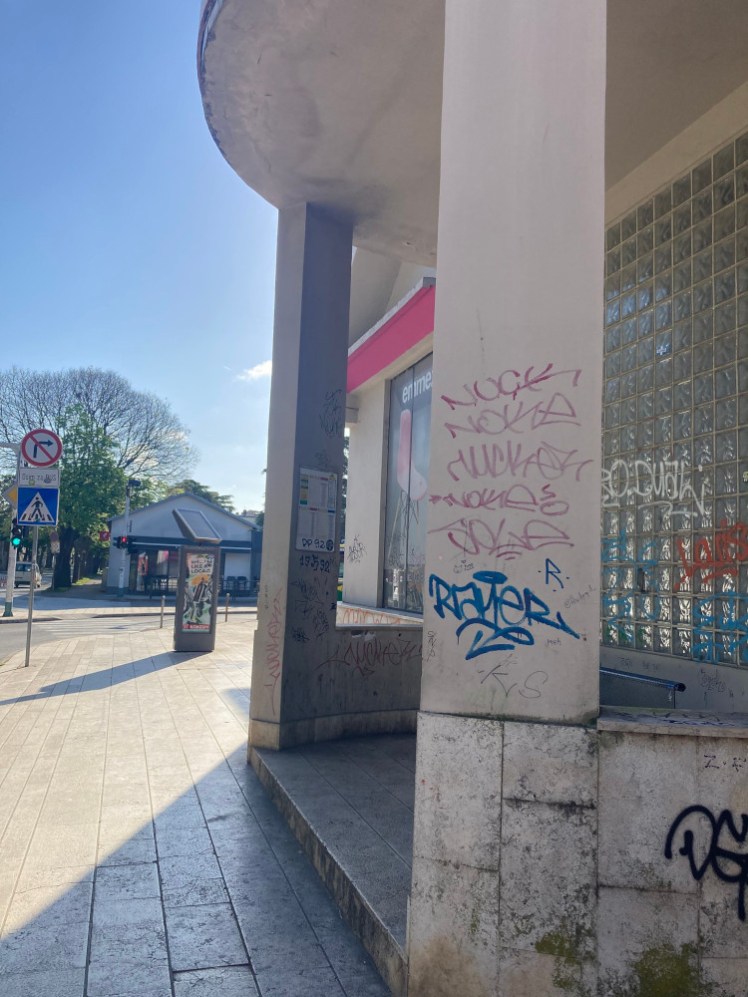
You can buy tickets online and scan the QR code on your phone or you can do what I did and buy a day card (all zones although Fažana is only in zone 2), which saved my bacon when my phone battery died. Pula buses have an LCD display showing the next stop so it’s easy to know when to get off (stop is Fažana A and lots of people will probably get off there in case you’re not looking at the sign, but you’ll have to walk 100 yards up the road to Fažana B to get the bus back to Pula, and note that afternoon buses tend to depart around the time the boat is tying up on the jetty so you’ll probably have to hang around). Cross the road and you’ll see the sea down the street opposite, turn right and at the end you’ll see the ticket office, if you haven’t pre-purchased your ticket online – you should probably do this, especially in high season because it’s no fun getting to Fažana and discovering the ferry is sold out. I was early enough both in the season and in the day that I had no problem but I wouldn’t turn up and hope in July or August.
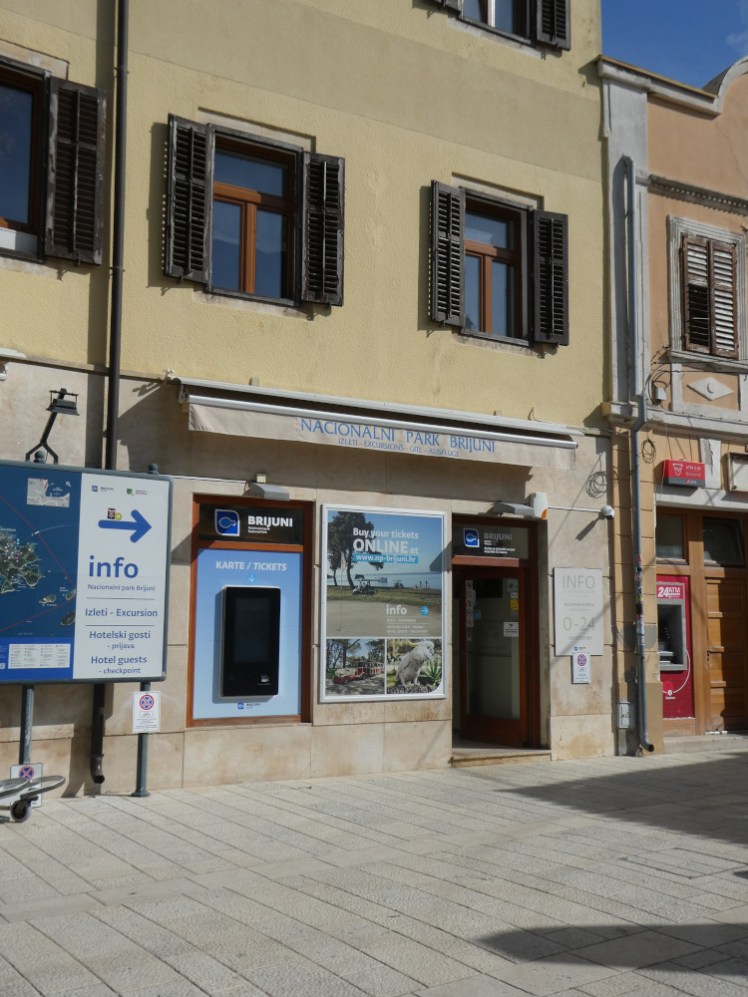
You’ll have a choice of ferry only or guided tour and as I do generally advocate for guides, I’m going to do it again. It was €30 for the boat and entrance to the islands or €35 including the tour, and it’s worth the extra €5 just for the land train. Brijuni tours run in Croatian, Italian, German or English and feature an hour or so on the land train giving you the lay of the land plus ten minutes in the safari park, a trip to one of the Tito exhibitions, a visit to a church and finish up at the boathouse. You can leave the tour at any point after the train tour and however long you stay, you can wander the island freely afterwards and go back on whichever ferry you fancy. If you’re really opposed to actually being told about the place you’re visiting but like the idea of not wearing out your feet too much exploring, you can hire electric golf buggies (you’ll need to bring your driving licence, which I didn’t!) or bikes.
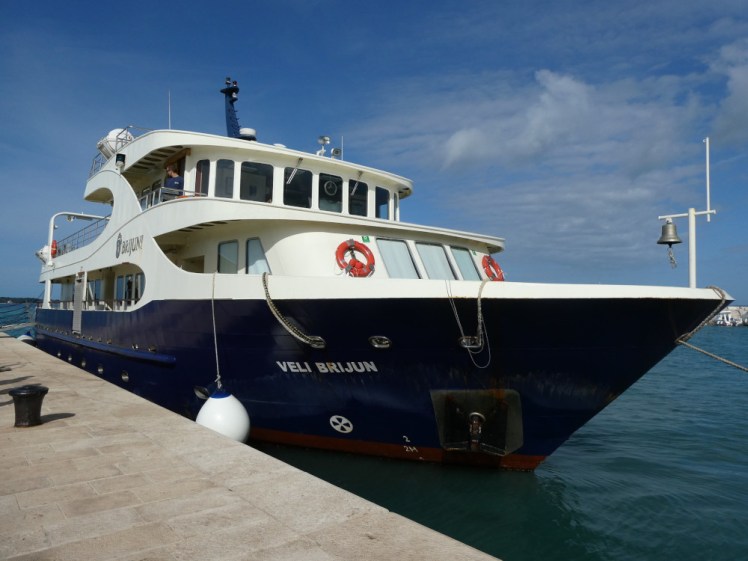
The ferry takes just fifteen minutes and runs at least once an hour in spring, probably more in summer. The sea turns from vivid turquoise to deep teal as you get out into the channel and then back again as you come into the small harbour. If you’re staying in one of the hotels, they’re right here, one to the right and two to the left and if you turn right, you’ll see right in front of you a cafe and the island’s one tiny souvenir shop.
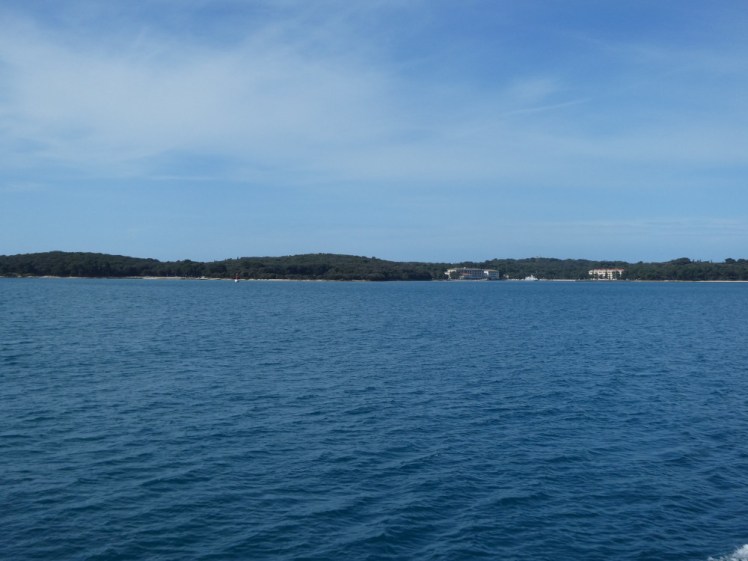
There are 14 islands in the Brijuni archipelago and this one, Veli Brijun, the biggest, is the only one easily accessible. It’s perhaps not like most National Parks of my acquaintance – the seascapes are beautiful but most of the land is very… manicured, definitely human-led. A huge part of the north is devoted to a very large golf course, there are Roman ruins everywhere and wherever there’s not golf, Romans or perfect meadows, there’s Tito.
In short, this island was the summer home of Yugoslavian dictator Marshall Tito. My history isn’t very good (I dropped the subject as early as possible at school) and it can be hard to differentiate between “we like this politician because he was a good guy” and “we like this politician because he’s our local claim to fame”, so I had some reading to do when I got home to discover Tito more or less falls under the latter heading. He left a couple of presidential villas, lots of staff houses, a limited edition Cadillac (you can hire it with driver if you don’t fancy walking, cycling or a golf buggy, for a mere €1,400 an hour) and a safari park, home to all the exotic animals and their descendants that he received as diplomatic gifts.
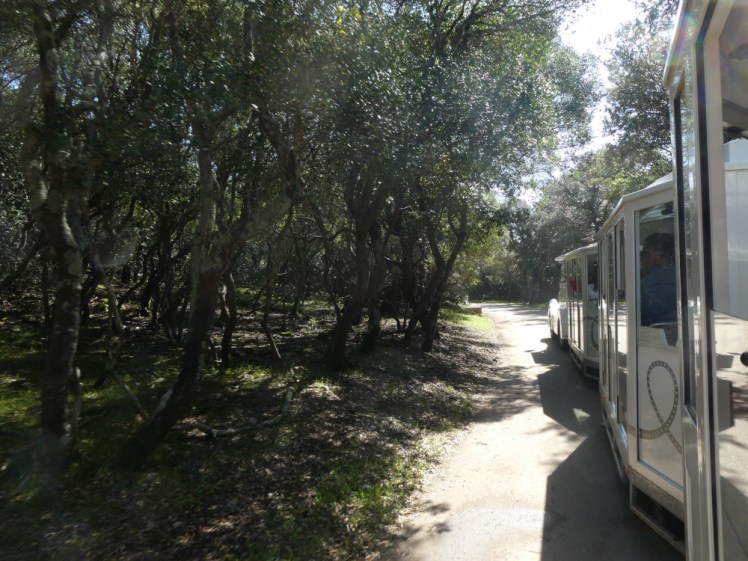
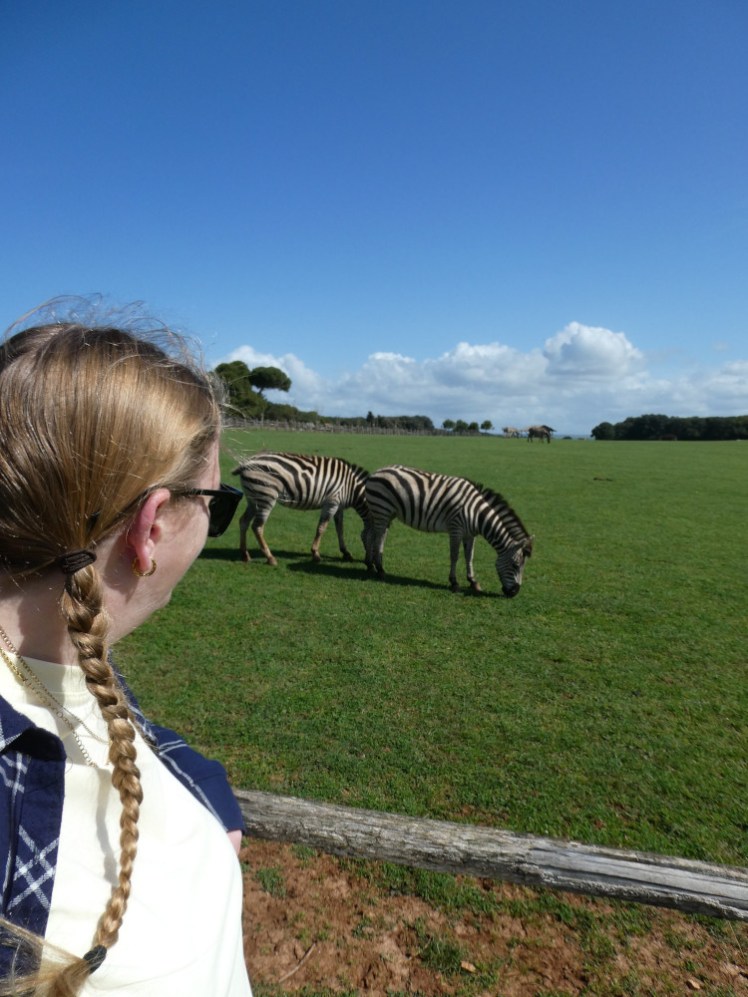
Actually, let’s start with the safari park. This occupies the northern end of the main island and is the star of the land train trip, if you take the guided tour. It trundles you up the east coast, giving you views across to the mainland and across to Brijuni’s second island and through the golf course and then you go through a gate and into the safari park. Other than the entrance and exit gates, this safari park is a lot more open than anywhere I’ve ever experienced. Lanka the elephant is in a proper enclosed enclosure, albeit one with enrichment, but the zebras, llamas, ostriches and more local animals like deer and donkeys are just behind wooden fences made out of branches. I have never been close enough to pat a zebra’s nose (I didn’t because they’re still wild animals and still likely to bite but I could have!). One of the exhibitions in the house the tour visits after the train trip is of stuffed animals – either exotic animals from the safari park or local animals Tito shot for fun, like birds and rabbits and I very quickly concluded that if you wouldn’t give an animal to a five-year-old, you probably shouldn’t give it to a world leader either. Four stuffed giraffe calves – apparently they died of E. Coli, but four of them? And how many chimpanzees can one man get through??
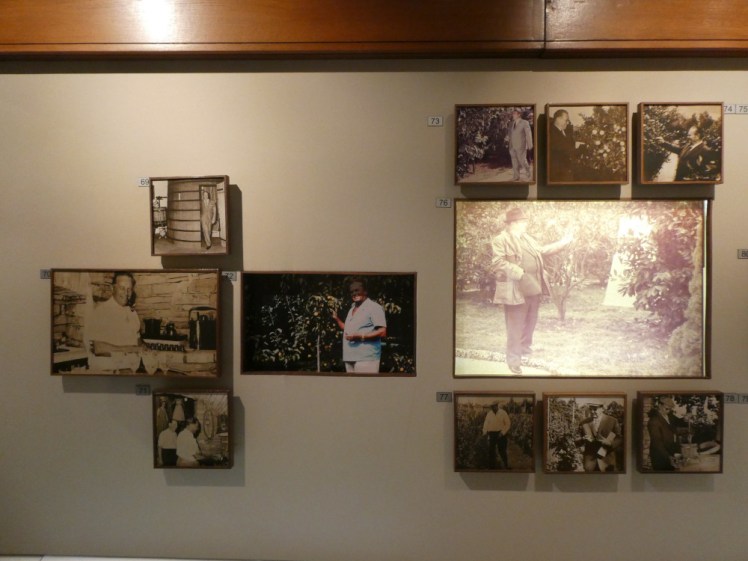
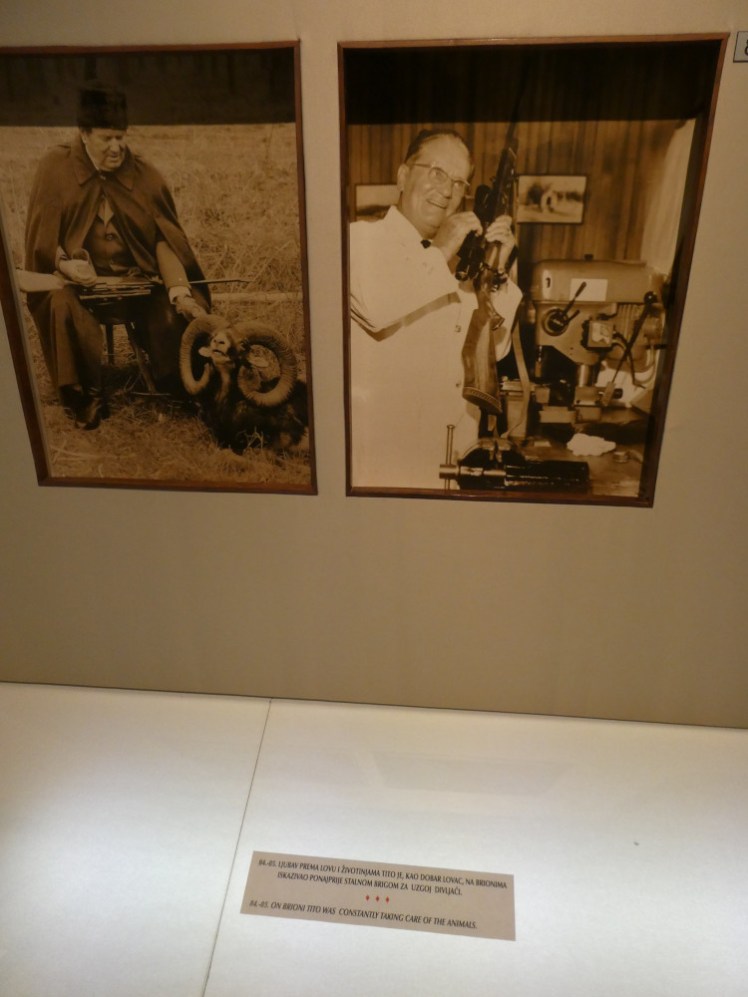
That’s the downstairs of the exhibition building. Upstairs are photos showing Tito on Brijuni and Tito meeting 50-something world leaders and celebrities. I particularly enjoyed two pictures of him holding a rifle captioned “Tito was constantly taking care of the animals” – maybe there’s a bit of self-awareness in there after all, because our guide and all the exhibits absolutely sounded 100% positive and adoring about him at all. Let’s give him the benefit of the doubt; perhaps he was one of these affable, fairly benevolent dictators – not going to put the words Paul and Kagame in the same sentence but.. IYKYK.
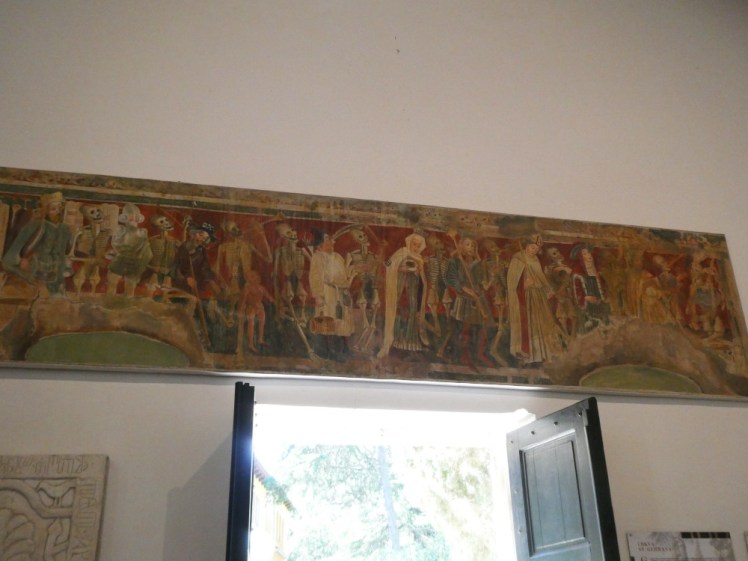
The church, one of many but specifically the one next to the souvenir shop, is a reproduction of one in a village on the mainland and contains reproduction frescoes and examples of Glagolitic script, the ancient Croatian alphabet which is a distant cousin to Cyrillic. The big fresco above the door is the particularly interesting one, the danse macabre, where skeletons are leading various figures to dance, from the Pope to the farmer, as a reminder that Death comes to everyone, no matter their station in life. If you watched Michael Portillo’s recent Balkan series of Great Continental Railway Journeys, you might recognise thus fresco – he visited the original. He also came to Brijuni and was driven around in Tito’s Cadillac, clearly having a bigger travel budget than me.
Next to the church is the entrance to a nice stroll among some former quarries, now a pleasant place for a stroll and a memorial to another name you’ll hear a lot if you take the guided tour, Dr Robert Koch. To the wider world, Dr Koch is probably better known for his work on the causes of tuberculosis and cholera, for which he was awarded a Nobel Prize in 1905. On Brijuni, he’s celebrated for eradicating malaria. Not worldwide, as I’m sure you’ve noticed, but in the first few years of the 20th century he identified the mosquito carrying the disease and then helped the islands’ owner at the time, industrialist Paul Kupelwieser, to remove the mosquitos by getting rid of swamps and basically re-forming the entire island landscape.
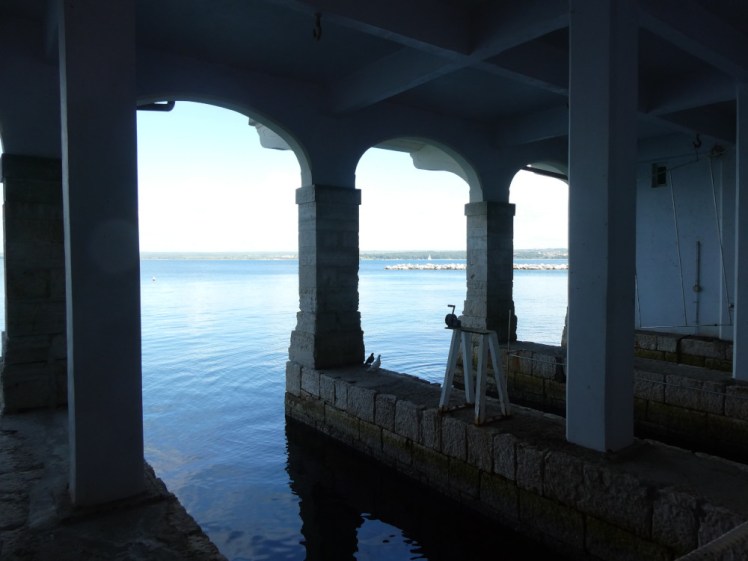
The last stop is the boathouse down by the harbour, a 1902 Austro-Hungarian confection once home to Dr Otto Lenz, the islands’ doctor. The downstairs is still – or at least, could be – a boathouse. It has four bays open to the harbour where boats could be stashed. The upstairs is now the Education and Interpretation Centre of the Brijuni National Park and is worth a stop if you want to know about all things related to the islands, which is mostly the natural side of the National Park, rather than the various noteworthy human beings who made their stamp on it over the last 150-ish years.
Here the tour ended. Most people dropped off after the train trip, another couple left after the exhibition and those of us who went to the boathouse mostly did so only because it seemed rude to walk away so close to the end. After that, we were free to explore and go back home on whichever boat we wanted. The times are up on the jetty, so go and check your options before exploring. Tito’s villas are off-limits to the public but you can ride and walk pretty much anywhere else you like. I knew exactly where I wanted to go.
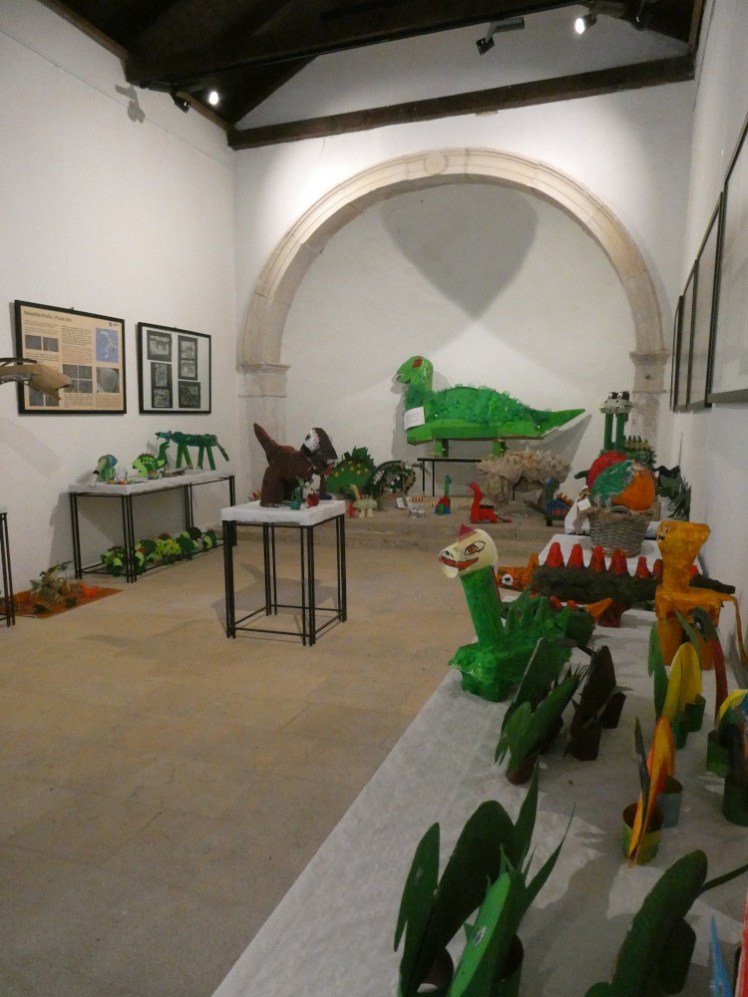
If you depart the harbour area and walk slightly uphill to the left, you’ll eventually come across several interesting things. The first is a small church turned dinosaur exhibit, which celebrates the various dinosaur footprints found in rock around the edges of the entire archipelago. However, while there are wall plaques about them, most of the exhibit is actually a collection of model dinosaurs made by children, some of them really exercising their imaginations and power of building.
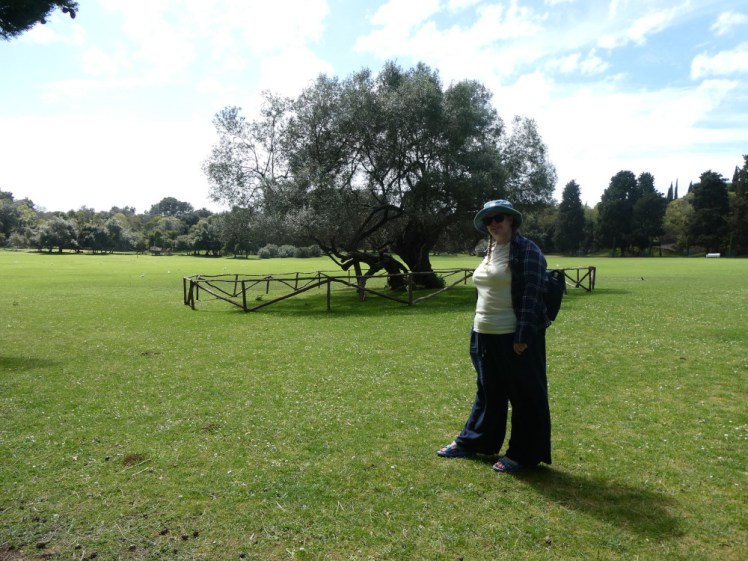
Second is an olive tree that probably sprouted somewhere around 400AD. It now lives behind a low fence that doesn’t impede its growth but keeps casual visitors from climbing all over it. Despite its age, it still produces olives and those olives still make olive oil, about 4kg of extra virgin a year from this one tree. If you’re not particularly into trees, you could walk past this one without noticing there’s anything special about it but the tour guide had told us about it and since it was on my way, I stopped to pay attention to it.
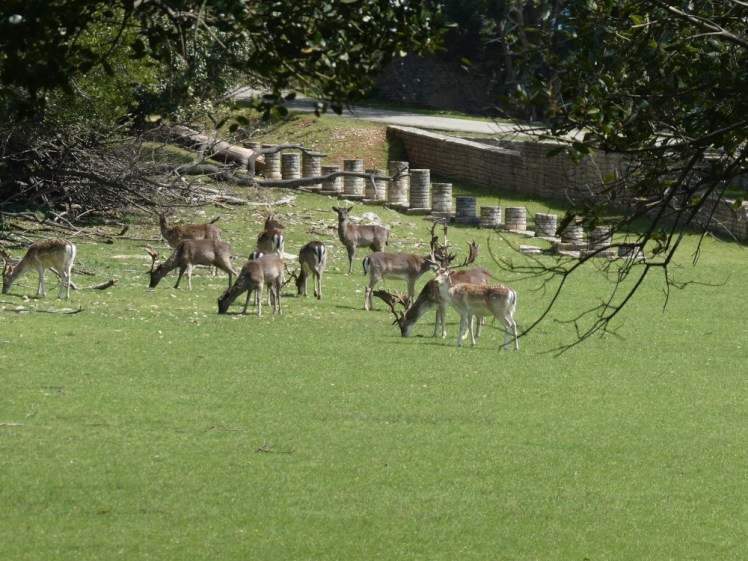
Round the meadow, follow the road towards the bay and eventually I ran into some Roman ruins being used as a dining room by a fine herd of deer. I crept closer and closer to get photos without disturbing them, and then the moment was nearly destroyed by a cyclist with a dog flying down the road on the other side of them. Half of them fled and the other half lingered on the edge of the woods, ready to vanish if anything else happened. I got my photos and then I carried on down to Verige Bay, the Bay of Chains.
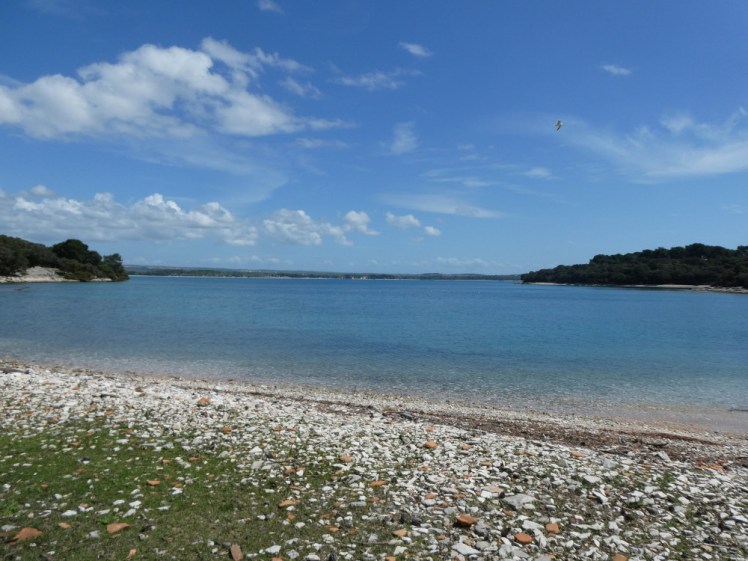
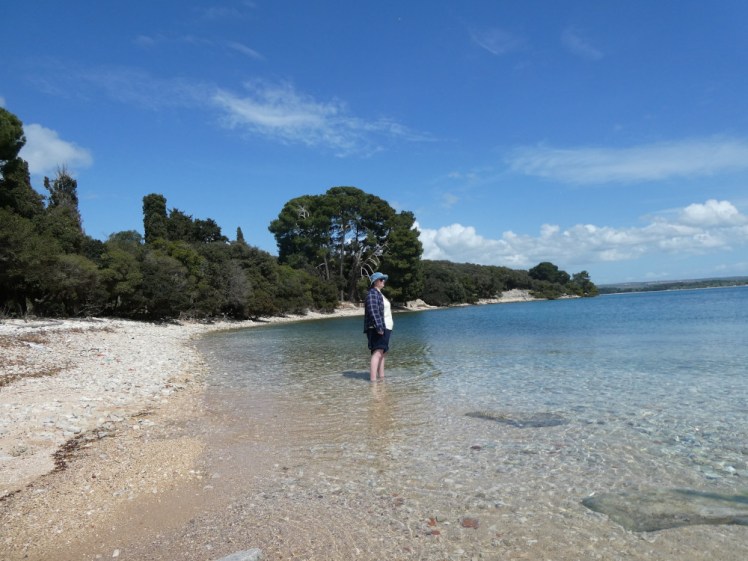
This place had caught my eye on the land train trip for two reasons. The first is that there’s a massive Roman villa on the hillside opposite. The second is the beauty of the bay. At its widest point, it’s a little over 300m wide but here, where the path comes down to the water, it’s less than half that, which means it’s quite shallow, which means the water shines bright turquoise. Actually, it’s a little baffling. For protection of the wildlife living in the bay, swimming is banned here – unless you’ve booked the educational underwater snorkel trail, where you swim the entire length of the north side of the bay. I rolled up my trouser legs and paddled, getting up about as far as my ankles in the rocky shallows. It was freezing. Actually, although it was a hot day by British standards (we’re more used to grey and drizzle than glimpses of sun), it was still cool enough and just breezy enough that I was wearing a lightweight shirt open over my t-shirt the entire week and I’d brought my down jacket just in case it was cold on the boat back. It was ok for paddling but even in the glorious Adriatic, far too cold to even consider swimming. I bet these islands are absolutely swarming with tourists in the summer, both on land and in the water around them.
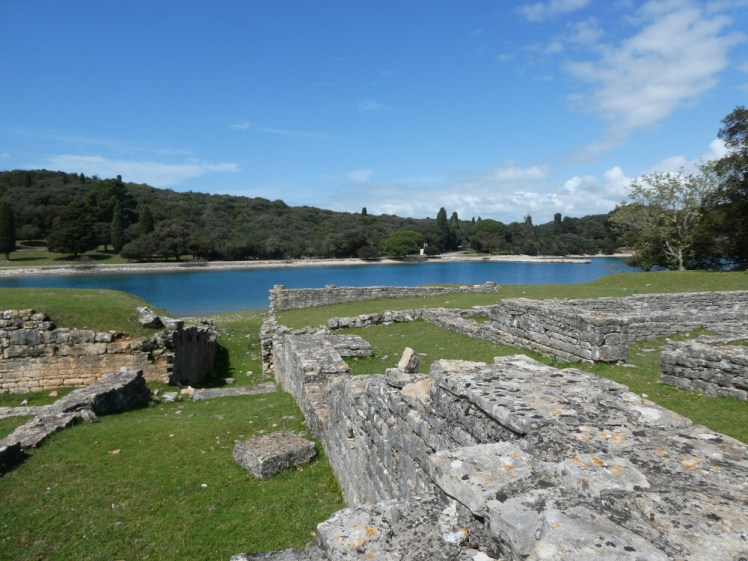
Having paddled, I walked round to the Roman Rimska villa. It was founded in the 1st century BC and at its peak two hundred years later in the 1st century AD and continued to be used for another 500 years. It’s now just ruins – the low outlines of rooms and corridors now set in lush grass and inhabited by thousands of tiny green lizards. The islands’ code of conduct says not to climb on the monuments but the website instructs to “explore this luxurious villa and stroll along the walkways that the ancient Romans used to walk on” so I didn’t feel too much compunction about making my way through and around the old stones. This was probably a summer home, complete with temples and the ruins on the other side of the bay, where the deer were exploring, included thermal baths and a commercial property. It seems people have been holidaying on Brijuni for literally thousands of years.
If you’re interested in ruins, the other place worth seeing is Castrum, the Byzantine complex at Dobrika Bay, on the south-west corner of the island. It put Rimska Villa to shame, having grown from a mere 1st century villa into a 4th century settlement, complete with the Basilica of St Mary, the Church of St Peter, olive and grape processing plants, forges, bakeries, storage and even later, defensive walls. I didn’t have the time – nor the energy – to hike across there but I’ve seen pictures of it and other than the fact that the walls never exceed three feet in height, it’s remarkably well-preserved and covers a much bigger area, with a debatably better view out over the sea and the other islands to the east of Veli Brijun.
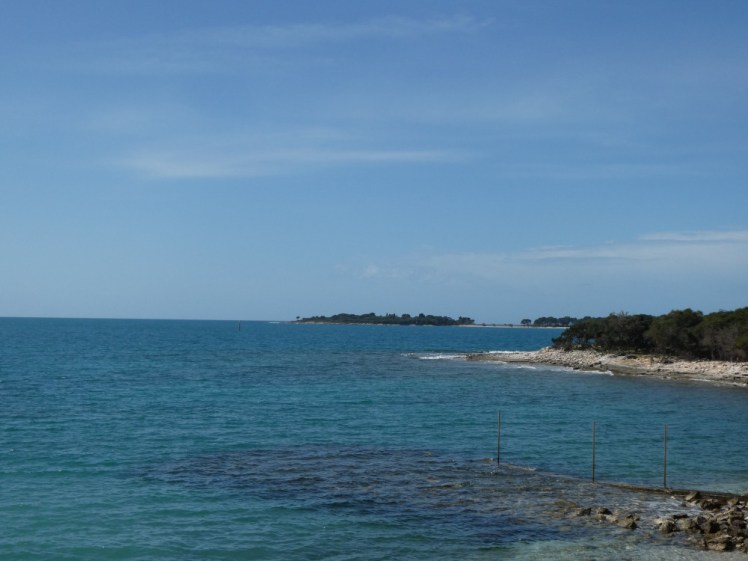
You could easily spend two days here, and that’s just for the big island. You can also do excursions to Mali Brijuni, Cossack and St Jerome. Vanga, “probably the most mystical island” is home to another of Tito’s villas and is still a holiday home for high-ranking politicians but is closed to the general public. Several of the other islands have the remains of residential buildings or hints of long-gone industry but can only be visited by authorised experts in the name of research, due to being protected parts of the National Park. I know, even in my long tiring day, even with a tour guide taking me to parts of the island I couldn’t or wouldn’t have got to on my own, I didn’t see half of what Brijuni has to offer.
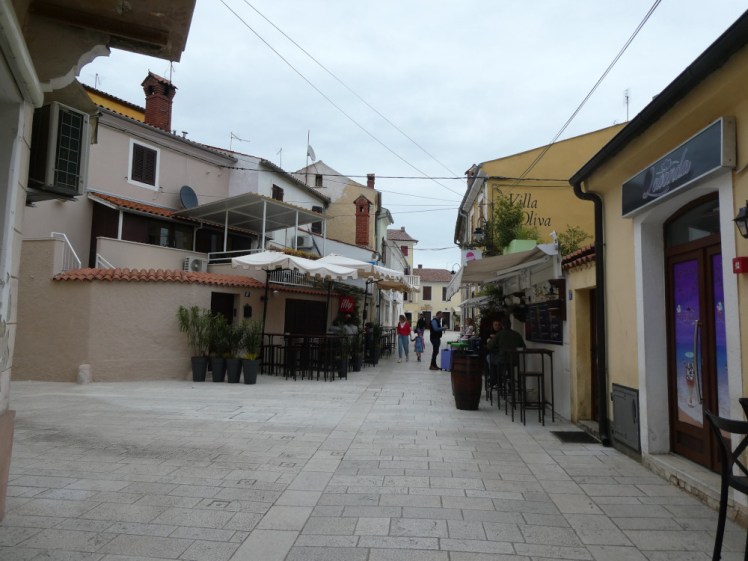
I took the ferry back, struggled to find the bus stop (ignore Google Maps that says to get the bus from directly opposite where you hopped off this morning; you need to keep walking up the road until you find Fažana B, which is roughly opposite the Pizzeria Bambino), waited an hour (the bus to Pula went at 16:40; the ferry got in at 16:15 and then had to tie up and let all the passengers off and is a five-minute walk away anyway). Word of warning if you got on the bus at Pula’s main bus station – the bus doesn’t return to the bus station! Instead, it turns left on the road that leads down to the bus station and goes round the back of Pula instead, finishing up just a short walk from the Arena somewhere around Istarska ul, so if you didn’t board the bus at the start of its journey at Pula Centre, you’re going to have a walk when you get back.
 I Am A Polar Bear
One thought on “How to visit and explore Brijuni National Park from Pula”