Pula is a port city in northern Croatia, on the southern tip of the Istrian peninsula. It’s a world away from bustling Dubrovnik – it was a Roman city and still has plenty of very visible evidence of that. The entire region is bilingual, noticeable on the road signs the moment you leave the airport, a legacy of belonging to the Venetian Republic and being fought over by Croatia and Italy for centuries and it certainly feels more Mediterranean than the more coastal southern coast. The very air is soaked in olive oil and you don’t even need to leave town to find pale stone villas with terracotta roofs. Pasta and pizza jostle for popularity with local seafood and semi-rural bliss is tempered by heavy industry. Welcome to Pula.

Our 24 hours starts in mid-afternoon, after a morning flight in. Mine was at 10.30 from Bristol with easyJet. The shuttle bus, which runs about 45 minutes after an international flight gets in – check the timetable on the airport website; it’s quite irregular- takes about ten minutes to transport you to the bus station at the north of town. I was staying just around the corner so as to easily get back on the bus a few days later. A side-effect of this is that I was also staying a three-minute walk from Pula’s Arena.
Because I was staying in an apartment, my first job was to get some food in. Pula has an abundance of mini Studenac Market convenience stores, including one right across the road. These vary hugely in quality and produce. Possibly very few other tourists would hike the kilometre up to the big supermarkets at the previous roundabout and then the kilometre back but if you’re self-catering, the big Plodine will stock you up better than any of the mini-markets in the city centre.

First, you’re probably going to want to make the acquaintance of Pula’s biggest and most popular landmark, the 1900-year-old Roman Arena. Pula proudly calls the Arena “the 6th biggest in the world” but neglects to specify which five are bigger and the internet is a bit vague on the subject. Rome’s Colisseum, of course. El Jem in Tunisia has a large and well-preserved amphitheatre, as does Verona, Padua and Nîmes but there are other potential contenders. Opening hours vary but generally from 8am in summer and 9am in shoulder season until quite late in the evening, later as the summer ramps up and is closed in winter. It costs €10 for adults and €5 for students and the lack of any other details makes me assume it’s free for children and no senior discount. For now, we’re just getting our bearings so take some time to marvel at this three-storey stone arch that’s been standing here for nearly two millennia. My guidebook hints at a historical mystery: Pula wasn’t a huge town in Roman times – why does it have such a big Arena?
Next, follow the paths through the trees and down to the harbour. In summer, this is where you board one of the dozens of boats that will take you a little way up the coast to watch wild dolphins but I don’t think they get started until May or even June. You can also take a boat over to Venice from here – it’s just on the other side of the Adriatic and you can do it as a (long) day trip of three and a half hours each way. Come back here to the harbour when it starts to get dark but for now, cross the road and head into Pula’s winding old streets for a drink and an ice cream at any of the picturesque cafes or kiosks.

As it’s getting dark, wander back to the harbour for one of the most unexpected tourist sights I’ve ever seen. Out in the bright blue island-dotted bay, joined to scenic Pula by a short road bridge, is a blot on the seascape, a small island made entirely of heavy marine industry. I think I’ve seen it called a shipbuilding yard but judging by the hulk I saw there, I suspect it’s shipbreaking, not building. Seven or eight huge cranes tower over the yard, as well as tall red and white towers. But when the sun goes down, the lights go up and the rust-streaked cranes become the Lighting Giants, a light display in vivid jewel tones accompanied on certain occasions by music. I was there four nights and I think I went to look at the Lighting Giants every night. Walk back either to your accommodation or to a bar with a view via the Arena so you can see it lit up in the dark.

In the morning, let’s get to know Pula properly! There’s a circular route around the city centre that will show off most of the sights – Kandlerova ulica in the north and Sergijevaca in the south (doesn’t feel like two separate streets when you’re actually there), which ends at the Gate of the Sergeii. Follow the wall up to Carranina ulica and that’ll take you back up to Kandlerova.
If you’re starting at the Arena, you follow the road along the top of the large car park, past the park next to it, across the road and you’re on Kandlerova. If you’re staying elsewhere, it’ll be more convenient to start this circle at your closest point. It’s a fairly narrow cobbled street with stone buildings, shops and cafes on each side and it leads you on a path that doesn’t feel particularly circular to all the places you want to see.
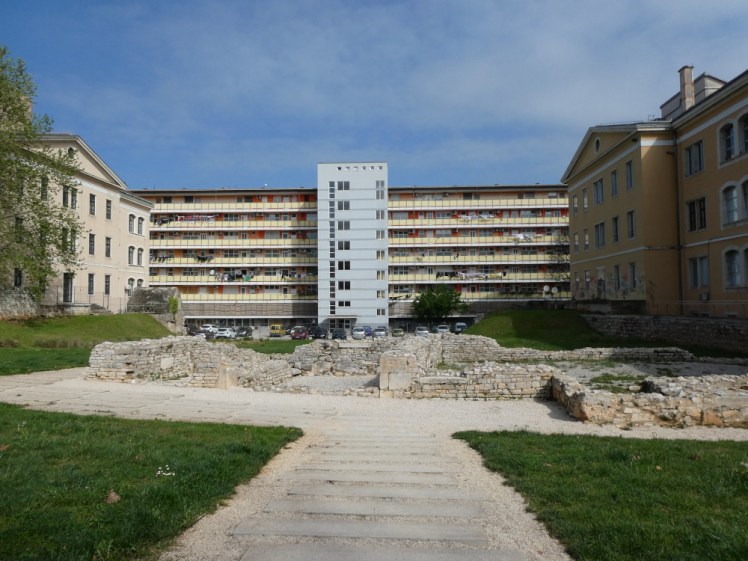
First, immediately after Tito’s Park, on your right, is St Theodor’s Quarter, a small maze of ruins from throughout Pula’s history set in the shadow of a u-shaped apartment building, mixing the past and the present in a slightly odd way. It’s worth a stop but it’s probably not worth seeking out on its own.

The next stop is the Cathedral of the Assumption of the Blessed Virgin Mary. Pula is vague about the age of the current building but it was built on and around the remnants of a 5th century church which was in turn built on the site used for religious worship since at least the Roman times. The separate bell tower standing ten feet from the front door dates back to 1707 from stones taken from the seating areas of the Arena – the locals never quite dared loot the actual structure but the seating was fair game until fairly recently. I never got to go inside the cathedral; the only time I found it not locked was when an Easter service was going on, which is also not a great time to stroll in and start taking photos but I hear it’s very beautiful and mixes architectural styles, which makes absolute sense for a church that seems to have been built as a bit of a patchwork over 1500 years.
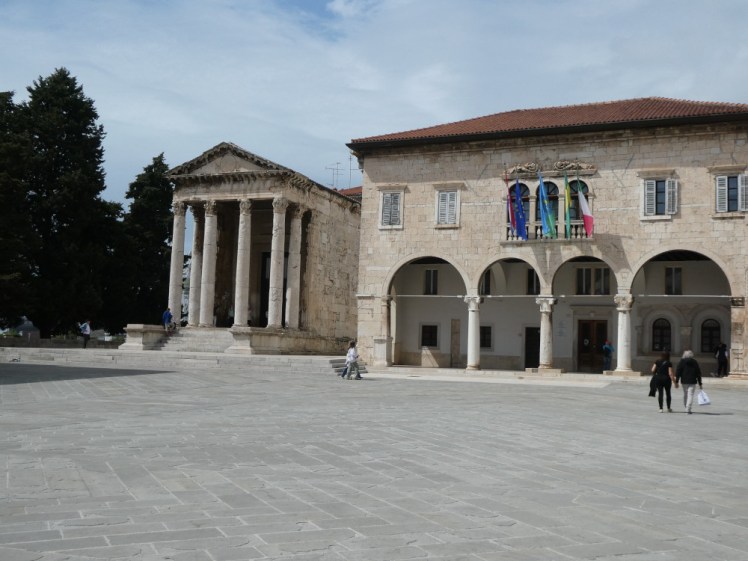
Keep going and the next significant stop is the Forum, the Roman town square which once featured a triumvirate of temples at its north end. Nowadays, only the Temple of Augustus survives, a small but high building featuring columns on the front and a single square room inside. It’s no longer used for worship – hasn’t been for hundreds of years – but today contains a collection of random Roman bits and pieces. On the right wall is a collection of small statues and carvings, on the left wall is a collection of fragments of larger carvings and at the front are the remains of statues. Actually, this building hasn’t survived the last 1900 years. It was all but destroyed in 1944 during an Allied air raid but a dedicated group of fans & supporters jumped straight into reconstruction.

Next door, the medieval City Hall building has swallowed up the two other temples that used to be here, although you can find remnants of the Temple of Diana at the back of it. The City Hall started as the Communal Palace at the end of the 13th century in the Gothic style, was rebuilt in Renaissance style towards the end of the 15th century, again in Baroque during the 17th century, in Neo-Gothic during the 19th century during Austro-Hungarian rule and was reconstructed after significant damage during WWII. Today it’s an administrative building and a tourist site, where you can see interiors preserved in the various architectural styles.
This square is also a great place for a drink – drink like a Roman, as this is where Pula’s social life would have been centred. It’s also where you’ll find Pula’s tourist information office and there’s a very interesting sign outside showing what the north end of the square would have looked like with its three Roman temples.

The next stop is a bit of a weird one. Keep following the narrow street around until you reach a crossroad, where a sign pointing to your left directs you towards Old City Bar. Halfway down this alley, you’ll see a sign for “mosaic” down an even narrower alley. This will open out into a bit of a rubbly area used as a car park. Follow the mosaic signs towards an ordinary apartment building just off to the right of where you popped out of the alley and just inside the gates is a perfectly preserved Roman mosaic, about eight feet below the current ground level and protected by bars so you can only look at it from above. Yeah, it really is just in someone’s front yard. It was built in the 3rd century and accidentally uncovered during WWII.
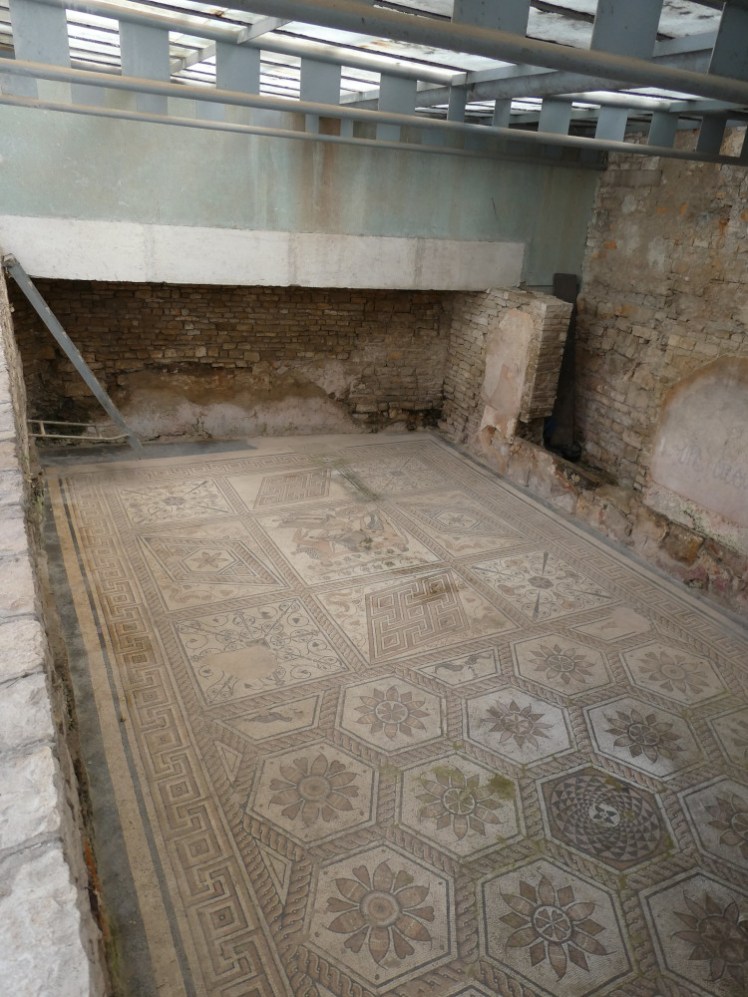
Most of it is a pattern of geometric shapes but at the far end, it features a scene showing the Punishment of Dirce. Dirce was a queen of Thebes, wife of Lycus, daughter of the river gods and reluctant aunt of Antiope. Zeus did what Zeus does to Antiope and she later gave birth to twins, one the sun of Zeus and one of her mortal husband. She left them to be raised by herdmen and was then carried off by Lycus, Dirce’s husband. The two of them hated Antiope, for reasons I’m not clear on, and when she escaped and returned to her twins, now fully-grown young men, Dirce followed and ordered the twins to tie Antiope to the horns of a wild bull. The twins, realising this was their mother, refused and instead tied Dirce to the horns. This mosaic pictures that moment.
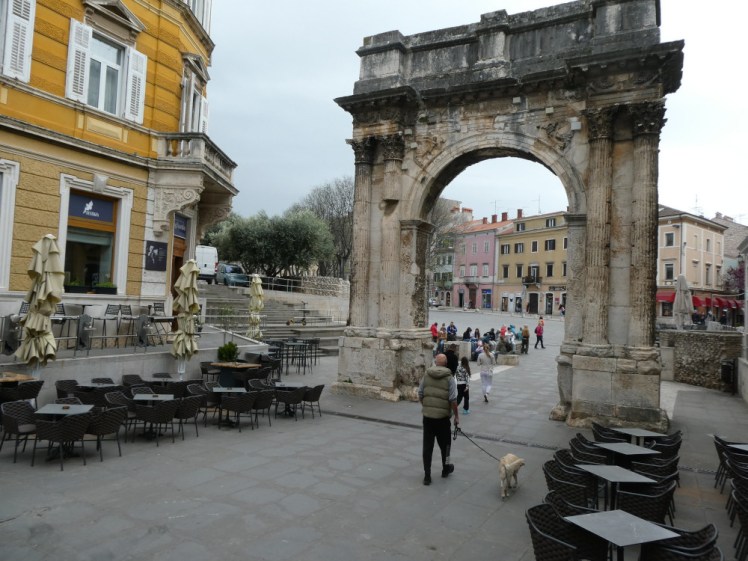
Wind your way back through the alleys to the “main road”, Sergijevaca. Your next stop is the Arch of the Sergii, a Roman triumphal arch celebrating its 2054th birthday this year and still just casually in the middle of a major tourist street and surrounded by cafes. It was built in honour of the Sergijevac family, who were important officials in Pula back in the day and the street still carries their name too, although it might be indirectly, in that the street is named after the arch rather than directly after the family. The more spectacular side is the side facing into the narrow street but you’ll get a better picture from the outside. The bronze statue sitting outside the cafe facing the arch is writer James Joyce who spent some time as a teacher in Pula and hated every minute of it. If you’ve got time, do have a cup of coffee at his table and enjoy the view of the arch.

Follow the city walls around to the left from the end of Sergijevaca and where the street turns round to the left, keep following it. These are the remnants of the ancient walls that once enclosed Pula and soon up here on the left, at the entrance to the Italian Consulate, you’ll find the Gate of Hercules, one of the ancient city gates. Hercules himself has been a bit blurred by time – he’s a bit over 2000 years old, like the Arch of the Sergii.

There are two more things to spot on this walk. Ignore the very obvious Twin Gates on your left and look at the sunken Roman Mausoleum in the park on your right. This is surprisingly easy to miss considering it’s a fairly major bit of Roman remains. It was probably built in the 1st century, around the time the Arena was built and was probably part of a much bigger complex. It was probably built as a final resting place for a prominent and rich Roman family.

Turn back to the Twin Gates or the Gemini Gates, which are so-called because there are two arches. This is another ancient entrance to Pula and these days, there’s a small Roman theatre behind it. I didn’t get to visit it, it was closed while I was there but I could see it from the fort. It’s nowhere near as big as the Arena and doesn’t have much in the way of exterior walls, but like the Arena, it’s still used for performances today.

Back towards the Twin Gates, you’ll find a tunnel with a turnstile in it. This is Zerostrasse, Zero Street, a series of tunnels dug under Pula’s central hill during WWI as bomb shelters, where 6000 people could be squeezed in for protection in the event of a raid, Pula being fairly strategically important as a major port belonging to the Austro-Hungarian Empire. There are four entrances found all over the city and you may have noticed another one just past the Gate of Hercules. They’re a bit creepy now if you’re in there alone but they serve partly as a museum to the tunnels themselves, partly to the war years and partly to Pula’s past, including its now defunct tram system.

It’s a little difficult to navigate but if you get to the central hub, you’ll eventually find a lift which connects you to the other two levels in this complex. The one above Zerostrasse is another tunnel system but shorter, most of it fenced off but you can walk down a section of dripping corridor and look into old prison cells now repurposed as a miniature museum. But upstairs is the interesting bit. You’ve found yourself in Pula’s Venetian-era citadel and without even having to climb the hill”
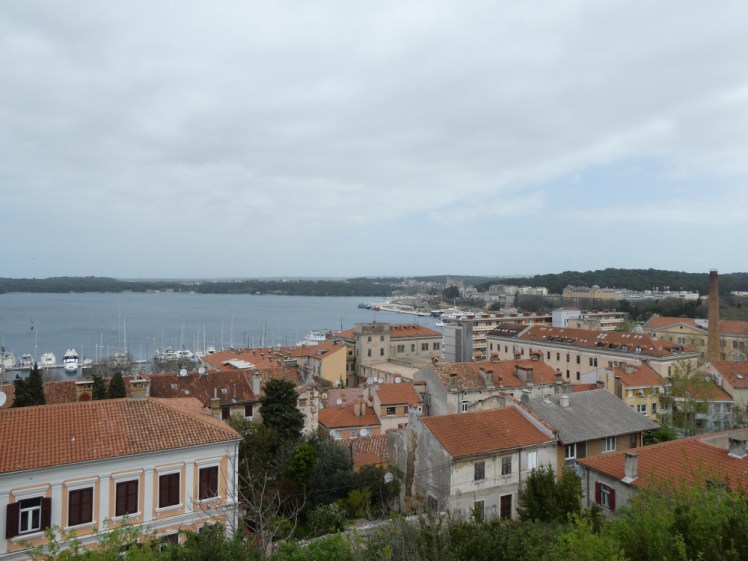
As with so many of these things, before the Venetian fortress of today, there was a Roman acropolis and before that a prehistoric hill fort. The modern fort, built in the 17th century, is a four-pointed star shape and while the Historical and Maritime Museum of Istria in its grounds is probably interesting enough, the main reason to come up here is for the views. There are slopes in various corners of the courtyard leading up to the ramparts, giving 360° views over the entire region. Did you want a proper look at the Lighting Giants? Well, there’s the rusty and extremely ugly shipyard, guarding the city from the open sea. Did you realise what an enormous bay Pula sits in? You can from here! Do you want to see how much the Arena dominates this town? Do you want to see red terracotta rooftops? And for the best view of all, there’s a small tower perched on top and if you climb the iron spiral stairs and then a short but extremely steep stairs-ladder, you can see just that bit further.

Of course, as a travel blogger I should be emphasising the historical elements – with its abundance of Roman relics, its narrow streets and stone buildings, it’s got all the makings of an idyllic Mediterranean tourist city but entire nations have fought over the ownership of Istria for a long time and that’s a pretty significant port. Pula is a big shiny red target in times of unrest and this fort and the ancient city walls are its main defences, so it’s worth diving into the history up here. But it’s also worth just enjoying the views.
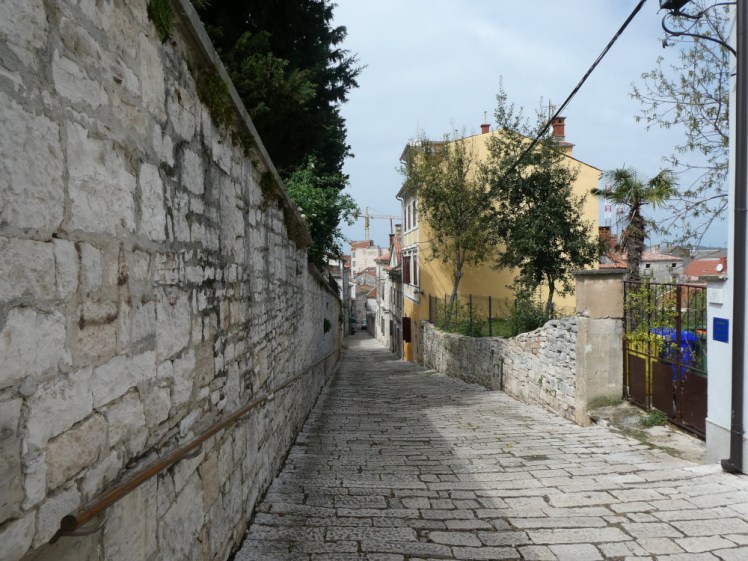
Leave through the front door rather than the tunnels and make your way straight down the hill in front of you, via the stairs which will take you directly down to the heart of the Old Town. Depending on how long you’ve spent at each of these places, the day could be well wearing on by now. You’ve probably stopped for lunch on your way round Pula but if you haven’t, do stop for something to eat now. Pula does a really good mix of Italian food and more traditional Istrian seafood and no doubt you’ve noticed an abundance of characterful cafes, bars and restaurants as you’ve been exploring.

The last stop of the day is finally back at the Arena because while it’s very interesting to see from the outside, it’s even more exciting to actually go in. Can you also hear the crowds roaring as you step out from between the stone ruins and onto the Arena floor? Yeah, me too. Took everything in me not to either roar back or yell “PROVE IT!” (because I’m just as prone to imagining Taylor Swift into this space as gladiators).

Do take in the whole place. Climb up on the blocks on the entrance side, touch the stone walls, sit up in the remaining seating, prance across the floor. Just take in this massive place that’s been hosting large-scale entertainment in this small city for two thousand years. Gladiators fought wild animals here. Saint Germanus was tortured here. Sheep grazed here. Jousting tournaments were held here. Foo Fighters, Alanis Morissette, Dua Lipa, Elton John, Sting, Avril Lavigne, Robbie Williams, Leonard Cohen and dozens of others have performed here. It can seat around 7000 and squeeze in about 12,500 if they’re standing, so it’s got about the same capacity as the likes of Wembley Arena and is so much more spectacular. When I’m famous, I’m going to put on a show here (and at Hrossaborg in north Iceland).

But there’s not just the Arena itself, although obviously that is the most interesting bit and the bit you’re going to want to spend the most time in. Underneath, there’s also a tunnel running the entire width of the Arena floor, once used to house the animals and where the gladiators got ready before erupting into the Arena like gods or monsters. Nowadays, this is home to an exhibition about olive oil and wine, with a massive collection of clay amphorae, Roman-era storage vessels made in a shape that can’t stand up and which apparently invites tourists to stroke them for luck like the nose of Greyfriars Bobby’s statue in Edinburgh. Yeah. Don’t say it.

By now, you’ve seen pretty much all the sights of Pula and you’re probably ready to spend an evening relaxing, eating, drinking, lying on your bed groaning over your sore feet, putting your pictures on Instagram or whatever. If it’s summer, there’s one more thing you might want to do, if you’ve finished the sights early enough and that’s take a boat up the Brijuni Islands to look for dolphins and take in the sunset from the water. Most of these cruises also include dinner but if you’re not sure your stomach can take a meal on a moving boat, there are a few that are just sightseeing. Best to book in advance and definitely know when the boat is going because when I was there, although it was too early in the year for them to run, they were being advertised as 4.30-7.30pm, which is earlier than I’d expect for an evening cruise.

On Monday, I’ll take you up to the Brijuni Islands – no dolphins, I’m afraid, just a slice of paradise a mere budget flight from the UK.
 I Am A Polar Bear
One thought on “How to spend 24 hours in Pula, Croatia”