When I booked my UNESCO Great European Spa Towns of Germany trip, I didn’t really know anything about any of the towns I was visiting. If UNESCO thought they were great, that was good enough for me. I made my lists of their spas, I found somewhere to stay, I figured out how to get between them by train and other than that, I broadly left them to surprise me. Bad Kissingen surprised me.
I got into Bad Kissingen on Sunday afternoon, after getting up in Baden-Baden at 7am and taking a bus down to the station three miles from the town centre and then three trains via Frankfurt up to Bad Kissingen. Despite the requirement for the bus for the last step, Baden-Baden felt very much like a reasonable-sized town with a reasonable number of both residents and tourists. Bad Kissingen, on the other hand, felt a little bit like discovering a secret hidden village in the middle of nowhere which has been forgotten, or never known, by the modern world. That’s not a bad thing. What I really mean is that it doesn’t feel like walking into a kind of German Disneyland where hurdy-gurdy music echoes from every bar and wenches serve up steins the size of their heads and you don’t meet a single German speaker the entire time. No, Bad Kissingen is small, quiet and I seemed to be the only tourist in the entire place.

The last train on my five-hour journey was a small diesel-powered one which divided halfway along the route, sending just one shuttle car all the way up to Bad Kissingen and once its handful of passengers vanished, that was it – station deserted. There was no one waiting for the next train down, no one arriving on a different train at a different platform, no one using the station for a bit of shopping or dining, no buses coming and going outside. At this point, not knowing what Bad Kissingen is like at all, my impression was very much of a ghost town.
I had a fifteen minute walk from the station to my hotel. There was no public transport option but I could take a taxi, which would also take about fifteen minutes. Looking at it right now, as I write this, it would only be a six-minute drive but it would be 3km instead of the 1.1km on foot. I was happy to walk. My luggage wasn’t too heavy and I’d need to walk 2km at some point by the end of the day, because that’s what I’ve been doing for nearly five years now. I left the station by a path hidden on the opposite side of the small car park, went down some steps and a hill down to the road below, followed it along for maybe a hundred metres, didn’t meet a single soul, turned left and found myself on the edge of a park.

As it turns out, most of residential Bad Kissingen is a reasonably large area to the north-east of the town but almost the entire southern end is parkland with villas and villa-style hotels overlooking it from various nooks and I very quickly realised that this is no ghost town, it’s just a small leisure town which has somehow retained its air of leisure without its old spa facilities. Once upon a time, in the late 19th century and early 20th century, there were three bathhouses. The first one I encountered was the large Neo-Renaissance building in the park where Google Maps directed me through its car park rather than through the parkland next to it. Today it’s a government building and exhibition centre but back in the day, this was the Luitpoldbad, one of the bathhouses and home to both mineral baths and mud baths. Even Friedrichsbad can’t boast mud baths!
Another one of the three is the Kurhausbad in the sprawling white stone structure almost directly opposite on the other side of the river and then third was the Salienenbad, which I’ve not managed to find. None of those three baths are in existence but you can still see the complex where they used to be. The Salienenbad seems to have been part of the Lower Saline saltworks, where salt is extracted and produced. This was replaced by a clinic and now I think even the clinic is gone.
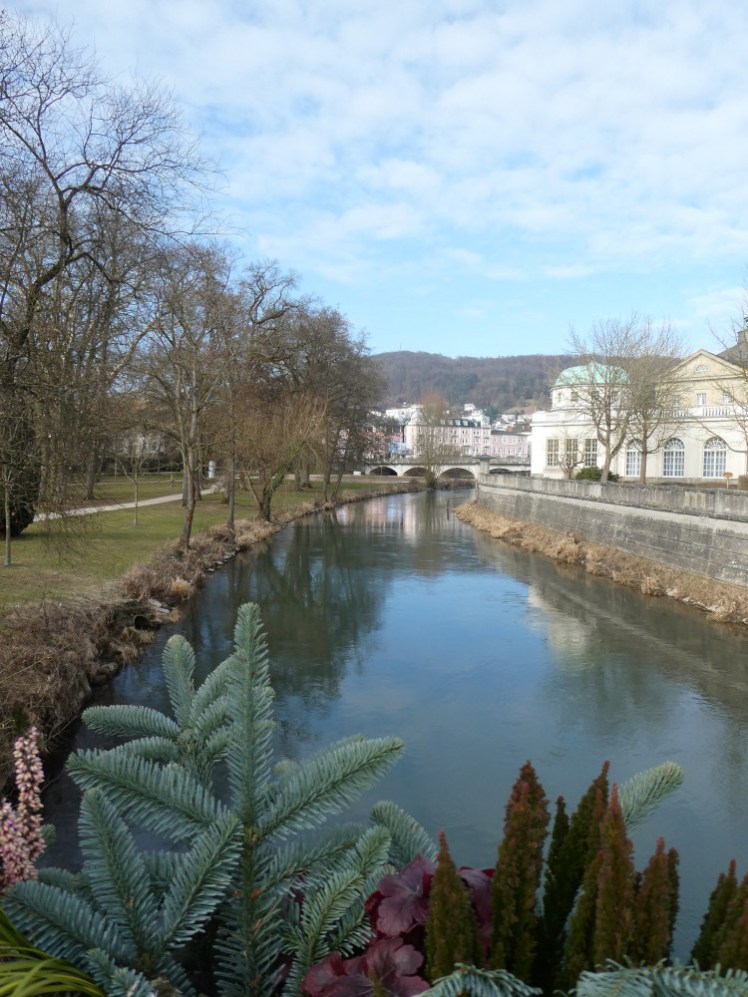
Anyway, this park continued up to and past my hotel. I watched dogs practising their tricks for a show, I saw dozens of trees with information plaques, I walked under the bridge and the town peeked back at me from the other side. If I’d had a front view from my hotel window, I’d have been looking out over the park and the frozen fountains on the other side of the river and I would have felt like a proper 19th century lady of leisure. I actually had a back room with a view over a car park but I did at least have a balcony. But I didn’t know any of this yet – I couldn’t check in because despite the long journey to get here, it was still too early for my room to be available but I could leave my heavy luggage and then go off for an hour or two.

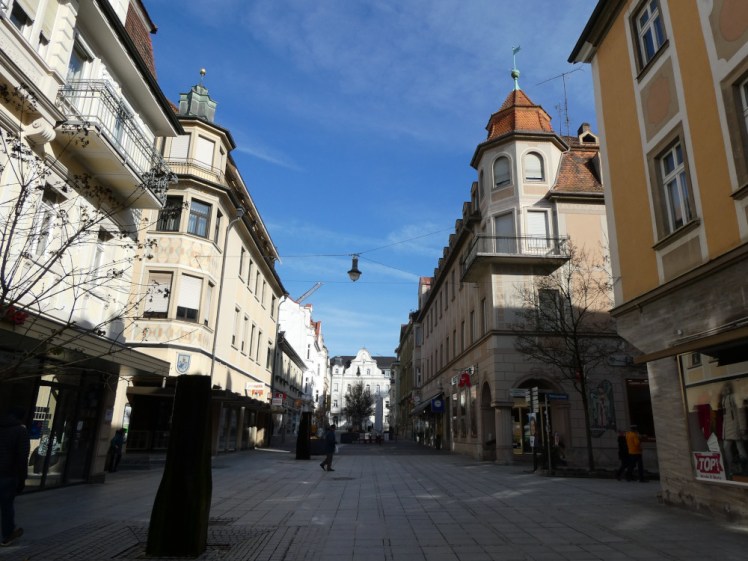
So I strolled. I could see a church tower in the distance so I walked through the largely-pedestrianised town to find that, which wasn’t nearly as Gothic close-up as it had looked from the other side of the river. There was a medieval fire tower just down an alley opposite, a watch tower from which the city watchman kept an eye out for fire in the town. You can’t go up it but you can look at it. As a matter of interest, Google Maps makes the public toilets, the Fire Tower Toilets, nearby a more prominent feature than the tower itself.

The rest of the town is a quiet, pleasant little place – admittedly, this was a Sunday afternoon – that mostly feels quite generically “modern German” but occasionally you’ll go around a corner and find yourself in front of something so Bavarian-German that you almost feel like you’ve walked into something lifted from the aforementioned German Disneyland.
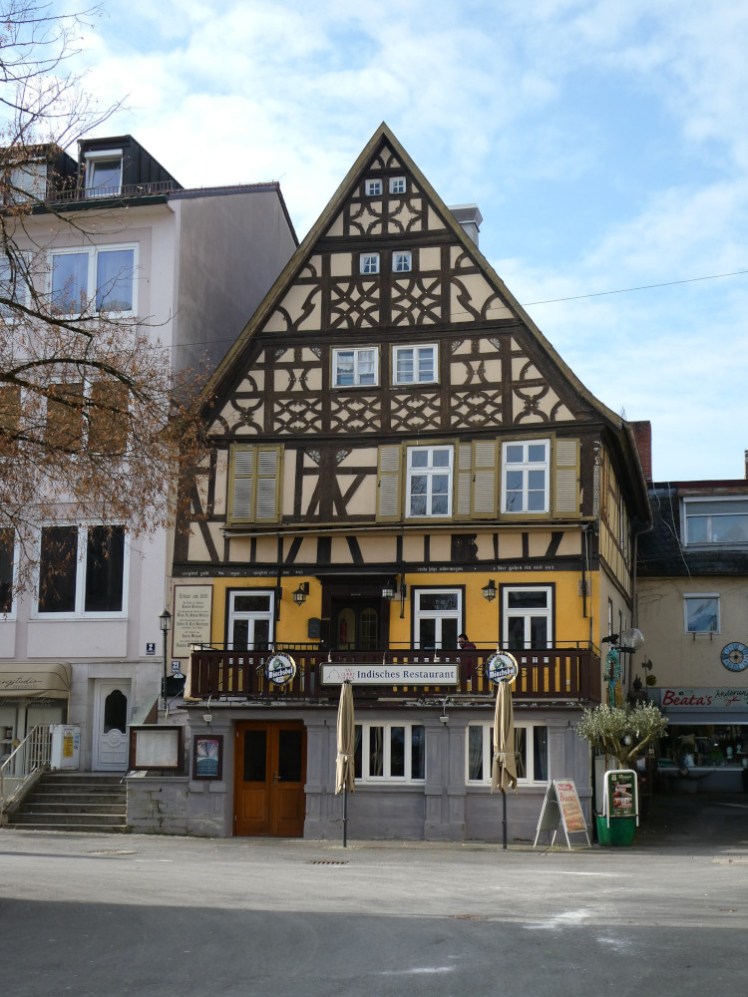
I went down to the Kurgarten, which feels like it was the heart of 19th century leisure Bad Kissingen and on a sunny Sunday afternoon, probably had pretty similar vibes to 150 years ago. We’re used to the idea of a spa being somewhere you relax and bathe in hot water and have massages but one of the central ideas of a spa town back in their golden age was that you drank the mineral water (see my Baden-Baden post for my thoughts on that!) so there would have been a Trinkhalle where you’d collect the water in cups or bottles, now generally replaced by cafes and restaurants, so you can still sit and drink there and have a nice peaceful time but without the unpleasant consequences.
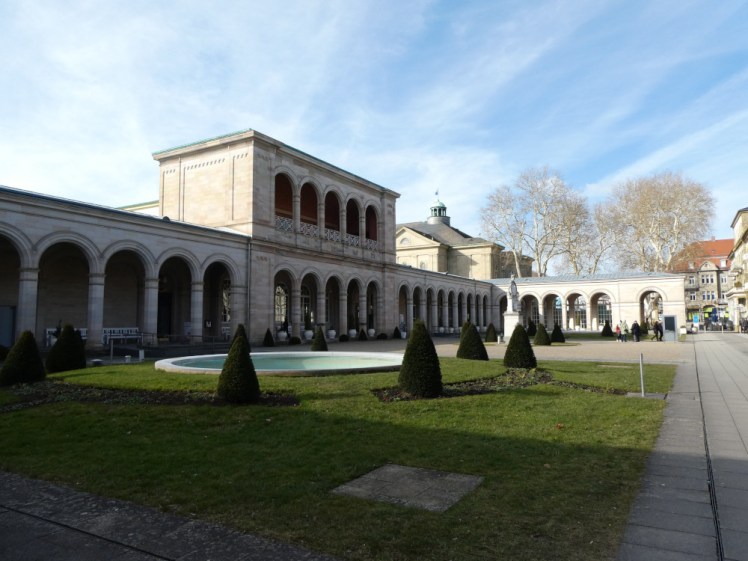
This building today houses the usual collection of cafes and restaurants, performance venues big and small, the tourist information office (imposing, as suits the building, but also weird – it has these very curvy, very modern desk-things that simply don’t belong in these surroundings!) and a little further afield are orchestra suites and the spa theatre.
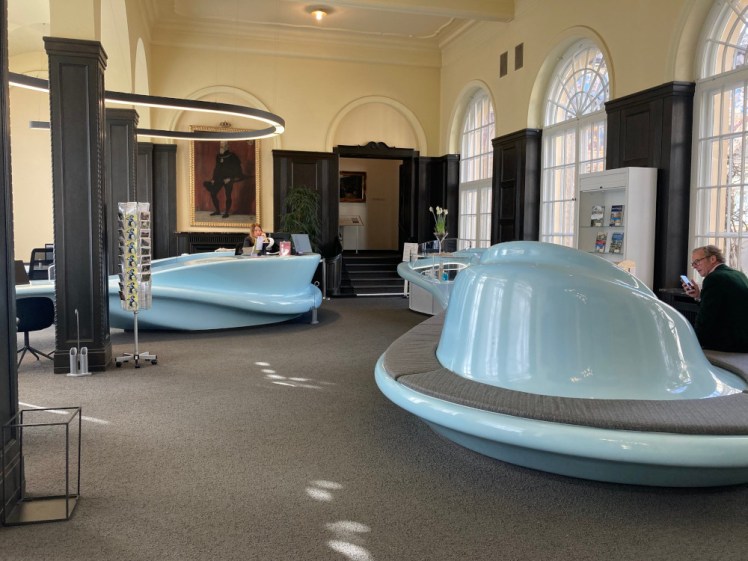
Back outside, it has ornate gardens. It was cold because it was mid-February but it was also bright and sunny and there were plenty of people taking advantage of that to sit or wander in the gardens. In places, this ornate stone galleried complex has large areas of glass that make it feel a bit like a really decorative greenhouse. The Kurhausbad would also once have been out here but it was demolished some years ago now. I think there was a plan for a hotel to go on the site but whether that happened and which one it is if it did, I never quite figured out.

To take what feels like a sudden detour, I was surprised at the lack of English I found around Bad Kissingen – and Bad Ems too but I haven’t got there yet. English is the lingua franca of tourism in Europe, not necessarily because the Brits show up in their monolingual hoards wherever there’s something worth seeing or a bit of sun, but because it’s the language that everyone shares throughout the continent. I’d been under the impression that Bad Kissingen is just as much of a tourist town as the likes of Baden-Baden but I rapidly began to get the impression it’s not. I mean, I’d had that impression ever since I got off the train but the lack of English combined with the lack of obvious tourist facilities, like souvenir shops or multinational chains, all came together to say “this is not where tourists tread”.
As I sat in the park, I idly noticed someone walking carefully with two crutches. Then someone else. Then someone else. As a general thing, I don’t pay a whole lot of attention to how many people are using mobility aids because it doesn’t matter and it’s none of my business but I gradually realised that there was a disproportionate number of people using them compared to anywhere else I’ve ever been in my life and it seemed to be almost exclusively the same thing – two crutches, walking slowly without putting too much weight on the crutches. No hopping like primary school kids with leg injuries, no single sticks, no wheelchairs, no real limping, and this was maybe one in every three people, which seemed a lot. This remained a mystery for a few hours until I’d moved into my hotel, packed up my little bag and started walking down to KissSalis. Three or four doors down, on the other side of the little road that crosses the river into town, on the littler road that runs along the side of the park where I hadn’t seen it earlier, was a huge orthopaedic clinic which, to my limited German, specialises in ambulatory physiotherapy and seems to stretch along the side of the road in various buildings for at least half a mile. Well, that would explain it. Bad Kissingen remains a wellness town, in that you come here for your health, but it now takes the form of clinics rather than international tourists flocking to bathhouses.
I’ve already talked about KissSalis, the modern version of Bad Kissingen’s 19th century bathhouses. It’s one of these modern thermes, where “spa” collides with “waterpark”. It took about twenty or maybe twenty-five minutes to walk down, crossing over a major road that seemed utterly alien to the small gentle leisure town I’d seen all afternoon. KissSalis seems a weird thing to put in this town. I understand that Bad Kissingen has this spa heritage; it’s on the UNESCO Great European Spa Towns list and it’s clearly very proud of it. It has banners in the station and around the town listing its own history and its own interesting residents and visitors but also listing the other towns on the list. So it absolutely makes sense that it should have some kind of spa. Maybe it’s even the existence of KissSalis that got UNESCO to put it on that list in the first place. Maybe there are several dozen other bigger and better and more famous 19th century ex-spa towns around Europe that don’t currently have a hot water facility and so didn’t get on the list. But KissSalis feels like it belongs in a bigger town, or at least one with more tourists.
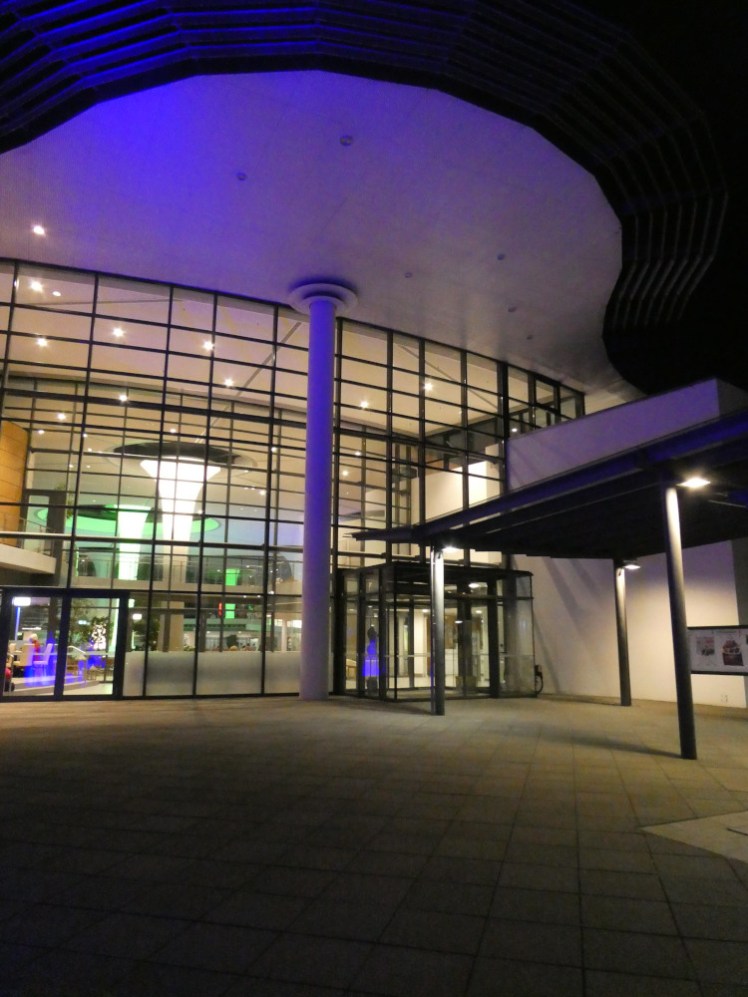
My plan for Bad Kissingen had been to arrive at lunchtime on Sunday, spend the afternoon or evening in the therme and then depart for Bad Ems on Monday. Knowing Deutsche Bahn’s reputation these days, I’d decided to set off in the afternoon on Monday, giving me the morning for KissSalis in case I was delayed enough on Sunday that I missed it then. Having not missed it or been delayed or had any major rail problems, I then found I didn’t have much to do on Monday morning. Bad Kissingen is a very pleasant place, evidently designed for you to just stroll and eat and drink and sit and take time out of the real world but that’s something I’m not very good at. I’d already strolled for some time on Sunday. I had a bag overflowing with snacks. I’d been up to the tiny supermarket opposite the church to drop off a bottle for recycling and buy some bread for the day and then… well, what do I do? Go back to the hotel in a rush to pay for my night there, for one thing! I tend to use booking.com and every place I’ve ever stayed has handled payment differently. Sometimes they take it immediately. Sometimes they take it a week before the stay. Sometimes they take it on a random date. Sometimes they don’t take it at all and I have to pay on arrival. Having not been asked to pay on arrival, I assumed this was one of the ones where it had been taken online in advance – it’s hard to keep track of these things when you’ve got four separate hotels in four separate places and you booked them over a month ago. There was no one at reception when I departed, so I left my room key behind the desk and walked out. Half an hour later, I found two missed calls from an unrecognised number in Bad Kissingen. Since no one else in the town had my number, it had to be the hotel. So I rushed back, paid and then spent two days in a panic because where my Baden-Baden hotel had “complete” against the booking, the Bad Kissingen one didn’t, and I’d been emailed to say that booking.com would take payment automatically from my card on Thursday. Please please update my account to say I have paid, it was a nice hotel and a nice breakfast but I don’t want to pay twice for it just because I’m an assuming idiot and they haven’t got the sense to take payment on arrival like everywhere else I’ve ever stayed! Long story short, they did update my account before Thursday.
In the end, after freezing my feet and half of my soul in an attempt to do the park’s barefoot trail (in February in Germany, this is a really bad idea!), I got the train two hours early. My ticket permitted me to take local trains any time the day I’d booked them so that was fine but the ICE train from Würzburg to Frankfurt was the one fixed train of the day that I couldn’t mess around with. I think maybe if it had been a bit warmer and if I didn’t have luggage and if I’d set my mind to it, I could absolutely have sat in a cafe overlooking the river and just enjoyed not doing much for a few hours but in February, knowing I’ve got five trains and a bus ahead of me and that I’m going to arrive at a hotel after reception closes, it’s hard to just settle down to some leisure, even in a town designed for it.

 I Am A Polar Bear
One thought on “Leisure in Bad Kissingen”