Baden-Baden is a well-known spa town. It’s almost the ubiquitous spa town. Does it do anything else? Does it have any other claim to fame? So when I started writing my Bath Book, a travelogue of some kind about hot water, steam and bathing culture, Baden-Baden was the first place to come to mind. But the golden age of spas is some years past now. What’s Baden-Baden like in the 21st century? Is it a bit… past its best?
No.
I admit, I was expecting it to be somewhat like Budapest – too many spas to choose from and I’d spend three or four days there trying to get through as many as possible. I was therefore disappointed to learn that today there are only two – give or take the ones inside hotels, which don’t really count. Three or four days got whittled down to one full day and one afternoon because if there are no spas, what else can there be in Baden-Baden apart from faded and crumbling glory?

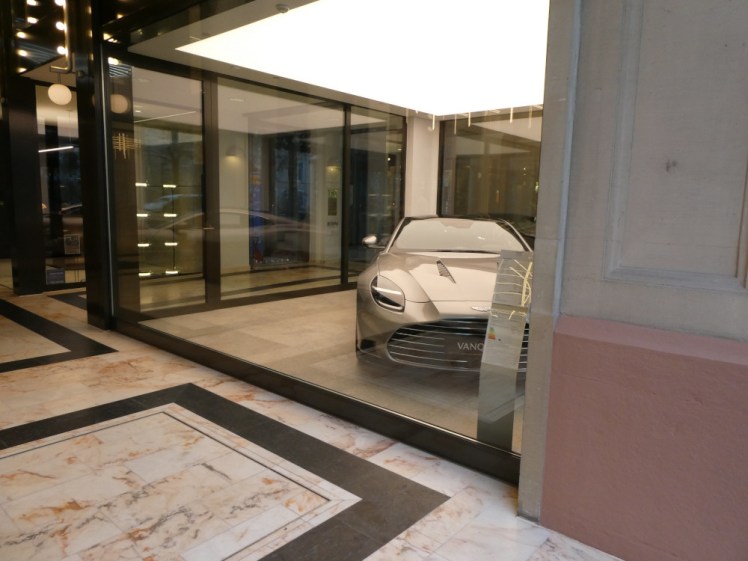
The first thing I saw when I got off the bus – the railway station is a good two or three miles from the heart of town – was an Hermès shop. I didn’t even know brands as exclusive as Hermès had shops outside of places like Paris and Milan, so that immediately turned my idea of Baden-Baden on its head. Walking down to the only supermarket in town began to solidify those ideas; coming across an Aston Martin shop with two Aston Martins in the window and a nicely-dresses couple looking at them and at brochures with wine glasses in hand cemented them. This town is perhaps a little old-fashioned but it is absolutely intended for a well-heeled clientele, even now.
What helped me really understand it was the realisation that “spa town” doesn’t necessarily mean that it’s dominated by long luxurious days with hot baths, saunas and a menu of massage treatments. In fact, a Golden Age spa town may never have had that kind of facility at all. Baden-Baden did – its Friedrichsbad dates back to 1877 and was inspired by the Roman Baths built here over two thousand years ago – but I’m yet to confirm that either of the other towns I visited had anything before the modern thermes were opened. No, a spa town is actually largely just a leisure town. They all almost certainly had a large casino originally and it was probably when the casino was shut down that they began to push the wellness aspects towns like these – got to find something to keep the aforementioned well-heeled clientele coming!
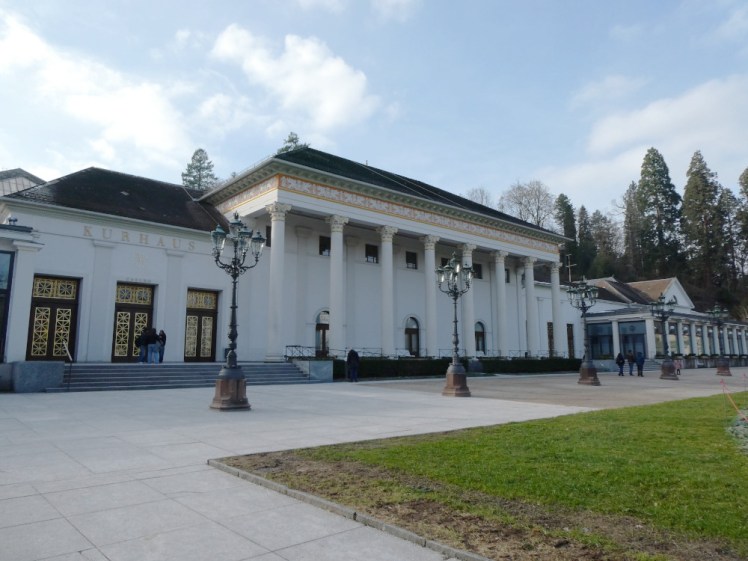
Towns like Baden-Baden, spa towns, tend to have a natural spring. It’s not necessarily a hot spring! We have several spa towns of our own in the UK; Bath claims to be the only one with hot water in theirs. Baden-Baden does have a hot spring – in fact, it has a few. So it has baths. But like its siblings, the main purpose of the spring water wasn’t bathing, it was drinking. Every spa town will have – or will have had, if it’s no longer there – a Trinkhalle, a probably large and ornate building where you went to drink the water. This is where the wellness aspect comes in.

Let’s be delicate. I have drunk mineral-rich hot spring water. The first time I went to Iceland I filled a bottle from the hotel tap. This is fine, normal and actively encouraged in Iceland. But this particular sink had a mixer tap and no matter how far I turned it and how long I ran it, it never fully produced the famous ice-cold crystal-clear cold spring water. It stayed ever so slightly warm and ever so slightly cloudy. “Well, it’s cool-ish”, I said, and drank it. And now I know first hand what real fresh-from-the-source spa water does to you (and from Michael Portillo taking one of his Great Rail Adventures to one of the UK spa towns, so this is not just coming from me!). If you’re being polite in the 21st century, you might say “it detoxes you”. In 1877, maybe words like “clean” and “purify” might get thrown around. It “detoxes” you by emptying everything you’ve eaten in the last week at great speed in a downward direction. Please do take a moment to picture these genteel 19th century ladies and gentlemen enjoying this effect in Victorian-era plumbing.

When they weren’t being turned inside out by the water, these people strolled and shopped and replenished. Spa towns didn’t have an abundance of heavy industry or agricultural markets. They had parks and promenades and theatres and villas. They existed more or less purely in the pursuit of leisure. And so, that top part of town, the pretty part, the bustling part of town, is where all this happened, and still more or less continues today. The two or three miles between here and the station are where the ordinary people live.
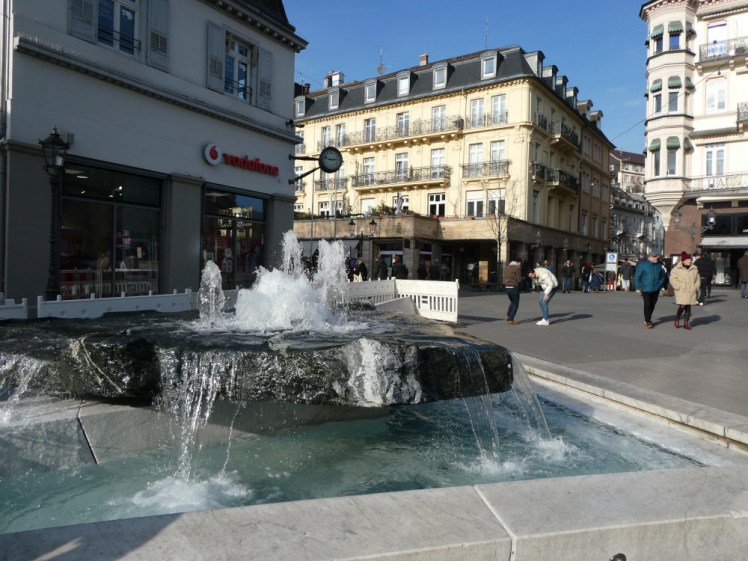
If you’re not in stately traditional Friedrichsbad or modern noisy Caracalla Therme, you’re probably out and about in town. There’s a couple of streets of assorted designer shops, jewellers, bakeries, cafes and so on and then, separated ever so slightly by the park, is the old leisure complex. The Trinkhalle is now a gallery, a restaurant and a room with a disused drinking fountain in it – the water still runs but you’re not supposed to drink it anymore. Go and have a glass of wine out in the garden instead. You’ll thank me later. The casino is still a casino, not hugely busy by day and the people constantly trickling out of its doors are actually exiting the big public car park lurking underneath. This imposing building also houses a restaurant and event space – which might be a banquet or a concert, or even a music festival.

From here, if you pass through the short “avenue” of designer and luxury shops in their own mini open air shopping centre and turn right, you’ll find yourself on Lichtentaler Allee, a leafy car-free avenue that winds along through the park, beside the river and passing the theatre and assorted galleries and museums for 2.3km. Officially this ends at its namesake Lichtental Monastery but it’s now part of a circular loop that comes back into town by Caracalla Therme. If you want a taste of that Golden Age decadence, you can take a horse-drawn carriage ride along Lichtentaler Allee – or you can just stroll.

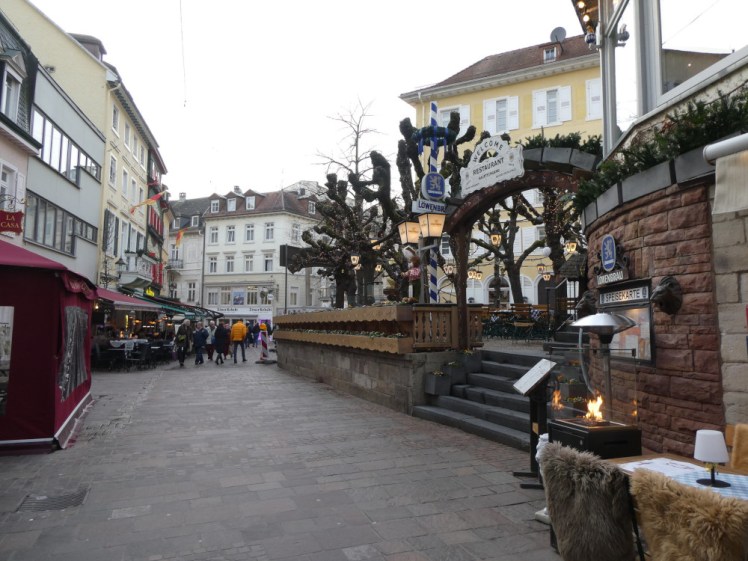
The obvious route from Leopoldsplatz, the big square/semi-pedestrianised centre of town through which buses nonetheless run, to the spas is up Sophienstraße, which is the leafy promenade with cars parked up each side. Just about where the promenade stops, you turn left. If you turn left earlier on, you’ll find yourself in the back streets which have a decidedly more Bavarian air to them. This is where you’ll find the slightly more utilities shops – bookshops, souvenirs, pharmacies, cafes more prone to steins of beer than glasses of wine and restaurants that lean more towards wurst.
The last thing I absolutely have to tell you about is the old hospital church right outside Caracalla Therme. It’s quite small but the doors are probably open and it’s got some spectacular stained glass. It looks very modern and by church standards, it is – it was designed by an artist called Harry MacLean in the 1950s and created at the Heidelberg glassworks. It depicts, as many do, scenes from the Bible, in screaming colour and an almost sketched style. The Four Horsemen of the Apocalypse shine down from the left, the Archangel Michael fights a dragon on the right and the sun radiates from the triptych behind the altar. I’ve said before, probably many times, that I’m about as un-religious as they come but stained glass is my absolute favourite form of art and these are well worth a visit. After all, you’re in Baden-Baden – you’re here to make merry, bathe and take in art.

Baden-Baden is perhaps a relatively old-fashioned and quiet sort of leisure town. Nothing outside Caracalla is likely to attract lads on tour or hen parties. Yes, it probably is past its Golden Age but it’s not yet fading – the designer shops and new(ish) spa say firmly that this town is remaining a leisure destination for the well-heeled in a way that’s adapting to the 21st century but it’s not entirely leaving the 19th century behind either. You probably don’t want more than a couple of days here as a tourist – as a lady or gentleman of leisure, I’m sure you could waft from cafe to Friedrichsbad to Hermès quite comfortably for quite a bit longer. But for me, I was moving on to Bad Kissingen.

 I Am A Polar Bear
One thought on “Is Baden-Baden past its best?”