I’m astonished I’ve never written about the natural hot spring at Landmannalaugar – or not in the summer, anyway. I wrote about the visit I made in 2013 in thick snow where we used the river as a road and scampered about in a snowstorm getting dressed but I’ve not done a proper snow-free trip to Landmannalaugar.
Ok, it’s an oasis in the Icelandic Highlands. At a push, you can get a conventional car there except for the ford right at the end. I wouldn’t recommend doing it in a conventional car but if you do manage to coax it all the way there without ripping out the suspension or getting caught in a river, you should stop at the first car park and walk the rest of the way to the campsite. It’s about 500m and there’s a footbridge to cross the river. If your vehicle can manage this last ford, you can park along the edges of the campsite. If you come by bus, it’ll deliver you right to the campsite. These days, you have to book and pay for your parking space in advance in the summer, which is currently 450kr a day for a car seating up to 5 people and 600kr if you have up to 9 seats.
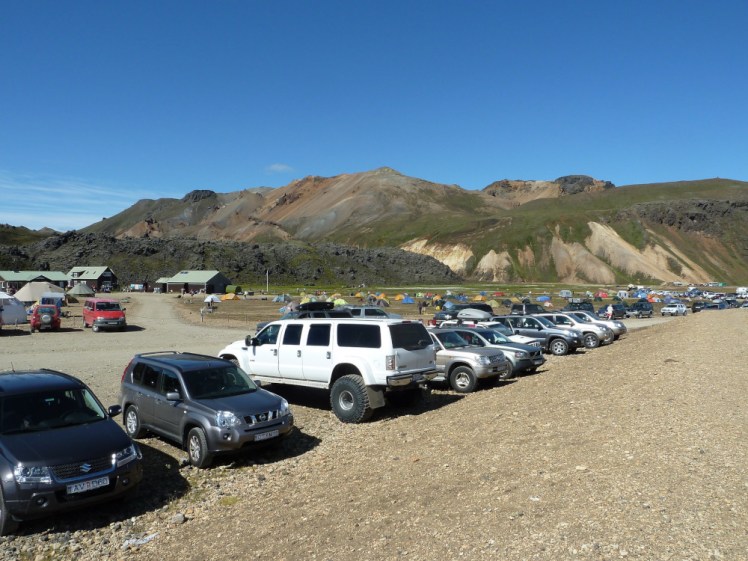
I call it an oasis because it’s very green – it’s rare you’ll find even thin patchy grass like this anywhere else in the Highlands and the reason for it here is that a cold stream running along the edge of a 500-year-old lava field meets a flow of boiling water from under the lava here, where it mixes to form a lovely little bathing pool. This constant flow of hot water means things don’t freeze quite so easily right here and they recover quicker in the summer. The campsite radiates out from around the central buildings, which house the wardens and rangers and a shower/toilet block. Day visitors who are not camping need to pay a service fee and wear a wristband for access to the toilets and showers. Campers can use the toilets for free but showers are 1000kr for 5 minutes – they like you to pay in cash at the warden’s office for this because internet connection can be patchy but you can also pay by card. You get a slip of paper with a QR code on it and you scan that once you’re ready to go. The hot water is generally pretty reliable – it comes from the ground so it probably smells of sulphur but there’s no need to wait for any machine to warm up.

If you’re camping, they advise you to weigh down your tent and your ropes with rocks which they keep in wooden boxes around the campsite. Please take the rocks back to the box when you’ve finished with them – it’s so much easier than campers having to play scavenger hunt around the entire campsite for them. The campsite is much greener to the north – that’s the end closer to the ford and the bathing place, so it’s probably less rocky and more comfortable up there. In 2013, when I last camped there, I found a patch of grass precisely the size and shape of my one-man tent to pitch on.

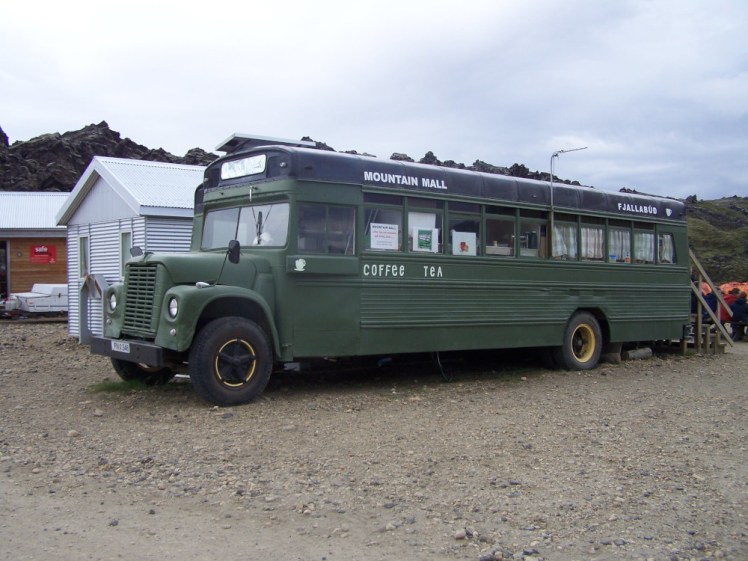
As a camper, you don’t get to go in the hut, where there are kitchen facilities for people staying inside in the bunkrooms but there are two green American school buses parked nose to tail just to the south of the camping area and these are called the Mountain Mall. This is where you can buy bits and pieces of food or camping essentials, get a hot drink or apparently even a hot meal – soup, toasties, sandwiches, nothing gourmet but more than you’ll get at most remote campsites. I understand that they drive these buses out to Landmannalaugar every year so they’re only there in summer but unless you’re on a specialist day tour, so are you, probably.
This is where the Laugavegur trail starts. If you’re doing a guided tour like I did, you’ll probably only stop here long enough for a toilet break and for your guide to write your group’s details on the departure board but if you’re going alone, I’d spend the night here, enjoy that which is special about Landmannalaugar and set off in the morning to give you the whole day to cover the 12km to Hrafntinnusker. It’s one of the shorter days – days 1 & 2 are 12km each, day 3 is 16km and day 4 15km – and it’s the one day with no river crossings but it’s still the most strenuous day, what with ascent of 470m to pretty much the highest point of the four day trail (it trends largely downhill for the second, third and fourth days), there’s probably snow and the Hrafntinnusker hut and campsite are the most basic on the trail, so I’d give myself as much time and luxury as possible before I set out.
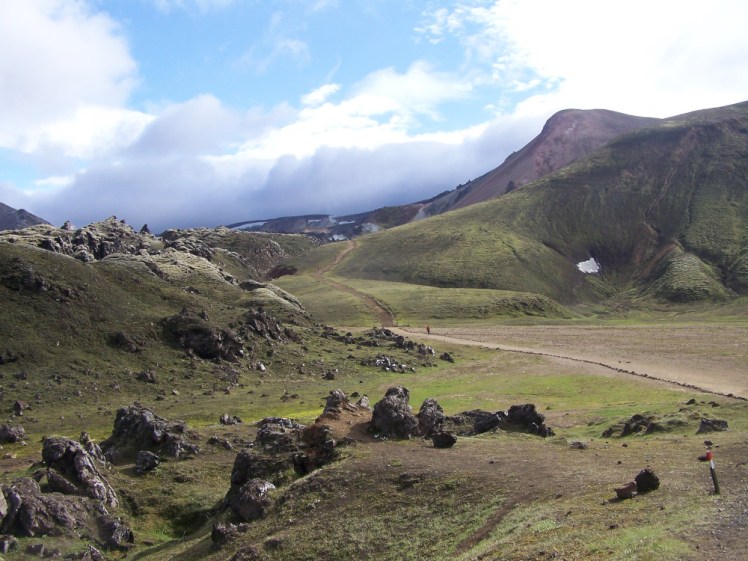
If you’re not hiking and you’re just here to enjoy yourself, there’s plenty to enjoy. I walked down to Green Canyon – follow the edge of the lava field south until you find a massive green boulder forming a step into a canyon – and round to the north end of the campsite, which is a lot more fun if you have a map and know that you’re ending up back at the campsite, which I didn’t! Or you can just stroll the gravel plain and enjoy the peace – you only have to get a couple of hundred metres from the campsite to find yourself alone. Or you can go into the warden’s hut and get maps for various other local hikes.

Or, and now we’re getting to the big one – you can go in the hot pool. That’s what this place is famous for, so during the day it’s going to be packed with tourists. The buses leave around mid-afternoon, so if you’re camping, it’ll be a lot quieter by about 5pm. A couple of warnings: this is a natural hot spring. You can see the water boiling out from under the lava, so don’t get too close. And be aware that there are things in the water. Things like handfuls of green weed flourishing in the warm water. Oh, and a larval flatworm parasite that can cause paralysis in ducks. It’s not known to cause serious harm to humans but it can cause allergic reactions and swimmer’s itch, so keep that in mind and have a good shower afterwards.

The other thing to keep in mind is that there are no changing facilities. There’s a kind of bench and fence where you can leave your clothes if you trust that they won’t get blown away or rained on, or you can change back at the campsite, in your tent or bunkroom or in the shower block and then run down the 170m wooden boardwalk over the bog in your swimwear. I get round this by wearing a microfibre towel, which is surprisingly wind-proof and carrying a drybag to put it and my shoes in, which I can then clip around one of the fence posts if it’s windy. You’ll probably want shoes – you then walk down a few steps into the cold river and then wade 20m along a pebbly river bottom until you reach the place where it’s warm and pleasant. I’ve done it barefooted every time I’ve been there but it’s probably better to protect your feet.

It’s not a very deep pool. It’s definitely a sitting pool rather than a swimming one. In fact, it’s probably a “sunglasses on, beer in hand” pool. Iceland has so much geothermal water, so many pools fed by boreholes or springs or pipelines but this one feels very natural. I daresay the pool itself was dug out but the water comes from that river right in front of you and that lava field to your right and you can see it mixing right in front of your eyes, which means you can also shuffle around to find a patch of precisely the right temperature.

If you’re getting the bus back, keep an eye on the time – it’s easy to spend too long sitting in natural hot water. Leave enough time for a shower (and buy your QR code before you come down to the pool!). If you’re camping, you’ve got all the time in the world. If you’re hiking the Laugavegur Trail, enjoy your last night in civilisation for a few nights – and remember, there are hotpots at the Volcano Huts when you reach Þórsmörk.
 I Am A Polar Bear