Back in August, I did a post about the benefits of tour guides and I’m starting to wonder how much this post is just going to be a rewrite of that one, but let’s give it a go. Iceland attracts a lot of tourists and a substantial chunk of them hire a car or a van and take to the Ring Road unsupervised. Of course, the vast majority of them come back just fine but I was inspired to write this by some idiot on YouTube who bleated about stopping at a glacier for a little explore and this – need I really say it? – is a really stupid and dangerous idea. So I thought it was about time to go around Iceland and talk about the kind of things you can and can’t do on your own.
Most things you can do just fine on your own. I’d advocate for tour guides more often than some people use them because disdain for all things reeking of tourism result in travel creators who can neither pronounce the place they’ve been to nor explain why it’s popular. All the vanlifers who’ve driven around the Ring Road: can even one of them explain why Þingvellir is one of the major Golden Circle stops? No, probably not. You don’t need a tour guide to explore geothermal pools or museums or most waterfalls. You don’t need a tour guide to climb certain volcanoes. But this is where you do need a tour guide.
Glacier adventures
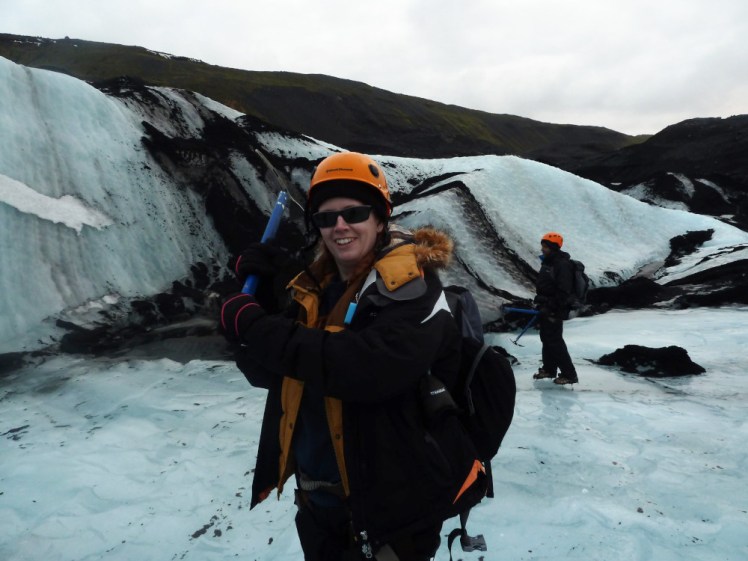
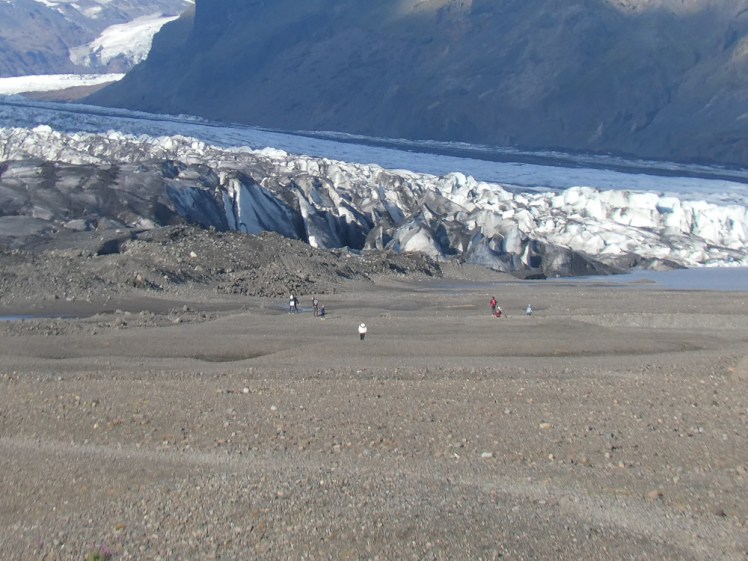
To the average tourist, a glacier is just a river of ice. No problem, let’s go and have a look at it! But glaciers are really dangerous. For one thing, they’re much deeper than you realise. Icelandic glaciers can be up to about 500m deep; serious glaciers right up in the north of the planet can be much deeper. You do not want to fall down a crack. You may not even see a crack. That crack might be covered with half an inch of ice, which your foot is going to smash straight through, sending you plummeting to an icy death. That’s the big danger of glaciers. Slipping on the ice and breaking bones is an inconvenience but can happen right in downtown Reykjavik in winter. Falling down a crevasse or a moulin, which is a kind of circular hole “drilled” by water, can be the kind of fatal where no one will ever find your body or know that it’s down there. Don’t go on glaciers on your own. No, not even right at the tongue. Take a close look at this photo of the glacier fading out at Skaftafell and then look closely at the people. Even right at the end, where it’s thinning out and melting into a muddy gravelly pond, it’s as high as a house. You want to fall the height of a house into muddy gravelly ice?
How to do it safely: there are so many companies running glacier tours in Iceland, from hiking and climbing to snowmobiling to exploring the interior. Glacier Guides, Arctic Adventures and Icelandic Mountain Guides are all good places to start.
Caving
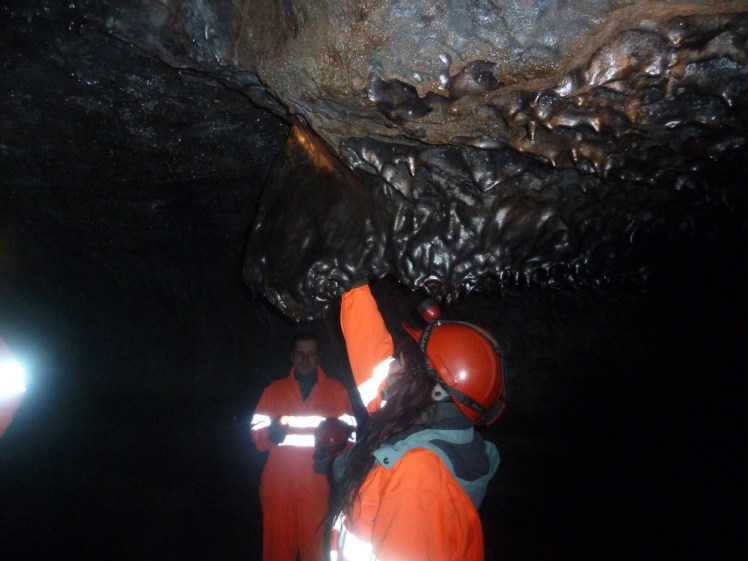
People have a sort of idea that caving is dangerous and they’re right, so this one doesn’t tend to happen unsupervised so often. People who’ve only been in show caves are vaguely aware that not all caves come with electric lighting and concrete footpaths and people who cave as a sport – like me – are acutely aware of the pitfalls and probably have personal experience with some of them. But Iceland’s lava caves have a few extra dangers to be aware of, besides the usual uneven floors, risk of collapse and getting stuck in tight spaces. As a general rule, limestone caves have fairly fresh air in them. Lava caves might have pockets of toxic volcanic gases trapped in them. You don’t know if they do or where they do. Ice caves have a huge risk of collapse, especially in spring and summer when the warmth melts the ice ceilings.
How to do it safely: again, Arctic Adventures are a good option for both lava and ice. Raufarhólshellir, a lava cave an hour or so south of Reykjavik, has its own tour, as does Víðgelmir in the west.
Exploring the Highlands
This is really popular with the kind of person who thinks they’re “above” mere tourists, to take their van and make an intrepid exploration into Iceland’s inhospitable Interior by oversized 4×4. I’m here to tell you not to do that. Number one, only specialised – and therefore expensive – rental companies are legally allowed to give you a vehicle you can take into the Highlands. There are signs at the start of all the F-roads, the ford-ridden mountain roads, declaring that it’s illegal to drive rental cars on these roads. The rental companies don’t like their undersides getting torn off by rocks, their suspension destroyed by lava fields or the entire car getting washed away in a river but they really don’t like it when their customers end up dead. So you need to find a special company with a lot of insurance and I suspect you have to prove your competence, because Icelandic river crossings are not for the faint of heart.
Number two, yes, the F in F-roads stands for fords, for roads that go straight through rivers. There’s one in the New Forest in genteel southern England where the water, generally, is only a couple of inches high and maybe ten feet wide and cars still come to grief in that, especially when the weather has been bad and the water is up. You want to do that on a glacial river? The campsite at Thórsmörk has an excellent book of pictures of cars getting in trouble in rivers they weren’t expecting to be as high or as fast as they were.
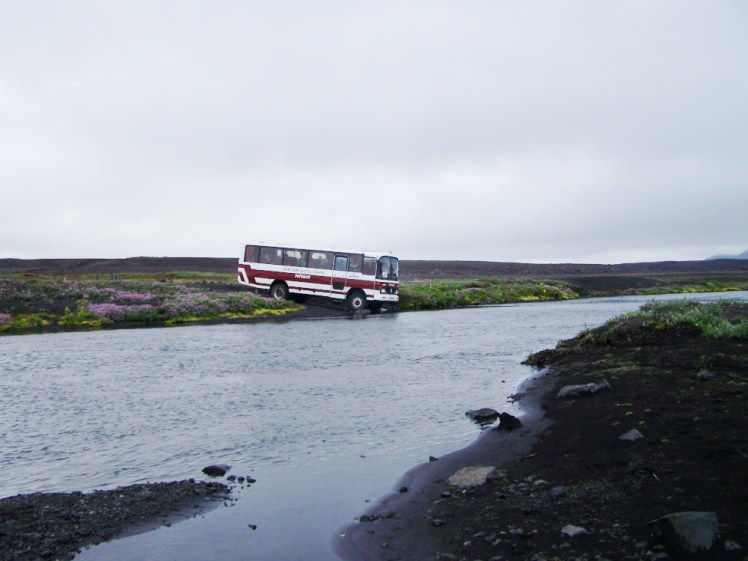
Number three is the fact that the roads are often little more than scratches in the landscape, marked by yellow poles. They disappear altogether in winter. Even if you’re capable of driving on several feet of compacted snow, good luck following the route in that.
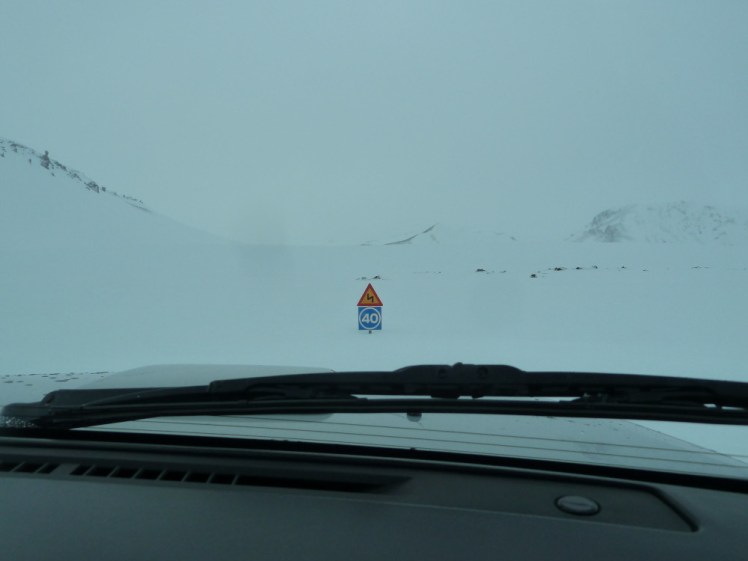
And number four: tourists who take to the Highland roads often forget that even out here, they have to stick to the roads. They want to explore, adventure, go off-roading and that’s illegal! Tyres very quickly and easily damage Iceland’s fragile landscape and in a country that’s almost entirely wind, rain, snow and cold, the landscape does not easily recover. No one wants to see your tyre tracks scarring an otherwise-pristine subarctic landscape.
Number five, I guess, it encourages people to wild camp, which is yet another thing illegal in Iceland for the protection of the landscape. There are campsites in the Interior and there are even huts and hotels. I promise you, for I’ve seen them, the police do roam the Highlands in the summer, looking for people illegally driving and camping in the Highlands. You’re not entering a zone beyond the law.
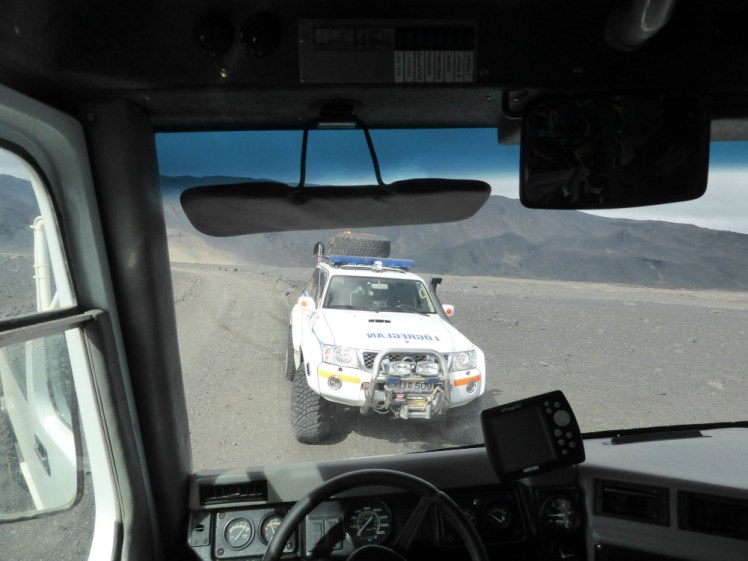
How to do it safely: there are relatively few ways to explore Iceland’s Interior with a professional. Askja tours are one way to approach from the north. Arctic Adventures and adventures.com (I suspect they’re the same company) do trekking or superjeep tours. Icelandic Mountain Guides does multi-day hiking tours. I did a Laki tour back in 2013 and there used to be a Highland bus that would go up to the north coast from Landmannalaugar three times a week but it seems those are long gone.
Diving
If you’re interested in diving and Iceland, you’re probably well aware of Silfra, “the crack between the continents” where you can dive in crystal-clear water between tectonic plates. “Between the continents” is a technicality – the edge of the North American tectonic plate is where you can see the black cliffs behind the car park but the edge of the Eurasian plate is a good couple of miles away. The fissure that you’re diving in is just a fissure in that no-mans-land – it’s not one wall of each plate.
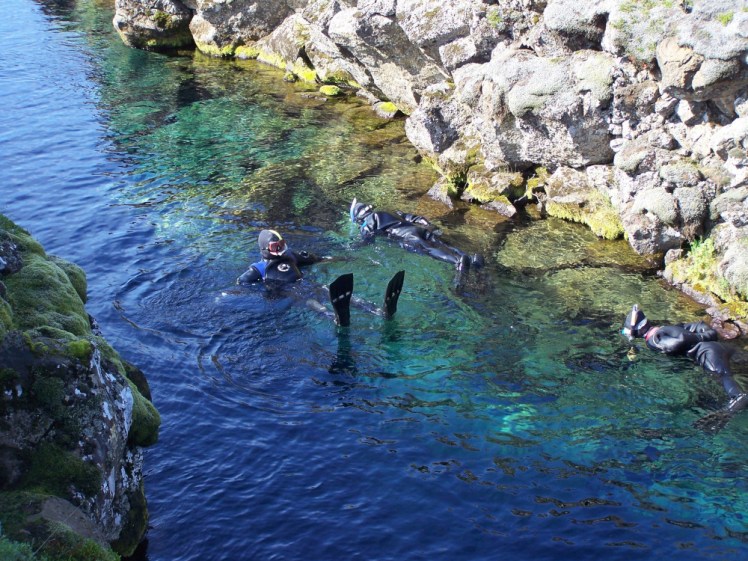
Once upon a time, there was very little to stop you turning up and jumping in. Now you can only go in Silfra with a registered company and if you want to dive rather than snorkel, they’ll want to check your qualifications. Silfra is glacial water which has seeped into Þingvellir from nearby Langjökull through the lava rather than over it in a river and chances are, you’ve not dived in water that cold before. Chances are also you haven’t brought a drysuit in your luggage, or even a wetsuit and quite frankly, in those temperatures, you’ll probably die without them. Yes, even in summer.
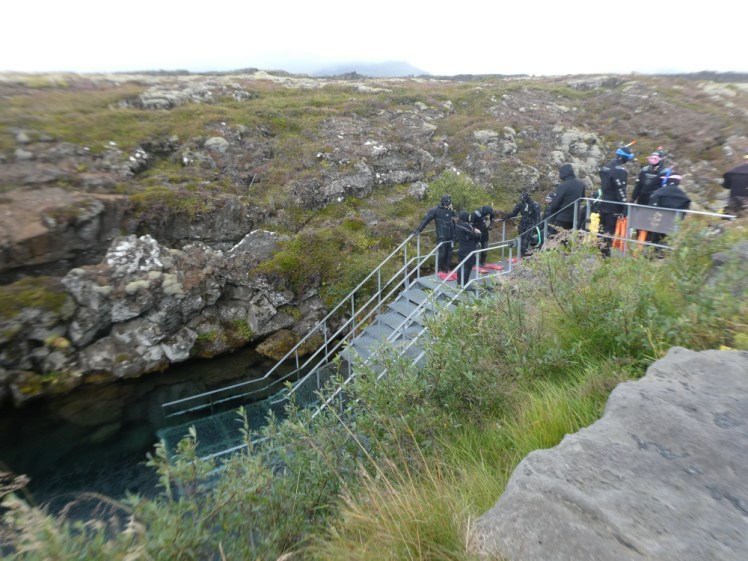
If you don’t have your qualifications, you can do your Open Water Diver certification and Dry Suit Diver certification in Iceland (but I’d take a good guess that for the price, you can go somewhere warmer and get the same qualifications for a fraction of the price in warm and scenic waters).
How to do it safely: The best company is probably dive.is although there will undoubtedly be a handful of other companies running the same tours, but most likely not offering the courses.
 I Am A Polar Bear