“The Cave” is a ludicrous way to start this but it’s the way the landowners are marketing their lava caving trip into Víðgelmir, Iceland’s biggest lava cave – or at least, the biggest one discovered that it’s possible to go inside. I have a hypothesis that a lot of things in Iceland are very self-explanatory because it has such a small population that you can pretty much get any top level domain you want. Hence their helicopter tours are at helicopter.is, information about its roads are at road.is and if you want to pay the fee for driving through a tunnel, you can do that at tunnel.is. Someone else got to cave.is first, so they went for the second most obvious and the Víðgelmir tour is at thecave.is. “What’s the tour to the cave called?” “The Cave.” “Oh yeah”.
“The Cave”‘s actual name is Víðgelmir. No one really knows what it means and I was too stupid to write down their best guess. I think the first part, the við-, means wide. There’s a river Vaðgelmir in Norse mythology which has been translated as “evil ford”, so Víðgelmir might be a take on that and it might be “wide ford” or “wide stream”. Anyway, its meaning has been lost to time and all tour guide Gareth could give us was a best guess, and while I like to know the meaning of Icelandic names, I suppose it doesn’t matter much. Víðgelmir is a lava tube, as are pretty much all caves in Iceland. I’m accustomed to the sort formed by water action in limestone myself but Iceland doesn’t have any limestone and although it does have canyons carved by water action, I’ve not yet found one with much of a roof. Lava caves are fundamentally different from limestone caves in that they’re created by adding rock while limestone caves are created by removing rock.
Whereas a limestone cave is carved out by water eroding the rock away over millions of years, lava caves are created pretty quickly during eruptions. If you watch videos from the recent eruptions, you’ll see rivers of lava flowing away from the vents. These are all pretty small rivers but the one that formed Víðgelmir would have been… well, I was going to say “pretty big” but having seen it, I’ll upgrade that to “enormous”. Víðgelmir’s tubes get up to 15m high. Lava “sets” fairly quickly on exposure to the air but it’s a very good insulator, so the lava underneath stays liquid. You can see all this for yourself up pretty close and in, of all things, a theatre setting at the Lava Show, which has locations in Vík and Reykjavík, by the way. In fact, I highly recommend you visit them before you go lava caving because it’ll all make so much more sense when you get to the cave… sorry, The Cave. Anyway, that lava river under its insulating cover continues to flow and when it runs away, it leaves a pretty perfect tube-shaped round tunnel. Maybe other lava flows will run over the top of it, building more layers and strengthening the “ceiling”. Maybe it’ll even create a two-storey cave system! It means that unlike limestone caves, which are formed underground, lava caves are technically already at ground level because they build a new, higher “ground”.
I went on Reykjavik Excursions’ Lava Cave & Geothermal Adventure tour. Now, I have issues with RE and, frankly, I don’t trust them as far as I can throw them but I’d actually booked with Icelandia, which I hadn’t realised at the time is a consortium of tour companies. RE used to be the trading name of Kynnisferðir and now the buses say “RE by Icelandia” on them, so I wasn’t delighted when I realised what was picking me up. Disapproval turned to mild bewilderment when driver-guide Margaret told me I was the only person on the cave tour, despite our mid-sized bus being pretty much full.
RE scored another black mark from me when it deliberately left five passengers behind, though. Now, it was entirely their fault they didn’t bother to be waiting at the bus stop for pick-up 30 minutes before tour departure but they were on their way in a taxi and only a minute or two away when we left. We knew they were running late. We were already sitting in the bus waiting for them and rather than wait one more minute, we just left them behind. We then had to wait ten minutes at a petrol station on the road out of Reykjavík while they were rushed up to meet us. Extra stress for the idiots and we were ten minutes than we could have been if we’d just waited at the depot.
I’m not sure how much idea I had about where I was actually going, otherwise I might have figured out how & why I was the only cave-goer on the bus. We flew up the west coast in the dark of a mid-December morning, when sunrise is between 10.30 and 11am, through the Hvalfjörður tunnel, past Akranes, and turned right at Borgarfjörður. If our famous five had been on time for their pick-up, we’d have stopped at Deildartunguhver, Europe’s biggest hot spring on the way but we didn’t have time for it. I’ve visited a few times – most recently in the summer of 2022 when I went to Krauma, the spa powered by the spring in its car park, and then camped in the village right opposite. I’ve spent a certain amount of time in this valley in the west. It’s also home to Reykholt, where author & lawspeaker Snorri Sturluson lived; the Icelandic goat farm, a couple of waterfalls and Húsafell. It’s fairly touristy, as rural valleys go, but it’s always going to be quieter than either the south-west/Golden Circle region or the south coast.
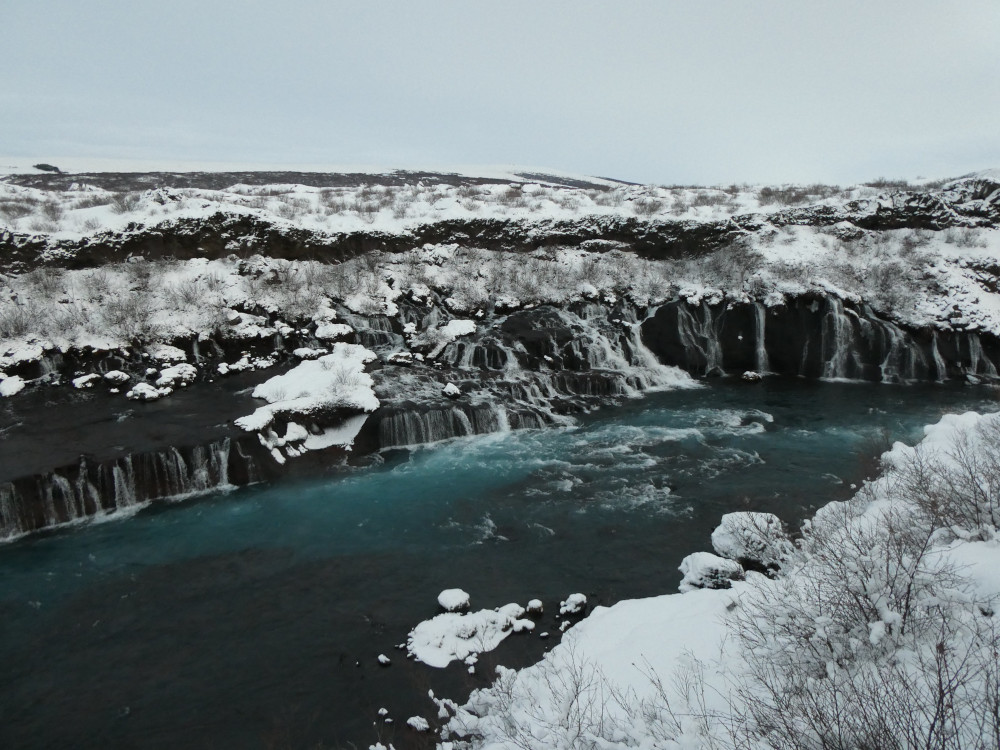
Our lunch stop was at the aforementioned waterfalls. They’re called Hraunfossar and Barnafoss – Lava Falls and the Children’s Waterfall. Hraunfossar is a length of riverbank with water pouring out of it. There’s no river at the top; the water just comes out of the lava field here where the river cut the side of the lava open. Barnafoss isn’t so much a waterfall as a rushing canyon – maybe more a horizontal waterfall carving the rock into whirls and swirls. It’s a terrifying thing to cross on a very rickety-feeling steel bridge. I’ve been here in summer and autumn and I think it’s prettiest in winter, when a thick coat of snow turns the landscape monochrome and the river turns from churning turquoise-white at Barnafoss and calming to a deep teal at Hraunfossar. There’s a restaurant here where most of the group had lunch but I’d brought food with me, so I found a picnic bench and used my swimming bag – a drybag containing swimsuit and towel – as a nice soft warm waterproof cushion for sitting on the snowy bench.
Then we drove the five minutes up the road to Húsafell. I talked about Húsafell in my last post but in summary, it’s part of a church estate, it has a hotel and campsite and is surrounded by holiday homes and it’s the start point for various tours, notably the Langjökull glacier tours. That’s what everyone else was doing. The family of four who made up 80% of our latecomers were doing the Into the Glacier tunnel tour, everyone else was snowmobiling and I was handed over to a man in a lopapeysa who was going to take me to The Cave, where it transpired that there was another tour group who’d presumably come up here under their own steam.
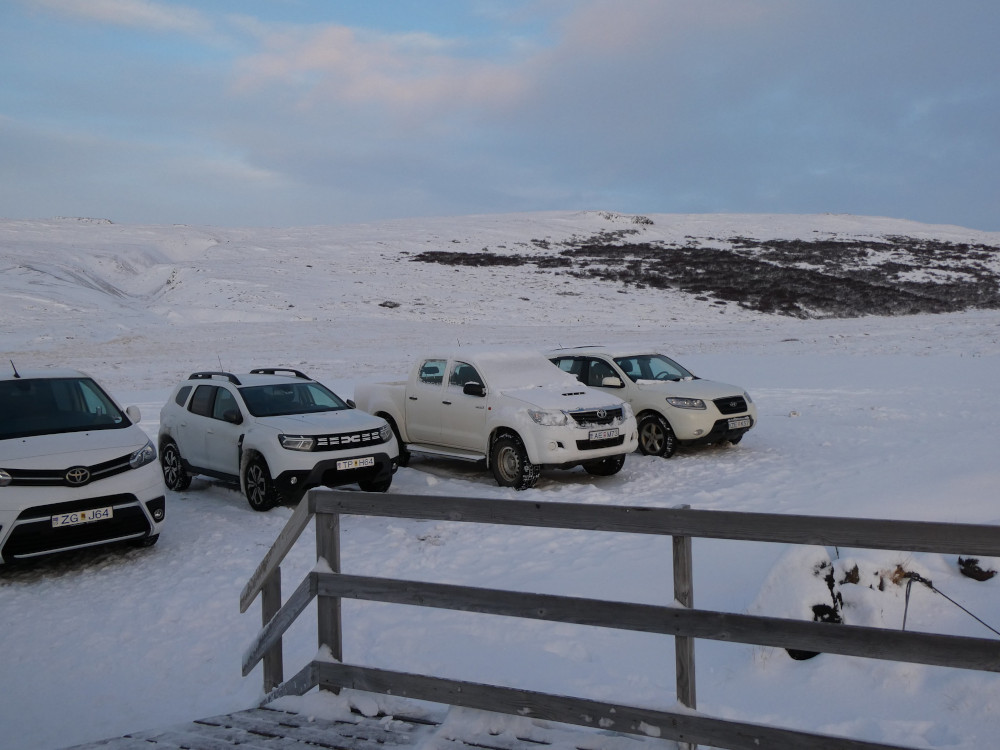
Gareth was very obviously not Icelandic. In fact, he’s a recent import, having met a girl and moved here to marry her. He’s spent his first few months learning all about Viðgelmir and lava caves and although he doesn’t yet speak much Icelandic, you wouldn’t know it from his impeccable – to my English ears – cave terminology. It’s about a ten minute drive from Husafell to The Cave HQ and we chatted – what brought him here, how many times I’ve been to Iceland, shared cave lore, my experience of how the country has changed over the last thirteen years and bad tourist-in-cave behaviour.
When we reached HQ, where I could leave my day bag in his car, we were given helmets with torches on and advised to dress as if we were going for a walk outside. Limestone caves tend to hover around 7⁰C all year round but lava caves – at least the ones with massive open entrances – get cold. I’ve never worn a hat under a caving helmet before and at first I thought I didn’t need to. Soon proved myself wrong!

It’s a short walk from HQ to the cave entrance across a magnificent white mountain landscape. We stuck to a path – not that you can see it – because in the snow, the rubbly ground around it is dangerous, from ankle-twisting rocks you can’t see to potential open holes in cave roofs. The Cave itself starts as a big open pit, perfect for explaining the structure of it, how it was formed, how the roof was formed because we’ve got a cross-section right there, and reassuring us that the roof is a big solid structure that isn’t going to just collapse on us. However, us collapsing became a bigger possibility than I expected – the wooden stairs down into the pit and the wooden walkway that leads into the tube are just thick with shiny clear ice. No photos on the stairs at the best of times but in winter you’re going to want to hold on with both hands at all times and I wished for crampons several times.
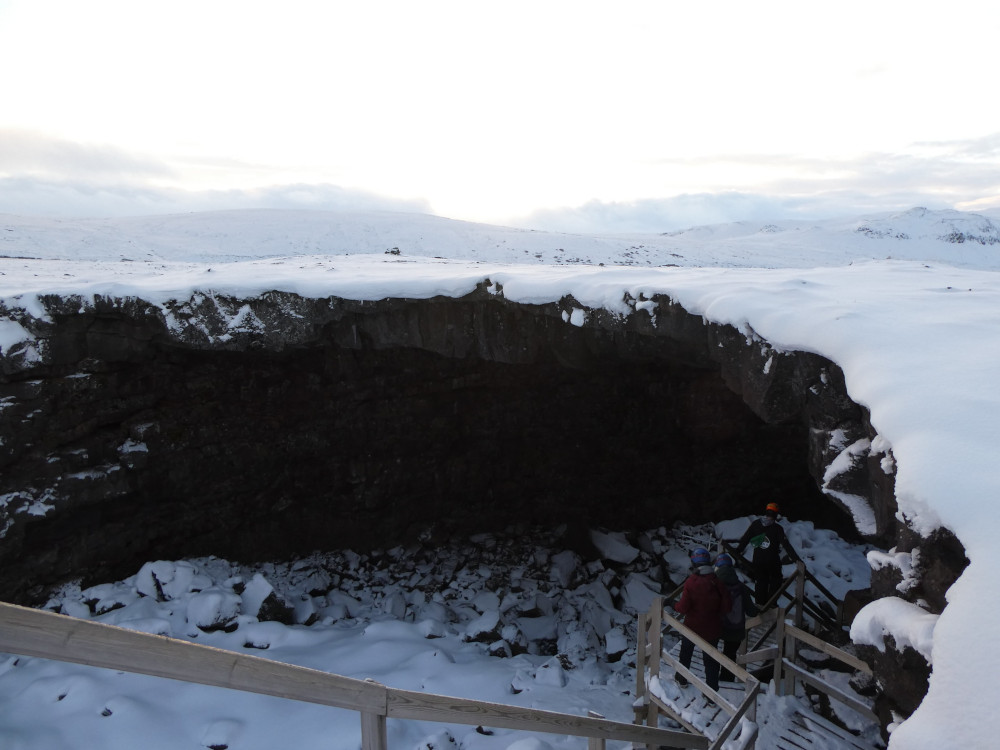
The ice goes further into the cave than I expected. Just as water drips through limestone caves and creates stalactites and stalagmites, it drips into lava caves too. It’s not laced with calcium, so it doesn’t create formations. Just ice. It makes the experience a lot more slippery than I imagined.
I missed the first feature. I forget what they call it. The Squeeze? It’s where a slab of rock narrows the tube immediately before the solid gate keeping unauthorised tourists and fools out. As a caver, this was so not a squeeze that I didn’t even notice it. Maybe you have to duck a bit if you’re tall as it lowers the otherwise excellent ceiling height. Maybe you have to lean as the wall leans towards you. But squeeze? Nah.
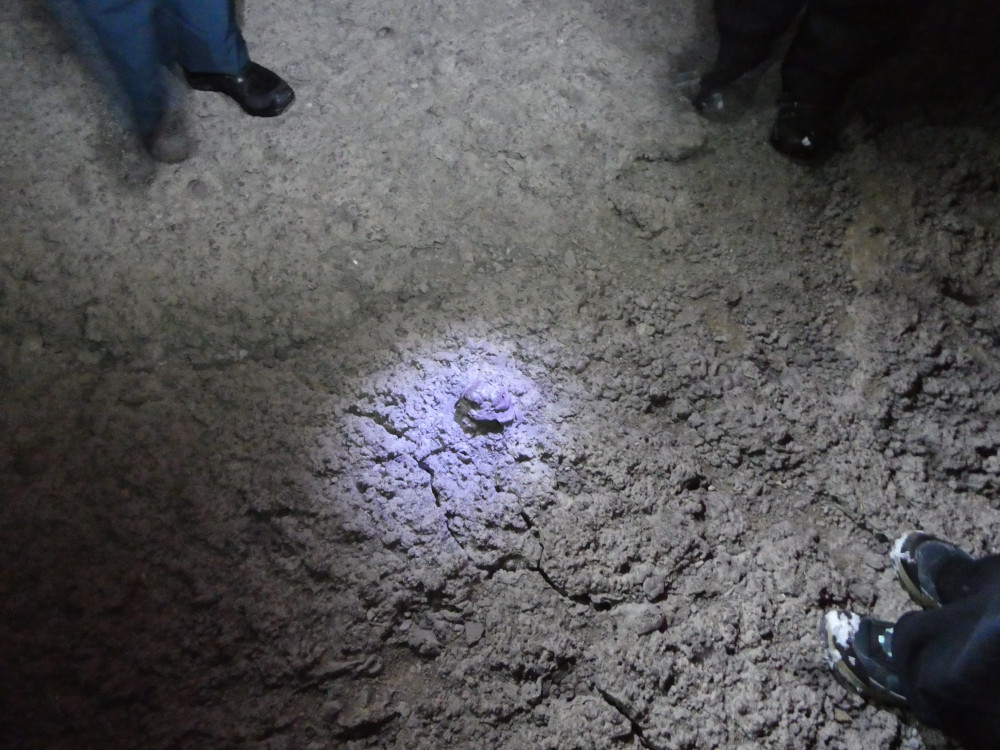
Lava caves do have some calcium-a-like features. I’ve seen them in miniature in Leiðarendi. It’s where the last of the lava drips, creating… ok, look. Gareth pointed out a drip-formed feature on the floor. In Hawaii, this is called a lava rose. But Icelanders, who live in the cold and the rain and the dark are more pragmatic, more literal, less romantic and poetic. I saw where this was going. I saw the feature, I heard the tone of voice and I chuckled when Gareth named it in Icelandic as hraunskitur. “Ah, someone knows some Icelandic”. Hraun is lava, whether in molten or solid form. The suffix –ur is a case ending that, in my utterly uneducated guess, denotes a noun or that the noun is the subject of the sentence or something. Chop -ur off to get at the noun. And I know how skit would be pronounced in sibling language Norwegian. It’s a lava poo!
We found limestone-like hollow straws on the ceiling, small stalagmites working upwards, walls covered in something with the texture of melted chocolate, a tide line about a third of the way up left by a kind of “skin” of custard-like cooling lava – lots of things I understood perfectly well at the time but didn’t, for obvious reasons, write down. When these tunnels are left by insulated rivers of lava, how were they only a third full? Were the tide lines left by the stuff that couldn’t drain easily, the plughole blocked by the river of lava that once filled this place to the ceiling? Do we want to imagine this place filled to the ceiling with white-hot molten lava?
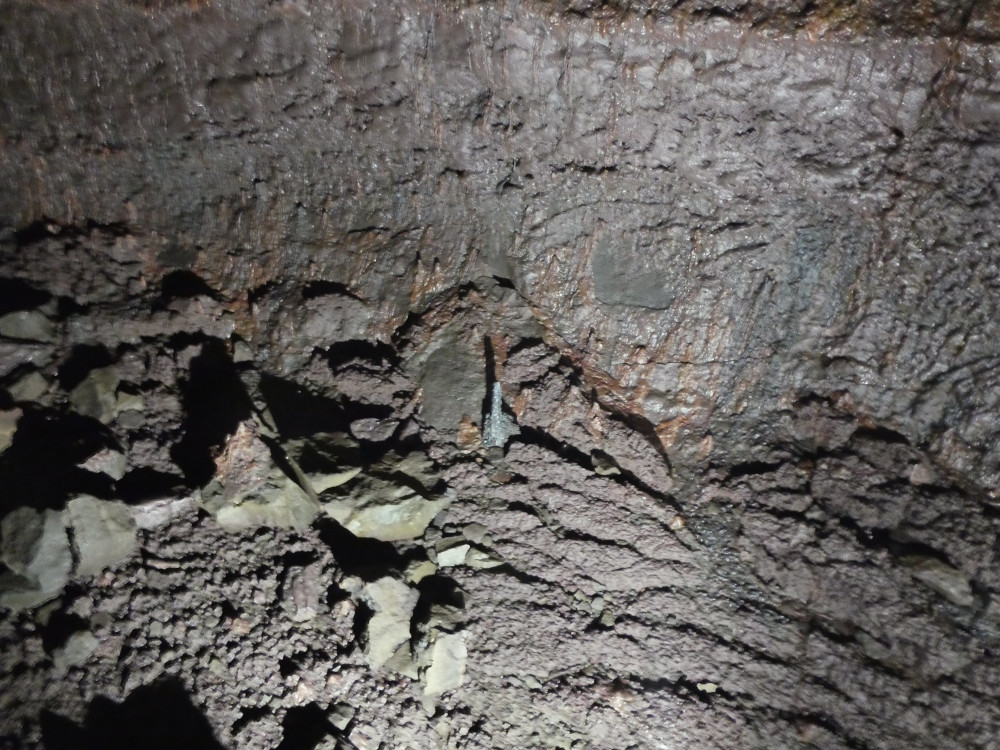
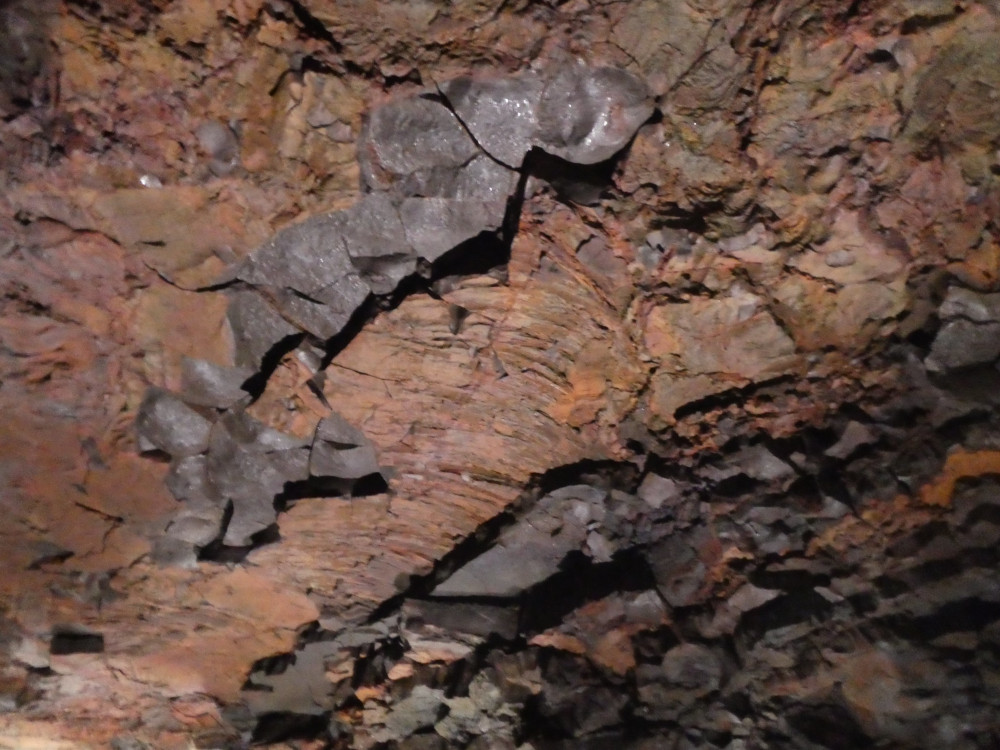
The other place I did reasonably well was in the “guess what minerals left the deposits of different colours” game. Tour guides often ask questions and tourists rarely answer them. I try to, to make it sound like I at least among these people am listening and interested. Yellow deposits are sulphur. Red is iron. Pink, I didn’t get. Pink is silica. I didn’t get blue without the clues – it’s a metal, burns with a bright white flame… Magnesium! Well, I am the daughter of a chemist. I have to know my flame colours or I’m out of the will. Then there was… either green or black and that was a compound, an actual mineral. Olivine? Oliviarite? No, Wikipedia says I was right the first time, it’s olivine and it’s a magnesium iron silicate – so all the elements we’ve already seen, combined to make a new colour.
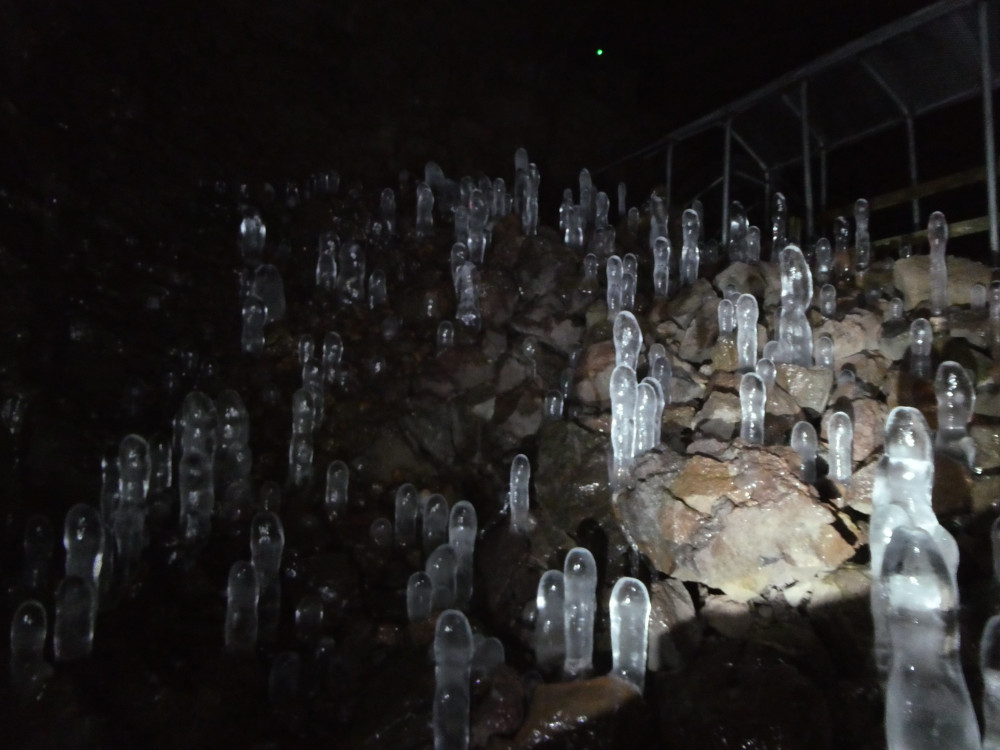
But the most striking feature, the most alien feature, was the field of ice stalagmites. I’ve seen ice stalactites in Leiðarendi – great sharp spears of ice hanging from the ceiling. These were growing from the floor, they were bulbous and they were about a foot tall. They’re also formed from the water dripping through the cave and they’re a winter-only feature. Like I said, Icelandic lava caves don’t stay at a consistent year-round temperature. These ice-agmites were only six or seven weeks old at the time and started to form in early November when the first snow came. I guess they’ll be around two to three feet high if you go there today and in the summer they’ll be gone. They’re by far the weirdest thing I’ve ever seen in a cave and strangely unsettling. Perhaps that was because Gareth mentioned a child eating one like a lolly on the way up to The Cave where we both indulged briefly in a horror-fantasy of ancient parasites trapped in the ice. It’s not ancient ice! It’s fresh rain and snow only fallen in the last couple of months! The Cave itself is around 900 years old, formed in a series of eruptions shortly after the Settlement.
We only went about halfway into Viðgelmir. This is for a few reasons. Reason number one is to preserve the cave. Tourists can’t break or remove or erode features they can’t get at. Reason number two is that there’s nothing new to see further in. It’s just more of the same. Reason number three is that the tour is an hour, maybe an hour and a half and that’s plenty of cave for most people.
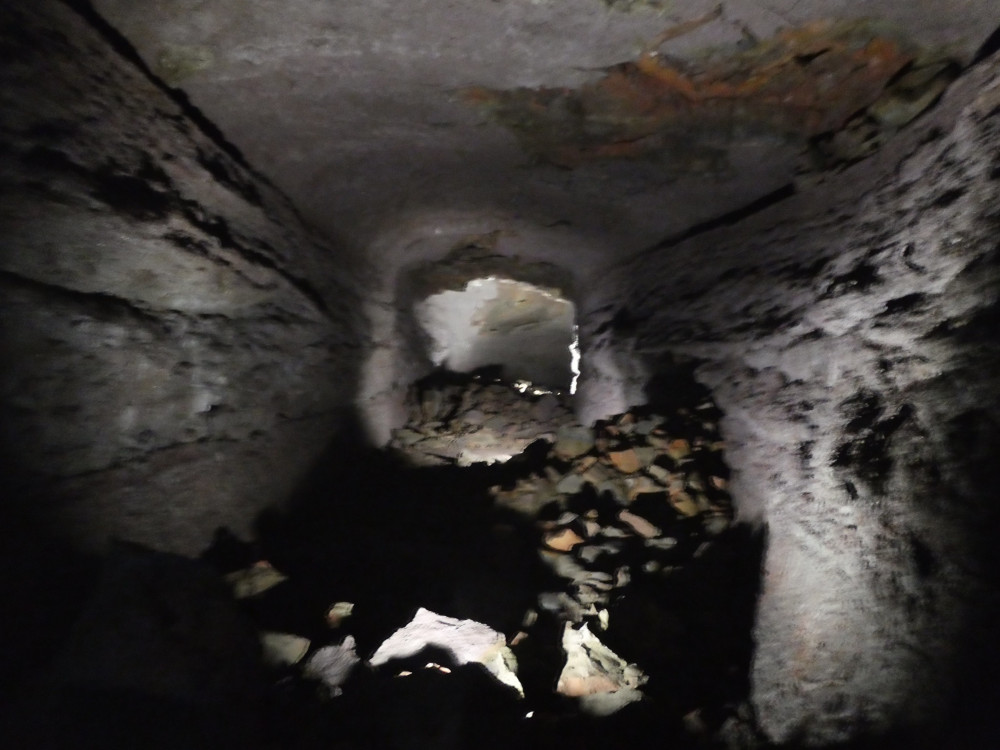
But at this end, in a large chamber with benches around the end of the wooden walkway, we were finally going to turn off our lights and experience the true darkness. This is something that cavers usually do as soon as they’re out of sight of the entrance, to get used to the dark before they start exploring. I’d been looking forward to it. I love to just be in the dark and silence of a cave. I love to wave my hand in front of my face and see it, even though I know I can’t see it.
I’m used to switching my light off regularly. I started my career underground with a Speleotechnics FX2: a helmet-mounted light with two little halogen bulbs in it attached by a thick cable to a rubber-coated brick-sized battery on a belt which, at full charge and mostly on the pilot bulb rather than the main one, could give you maybe four hours of light. We got used to switching our lights off whenever we weren’t actively moving and although LEDs are a tenth of the size and weight, give off at least five times the light and will last for days, it’s a habit I can’t seem to get out of, until Gareth mentioned that in the dark, he’d be counting lights rather than tourists. Please leave them on at all times. Naturally, I’d brought my own headtorch. Cavers don’t go into caves without knowing they’ve got light and let’s ignore the fact that of course a professional guided tour will provide sufficient light! It took until at least a quarter of the way into The Cave to figure out that I could adjust the angle of my light so it pointed where I was going rather than at the ceiling, so I’d silently grumped about it for quite a while, wrapped my own light around my hand and explored using that – trying to keep it low so Gareth didn’t mistake it for a non-existent seventh tourist. That was a question he asked in the dark – when we switch the lights back on, is it scarier to have lost a tourist or to have gained an extra one?
Before we plunged ourselves into momentary darkness, we took some selfies. You can’t take a selfie with your headlight on because it just floods the photo but you can’t see yourself with it off because it’s too dark. Enter the second torch to act as selfie light! Gareth also acted as selfie lighting but it meant I could do mine myself, as many as I liked, without taking the light away from the rest of the group. I have so few cave selfies! And of course, when any of us weren’t taking selfies, we all pointed our lights at anyone who was. Mini underground photoshoot!
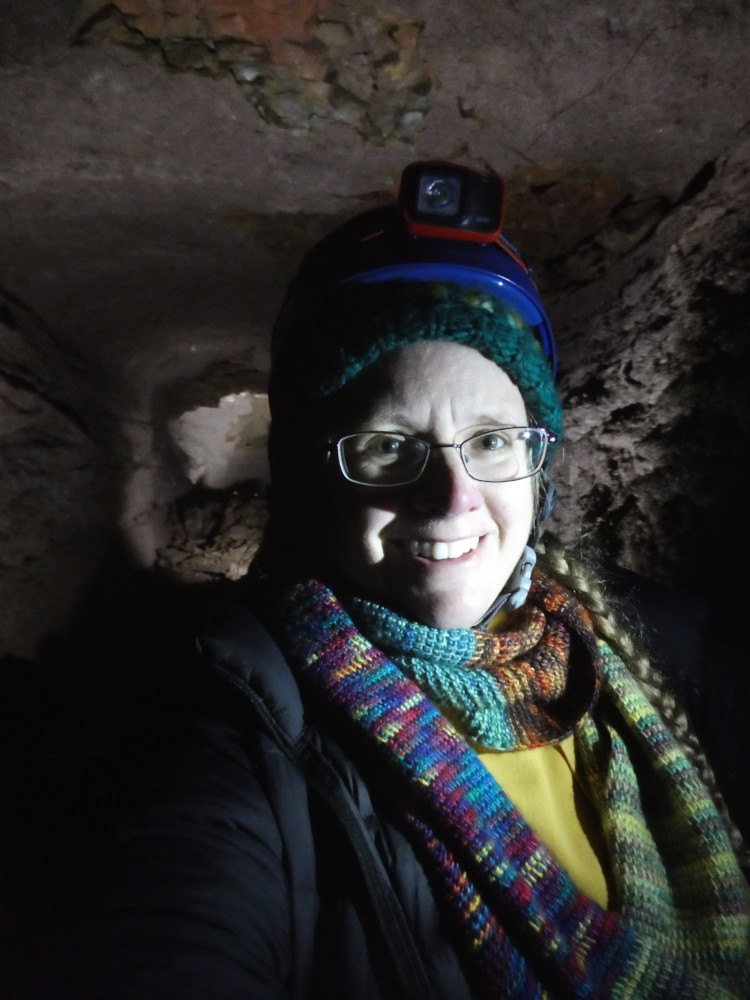
We were back out in probably ten minutes, for all the time it had taken to get to the end. No stops to learn about features on the way out. We’d done all the talkie bits. We paused only to examine a small passageway that left the main passage and loops back in further up, which holds electrical wires for the cave lighting. We agreed that it was quite tight but it’s not the tightest I’ve ever crawled – not that I got to crawl it. But there’s a tube in Goatchurch in the Mendips called the Drainpipe, nine to twelve metres long (I can’t seem to find a definitive answer – has no one ever taken a tape measure in?) and too low to even crawl in. The first time I shuffled myself along it, I was told that two people can pass in opposite directions “if they’re very good friends”. Even I would draw the line at that. It’s flat-out head-down, thrutching with your elbows, except at a 45° angle, the Drainpipe. Nothing Viðgelmir can offer comes anywhere near it.
And that was my trip! We walked back to HQ, handed back helmets & lights and Gareth drove me back to Húsafell and to Lindir for a swim while I waited for the glacier adventure groups to come back. I’m a dwarf. I’m one of Durin’s Folk, I’m far more at home below the ground than inside a glacier. If you’re in the area and especially if you’re interested in lava and volcanoes, you should get yourself to Viðgelmir to explore an eruption from a very different angle.
 I Am A Polar Bear
2 thoughts on “Visiting The Cave, Iceland’s biggest lava cave”