Perhaps you don’t know that Budapest is actually the fusing of two cities? Buda is the half on the west bank of the Danube; Pest the one on the east. Once upon a time the young double-city was called Pest-Buda before everyone presumably realised that a) it rolled off the tongue better the other way b) like Ant & Dec, you read from left to right when looking at it on a map. There’s a lot to do in Buda, including enough hiking in the Buda Hills to keep you busy for weeks, to say nothing of Rudas and Gellert Baths. But let’s concentrate on the most spectacular bit: Buda Castle & the Fisherman’s Bastion.
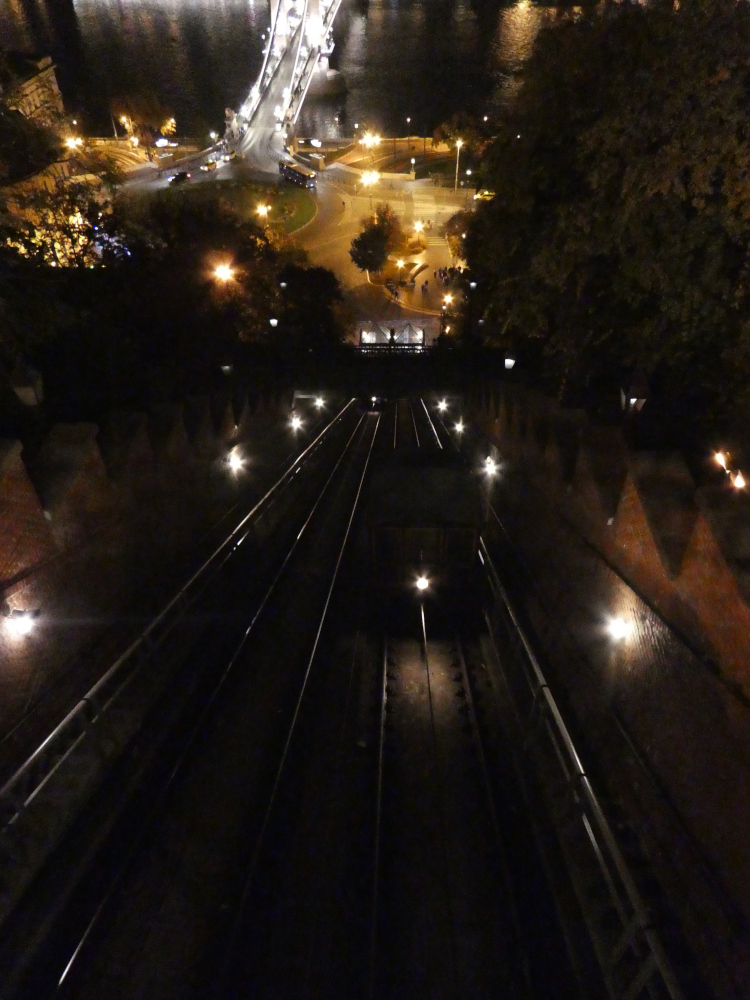
There are four main ways to get up the hill to these places. Undoubtedly the best is the funicular from the little square at the west end of the Chain Bridge. This isn’t included in your public transport ticket, if you got one of those. You have to buy a separate ticket, which is a return, whether you intend to use it in both directions or not. It currently costs 5000ft, £10, for a standard ticket, runs every five to ten minutes until 10pm and lifts you 50m above the city in 95 seconds. But when I was there on a weekday morning, the queue ran from the little terminus all across Clark Ádam ter and almost back down to the bridge. The funicular works as quickly as it can but it can only take 24 passengers on each trip.
The next option is to walk. I’d walked quite cheerfully a bridge or two north on the other side and then crossed the Chain Bridge on foot but a steep uphill hike was not appealing. It’s the cheapest way and the best for your cardiac health but I could find another way.
There are little blue electric buses, like overgrown golf buggies. That was a cute option but I couldn’t figure out where to get on them or how much they cost. 6000fr (£12) for an all day ticket, they’ll take you for a little guided tour around the major landmarks of Castle Hill and the official start & finish point is just to the left of the Chain Bridge, although you can hop on and off pretty much as you fancy.
Guessing this was probably the expensive option – better value than the funicular, though – I opted for the free way up the hill. Or at least, it’s free if you’ve already got a public transport pass, which is usually the first thing I buy in a new place. I got on the ordinary number 16 bus from opposite the funicular, which took me up to the Fisherman’s Bastion in just a few minutes.
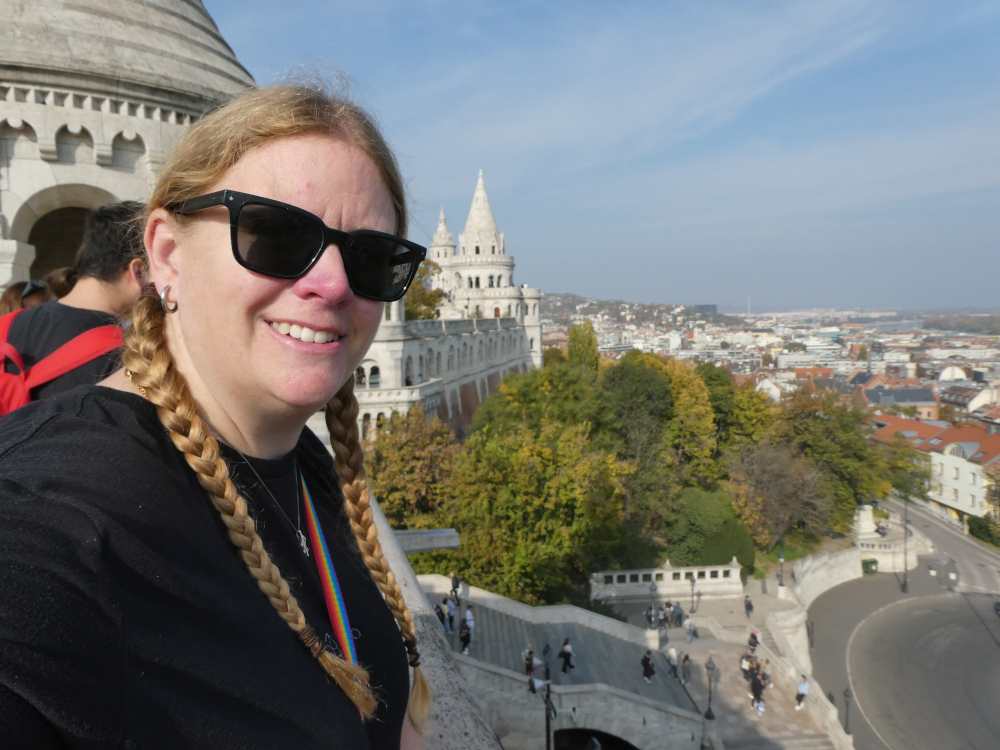
The Fisherman’s Bastion is, effectively, a folly. It’s believed – although not known for sure – that the walls of a medieval fortress once stood here, and played a part in the siege that resulted in the Turkish occupation of Hungary. There were walls here by 1700 but over the next 200 years, they gradually fell apart. The current walls are only a little over 120 years old – to put it in human terms, they’re about the same age as my great-grandparents would be. They were built largely as a tourist attraction and scenic viewpoint. This is a very touristy area – behind the walls are two souvenir shops, a Starbucks and some food stalls and kiosks outside; the interior of the walls mostly houses restaurants and cafes and you have to pay if you want to climb up the batiments to see the view. That is, you don’t have to, they’ll tell you the views are just as good from the ground and yeah, the views from that big sweeping staircase are pretty amazing. But if you want unobstructed views without sitting down at a restaurant, your best bet is to pay for a ticket onto the walls.
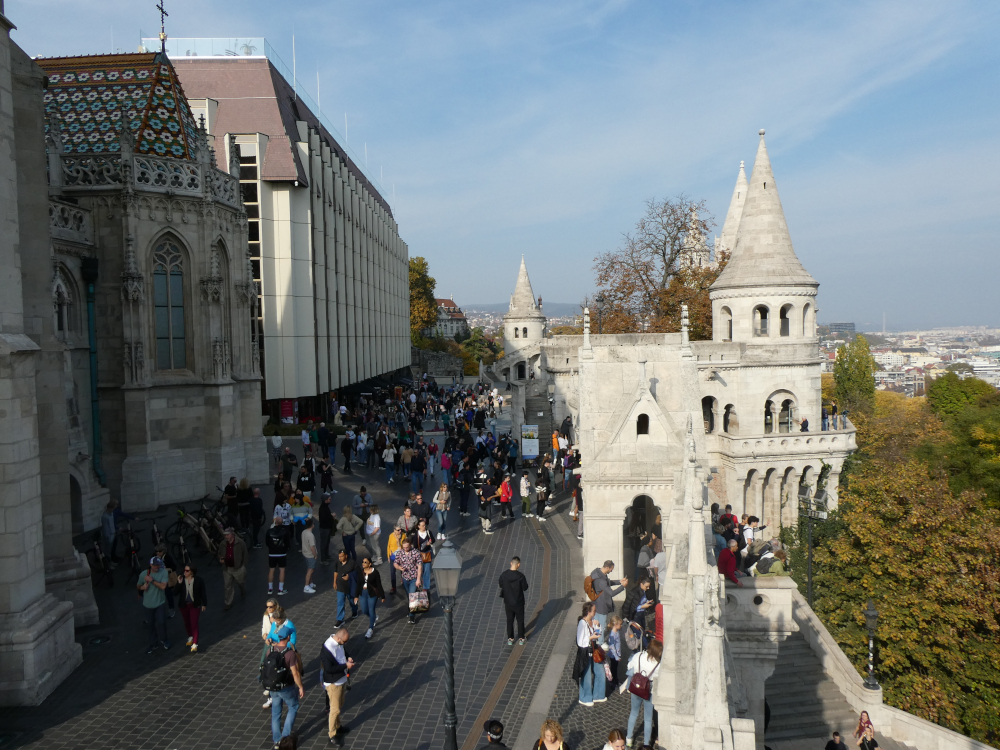
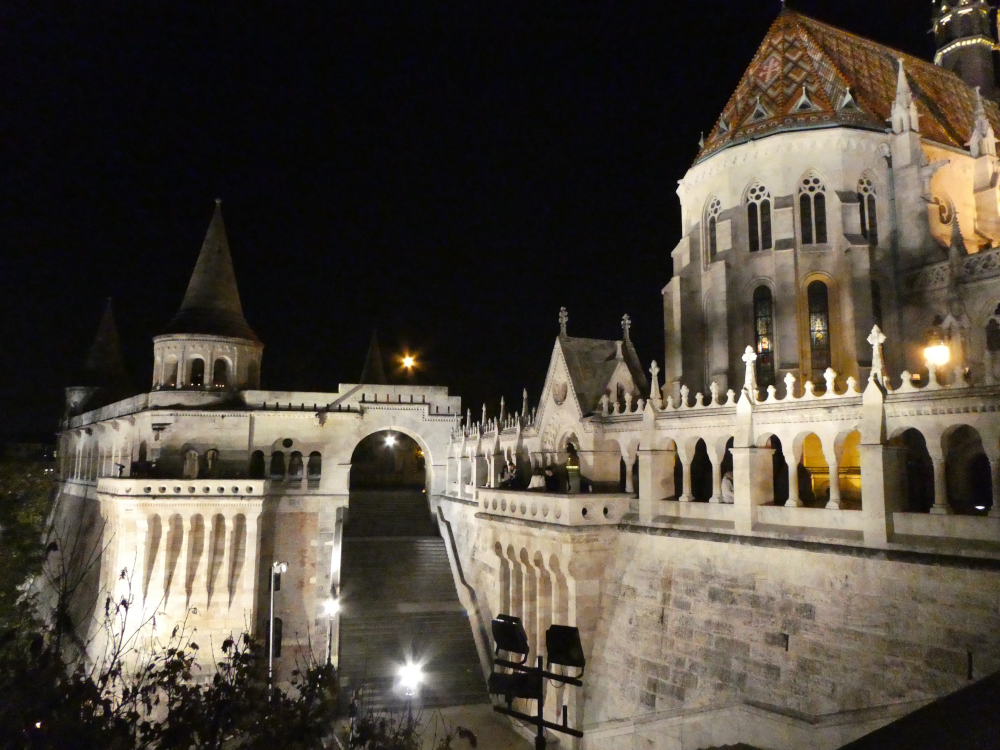
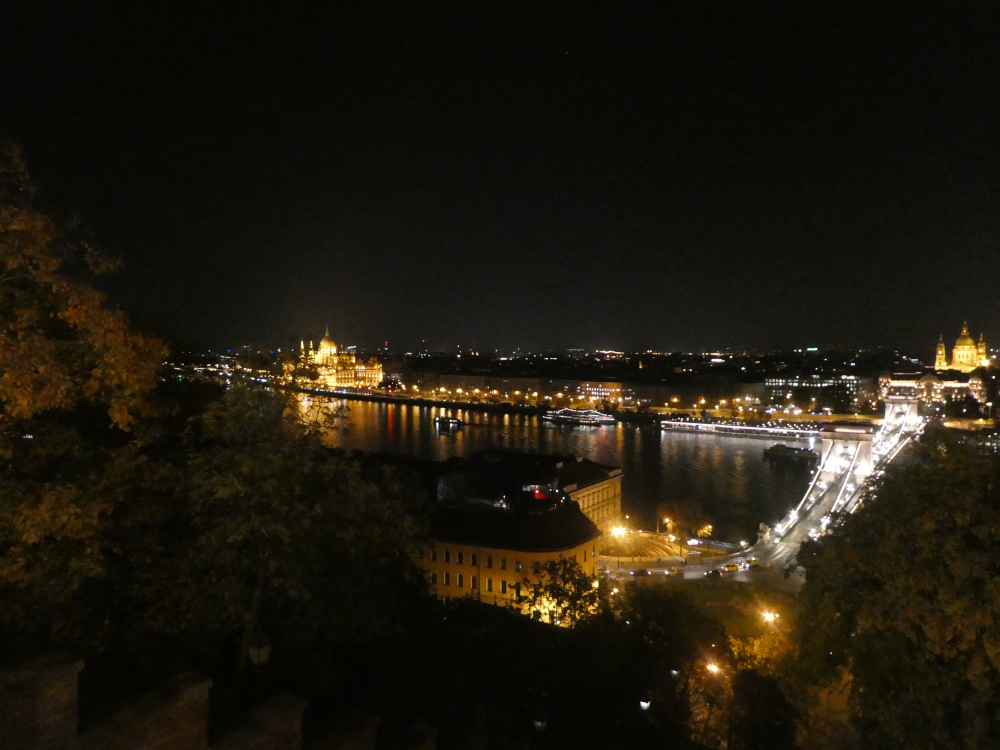
You can buy this from the line of ticket offices opposite the church or you can save yourself the wait by scanning the QR code on the information board at the bottom of the steps and buying it on your phone. It costs 1200ft, about £2.40 and gives you admission to the ramparts just once, so make sure you’ve had your fill before you come down. Alternatively, it’s free overnight – from 9pm in the summer or 7pm the rest of the year. If you get the opportunity, do come up here by night.
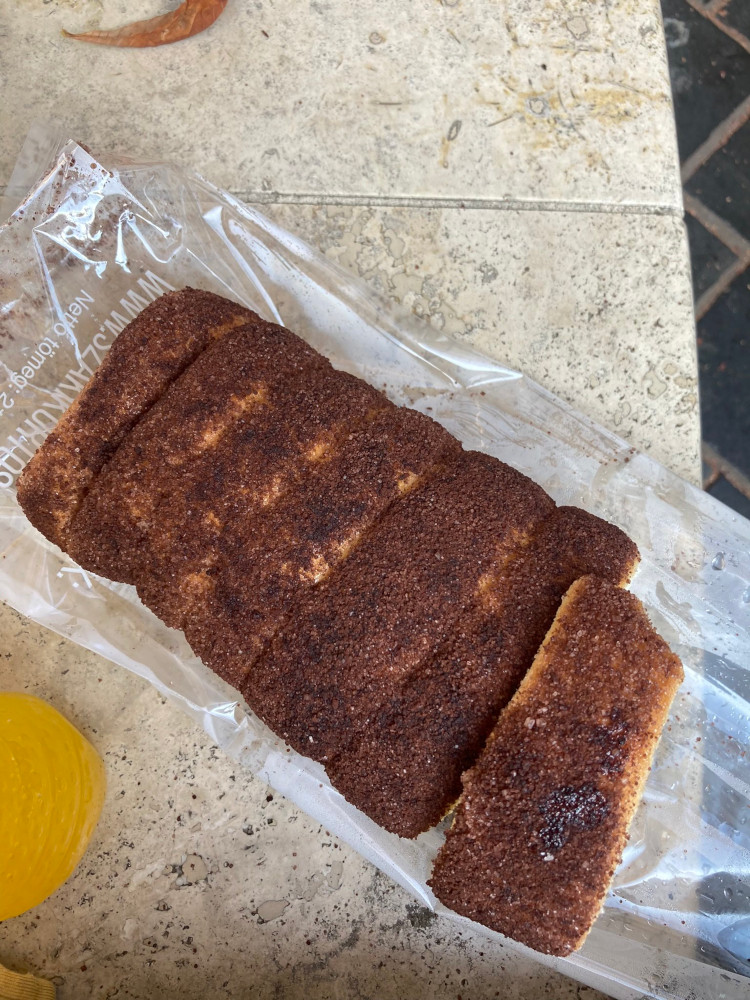
I’d had breakfast before I came out but I’d walked from the tram stop on the other side of the river and was ready for a snack by the time I’d had a look at the walls. I opted for my very first Hungarian chimney cake. If you haven’t encountered these, they’re a strip of pastry wound around a conical wooden mould and freshly cooked in front of you in a special oven. This caramelises the sugar on the pastry and turns it a deep golden-brown colour and it’s then rolled in your choice of topping – chocolate powder for me. Sometimes they’ll fill it, usually with ice cream but that isn’t traditional and some bakeries pride themselves on the fact that theirs are unfilled. I have to say, mine was excruciatingly hot and sweated hideously in its plastic bag, making a sort of chocolate sludge that got all over my hands. I also had no hope of eating the whole thing in one sitting – or even three as it turned out.
The highlight of my trip up there, though, was Matthias Church. I’d already admired its Gothic exterior and coloured tiled roof and since no one was queuing at its ticket window, I went to buy a ticket (2900ft / £5.80 without audioguide, 4500ft / £9 with) and went inside. The door is in the corner, at the top of a few stairs where people were stopping for photos as if there weren’t people right behind them trying to get in. Once I got in, got past the massive doors, I understood.
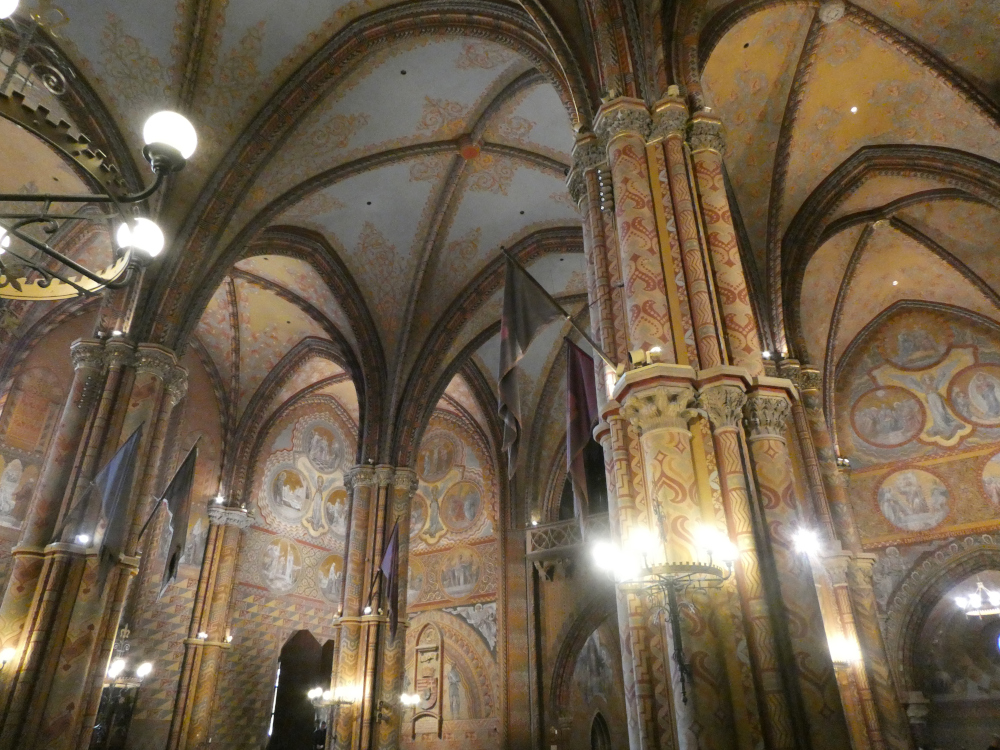
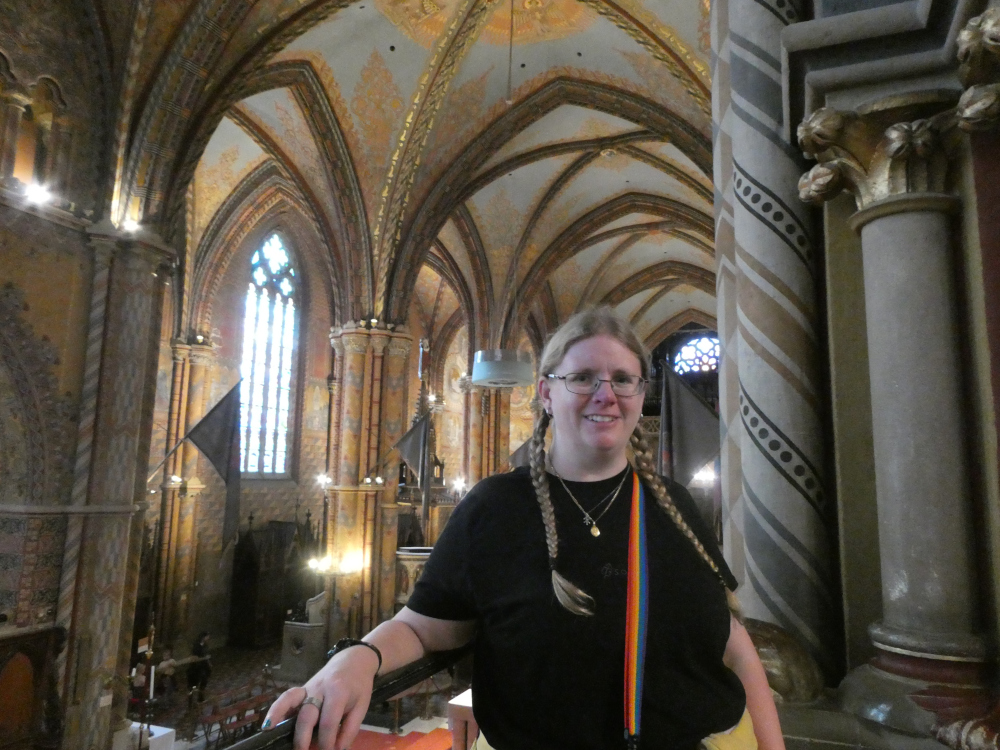
When I say I stood dumbstruck with my mouth open, don’t assume I’m exaggerating. I’m not. This church looked like many other Gothic churches I’ve seen from the outside. On the inside, every square inch of the building was covered in frescoes or paintings or patterns. An absolute riot of colour, in the way many medieval churches would have been before the literal whitewashing during the Reformation. I have never seen anything like it in my life except in a couple of churches in the Kremlin, and they weren’t Gothic. The stained glass almost faded into irrelevance beside the gold and red and swirls and magnificence. You can go upstairs to the exhibitions and look down from various windows and balconies to see all this from above. My photos don’t even nearly capture its beauty and I knew it at the time, so I bought some postcards.
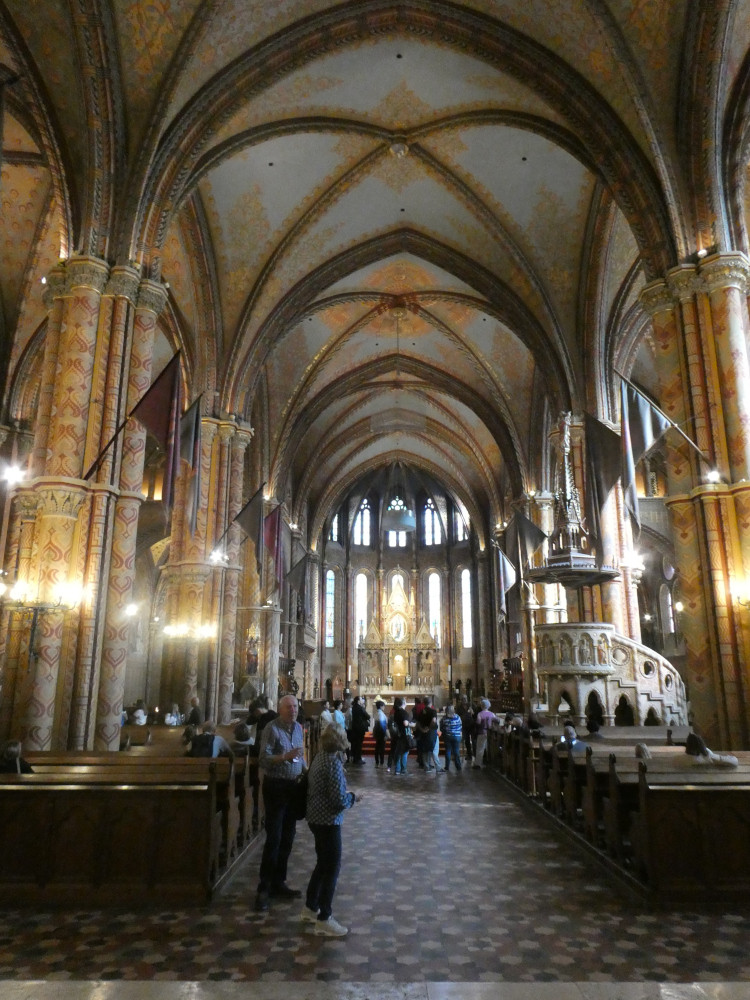
I lingered there a long time. My Hungarian colleague, of more than five years’ standing, had given me a personalised Budapest itinerary but had somehow neglected to mention that the most beautiful church in the world is right here in his home city. Had I never raved about my love of all things Gothic in his presence? Surely I had? I’d tell anyone about this church regardless of their feelings towards ecclesiastical architecture – and yeah, I know, most people don’t have any.
Eventually I had to move on. I can’t live in the church and there was still plenty of Budapest to see. Rather than trail down the steps like a princess leaving a ball and getting the bus back down the hill, I decided to walk along the top of the district to Buda Castle. Now, in all the times I’d looked across the river at the lights and the glory opposite, my eyes had barely paused on Buda Castle. It’s predominantly Baroque, which is an architectural style I have no interest in. Probably the palace interior is very interesting and maybe I should have gone in, but most of the complex is home to various museums, including the Hungarian National Gallery and I’m an absolute philistine – I just don’t care about art, galleries or exhibitions beyond a very narrow personal interest. For example, I did seek out and very much enjoy the Miksa Roth Memorial House, which is stained glass and mosaic art. Besides, I was kind of distracted by the fact that I’d sat down on the edge of an empty fountain to have another go at my chimney cake and my fingers were absolutely covered in a chocolate sludge. If that fountain had been switched on, I could have dabbled my fingers clean in it and gone about my day but it became difficult to think about anything other than “why is there no water up here??” after that.
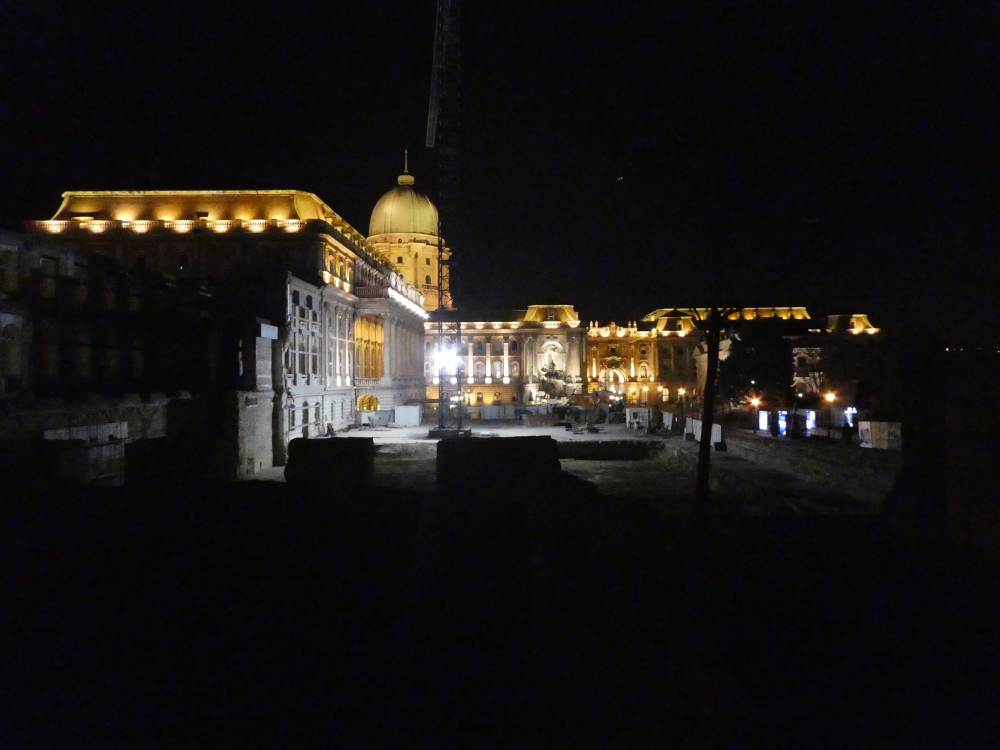
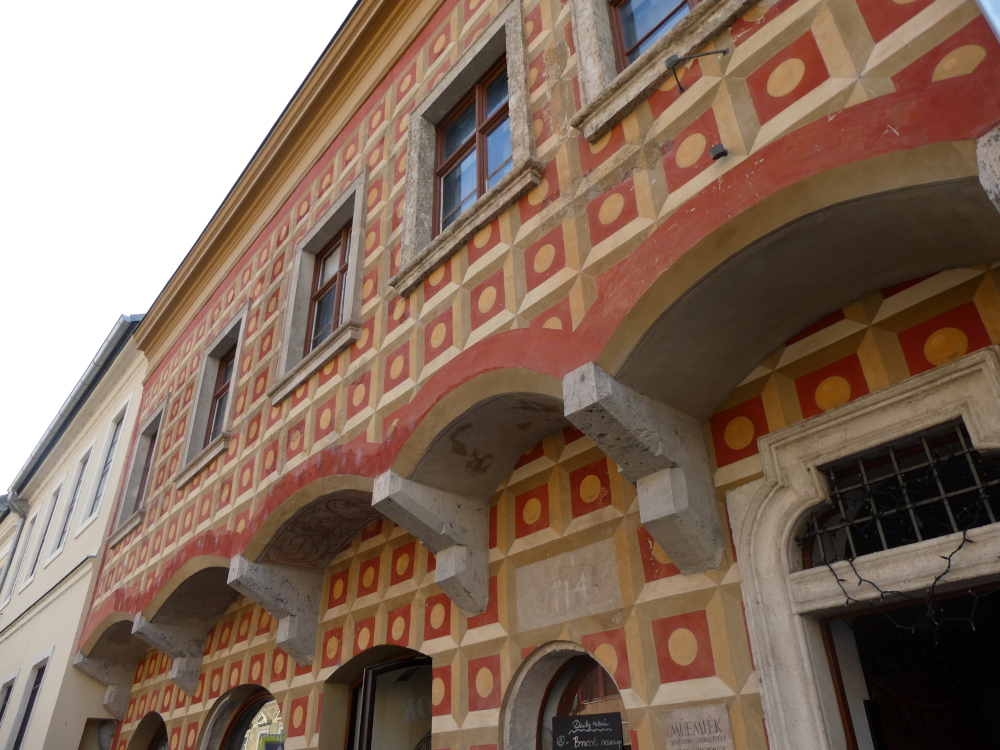
Anyway, I walked down through the castle district. This is the oldest part of Budapest and it has something of the feel of Paris about it. More Latin Quarter than Champs-Élysées – Budapest already has its own Champs-Élysées in the form of Andrássy út over the river in Pest. The castle district has cobbled streets, cafes and restaurants, interesting little alleys leading off all over the place, unexpected miniature parks on street corners and restricted traffic, corralled by illuminated barriers. There are so many things up here that I wish I’d done – the Hospital in the Rock, the labyrinth, explored further north than the church. Ah, well. It’s good to have a reason to go back to a place, besides the fact that two of the baths I wanted to do were closed indefinitely for renovations.
I’d planned to descend via the funicular, reasoning that it would still be more full of people coming up than going down but I was wrong. I did get the funi done a few days later, when I went out for a stroll in the dark, went on the big wheel and went off to the funi on an impulse. I’ve already said it but it’s absolutely worth coming up here in the dark, not least because you can have the entire funicular to yourself in both directions! But no, at this time in the afternoon, the queue to go down was almost as long as the queue to come up had been earlier. So I went through the little gate and down the stairs and into the grounds of the castle. To be honest, I didn’t really have any other plans at this point than to find a fountain or a toilet or some source of water for my sticky chocolatey hands but there was nothing. There were some snack kiosks outside the main castle doors and I should have just given in and bought a bottle of water but I didn’t.
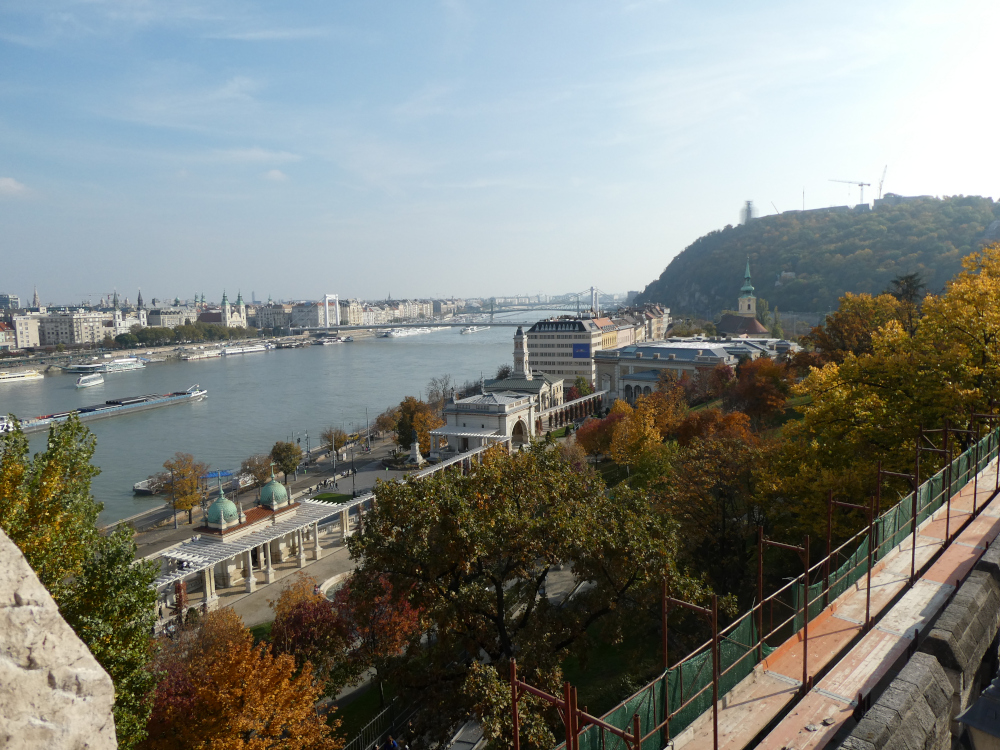
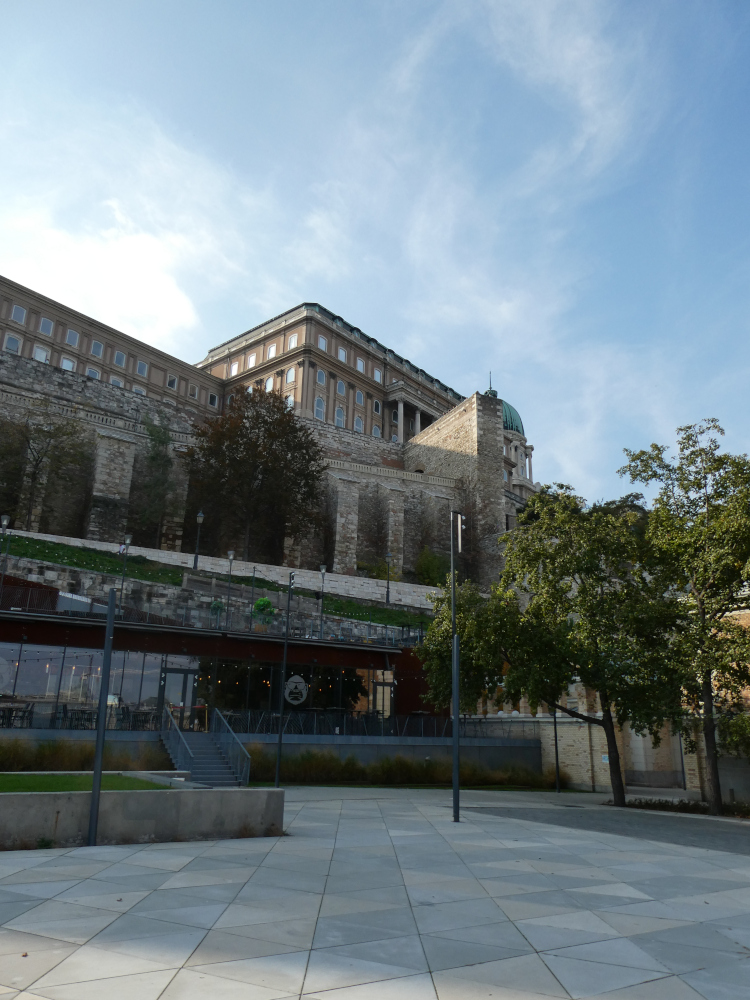
The area around the southern end of the castle is a bit of a labyrinth. Once you leave the terrace in front of the palace, you’re out on the walls and at the end is a literal lookout point. Behind it are stairs running down the end of the wall and into the courtyard behind it and then you go through a few more courtyards via gate-shaped holes in walls and a few more terraces and suddenly you’re on the stairs down to the city below. These deliver you into the Foundry Courtyard, where there’s a bar that’s either closed in daytime or out of season, some interesting concrete seating for views back up to the castle and, hidden under the stairs, public toilets! But in Budapest, you have to pay to go in, so I continued my quest for a public fountain. I found one eventually in the gardens of the Várkert Bazár, through the gate behind the stairs.
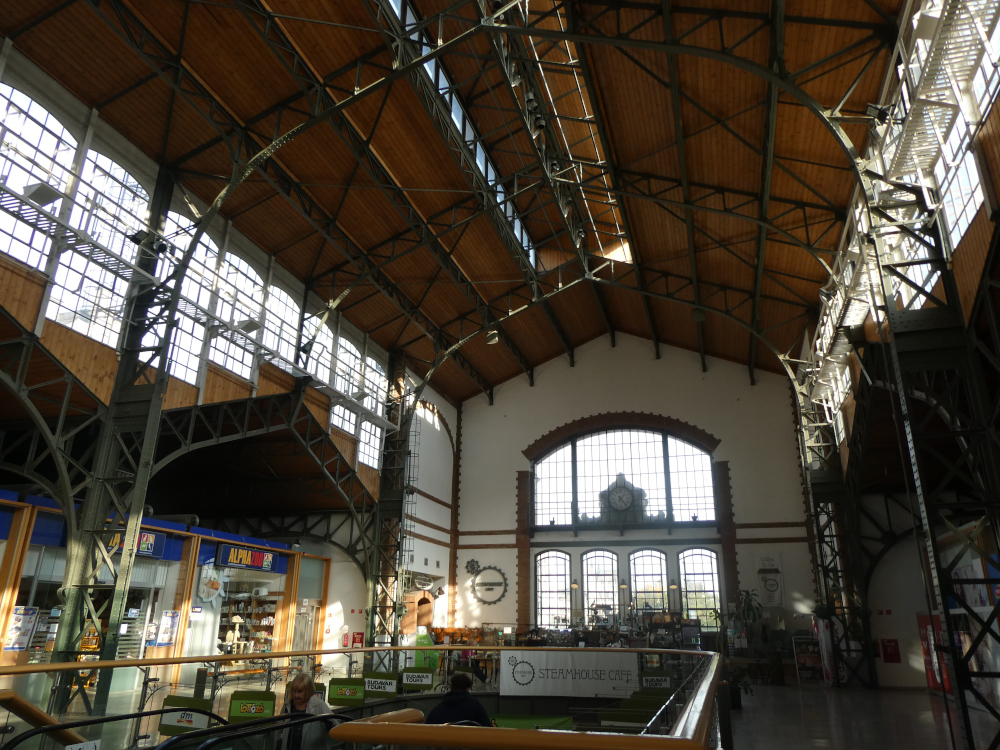
My next stop was the Central Market Hall, only it turns out it’s called that rather than the Market Hall because Budapest has more than one. The nearest, which my phone decided was the one I was looking for, is a short tram ride away, just a little way past the Fisherman’s Bastion. I was surprised at this because I thought it was further south and on the other side of the river, but I went where my phone told me. And it was the wrong one! It’s a similar sort of building to the better-known one, half brick and half wrought iron but much smaller, used more as a shopping centre than a market hall. It had a Spar supermarket downstairs and upstairs were various smaller stores. Interesting to find a place that most people probably don’t find, useful if you want to get some supermarket bits for a picnic before or after your Castle Hill adventure but not a tourist experience in itself. Getting to the actual Central Market Hall took, if I remember rightly, a metro ride from the handy station right outside the Wrong Market Hall, a bus, and then a 300m walk from Kalvin ter, where I should have arrived by metro in the first place. This is what comes of not planning properly where you’re trying to get to. But that’s another story.
In summary: get the bus up to the Fisherman’s Bastion, enjoy the views, go into the church, stroll back down, visit the castle and then walk back down to the city. I didn’t make as much of my day on Castle Hill as I could have done but nonetheless, I think I did it the right way. And I’m also very pleased that I went back in the evening to see the views by night and get my ride on the funicular.
 I Am A Polar Bear
One thought on “How to spend a day in Budapest’s Castle Hill district”