There are so many thermal baths to visit in Budapest but Rudas was high on my to-do list for one important reason: it has a rooftop hot tub with city views. Even better, at weekends it does night baths. A night bath with views of the city lights sounded like everything I could want!
Iceland’s geothermal pools tend to stay open until late so it was a bit of a shock that Budapest’s close so early – generally by 7 or 8 in the evening, and sometimes by 4pm. I’d pictured my “night bath” being more of a late evening – getting put somewhere between 10 and 11, so it was a bit of a shock to find that Rudas Baths closes for the day at 8pm and then opens again for night bathing at 10pm. That’s the sort of time I was envisioning getting out, not in! And because night bathing is Fridays and Saturdays only, if I wanted to do it, my only opportunity was on my first full day, when I probably wouldn’t have had time to get the lay of the land. Staying until closing time at 3am simply wasn’t an option but for the price and the experience, I’d have to stay until at least midnight. Venturing out in a strange city alone at midnight is kind of one of my cardinal no-nos. But… if Rudas was open until 3am, that implied public transport was still running and so I plotted my route home, albeit with a kind of dread.

I would have liked to be getting ready for bed a little after 9pm after my first day in Budapest but instead I was packing my bag with swimsuit, travel towel, swimming cap and slippers, making sure my GoPro was charged after three-quarters of a day at Szechenyi Baths, checking I had my room card and public transport pass and going out. Rudas is on the other side of the river in Buda, and about as far south as the tourist city centre goes. The nearest bus stop is a good five-minute walk away and leads you to the back wall of the Baths, making it feel even further. But there we were!
At 10pm on the dot, the staff opened the door and I discovered half to two-thirds of the queue hadn’t bought their tickets in advance. There’s a QR code on the inner door but they caused a bit of a bottleneck for those of us who were ready to go in. Normally when you book a bath in Budapest you have to choose between an ordinary locker or a private lockable changing cabin. In this case, cabins came as part of the experience. I have to say, signs and directions did not. A lot of us wandered around looking lost and confused at the complete lack of indication about the rooftop pool.

It turns out you have to scurry through the cafe and right past reception and the front door, past the 19th-century swimming pool, past the modern wellness pools, up two floors, past a weird closed bar in a hallway and finally outside to a raised hot tub with a crown-like structure over it.
Let’s start here and let’s be honest: it’s far too small for the number of people who want to sit in it and there are very few spaces in it where you can see the view. The moment anyone moved or left, the entire hot tub squirmed to either leap into the space or at least shuffle closer to it. I got a spot with an acceptable view and had a nice chat with my neighbour, a native of Texas living in Chicago for school and work who’d come to do a mini-tour around Europe before flying home to vote. I’m reasonably confident she was planning to vote the way I would if I had the right to vote in the US but we were getting on and I didn’t want to risk discovering she’s actually a terrible person so I didn’t ask that question.
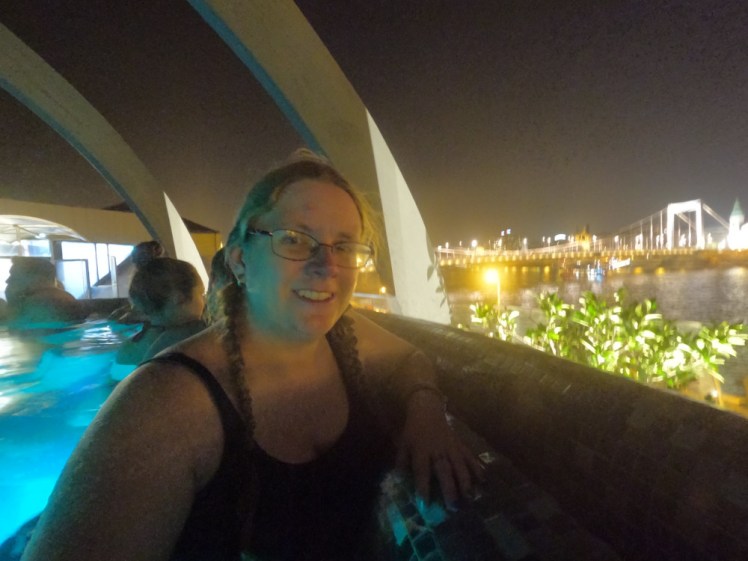
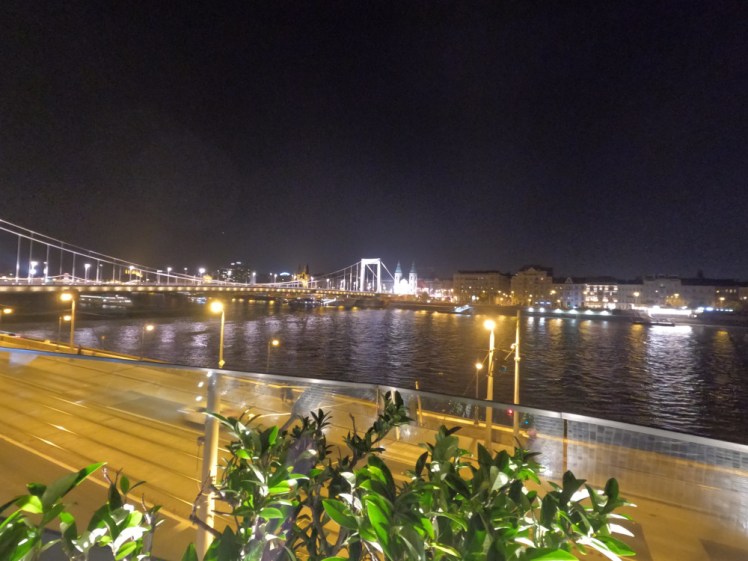
I got my opportunity with the good viewpoint and I used it in a businesslike way to take my photos for a couple of minutes before ceding it to someone else. The view from the inner circle was acceptable for enjoying but you need a clear line for pictures. Unfortunately, when I got home, I discovered I’d been too hasty in taking my photos and about two-thirds of them were just light trails. After a while, I decided I’d had enough of being squished in an overfilled hot tub and went to investigate the indoor facilities.
The first thing you come across downstairs is the thermal wellness area: two relaxing pools of mineral water in slightly different pleasant temperatures, both with massage jets that switch on and off randomly. The lower one, tiled inexplicably in red, is the cooler. The higher one, in blue, is a little warmer. At the other end of the room are the contrast pools, raised up so you have to climb the ladders to get in and out of them. This is your classic hot-cold therapy. The hot pool is around 42⁰C, a pleasant soaking temperature for Icelandic men whose skin has turned to leather but an uncomfortably hot plunge in Budapest. This is followed by the 11⁰ cold plunge pool. I did this on my last day in Palatinus Baths on Margit-sziget but after scorching my ankles tonight, I returned to the safety of the bathing pools.
I skipped the swimming pool. Unusually, they weren’t enforcing swimming caps here but neither was anyone swimming lengths. This is used more as a therapeutic pool than an exercise one and most people were just floating languidly on oversized rubber rings in the half-darkness. I’d have put a couple more lights on, myself, but the reason I skipped it was neither the dark nor the langour; it was the fact that the pool was freezing. Or at least, comparatively. Rudas is unusual in Budapest, in that it doesn’t list every last pool and its temperature on their website. But it was no more than 20⁰, if that, which is a lot colder than I like and a lot colder than any of the thermal pools.
The last bit – which I actually went in first while hunting for the rooftop pool – is the oldest bit, the Turkish, or vapour, bath. It dates back to the 16th century. I don’t know if either the pool or the room are literally the original structure or whether it’s a modern replacement based on the one here or even whether renovations over the centuries have turned it into a bit of a Trigger’s Broom of a bath – Ship of Theseus is probably a better name for that phenomenon, since we’re talking about a part of the continent that appears in the classical world. Since I, like almost all of you, knew nothing about Hungarian history before my trip, I had no idea that Hungary was occupied by the Ottoman Empire for centuries and that Turkey probably has more influence on its culture – and apparently language – than any other country. That’s a long-winded way of saying that almost all thermal baths have an octagonal hot pool under a stone domed ceiling somewhere, even the modern ones.
I had my doubts about the mineral content of the water in the other pools but here, calcite build- up around a few fountains put those doubts to rest. It’s a nice big soaking pool and it has noodles for you to relax on. In the four corners of the room are four smaller pools of various temperatures, including at least one uncomfortably hot and one uncomfortably cold. If you look carefully at Budapest baths, they usually have their temperature carved discreetly into a stone plaque somewhere nearby. The main pool is a little on the warm side so I was glad to slither into the 36⁰ pool for a while to cool down.
This dark, stone end of the building, which is in stark contrast to the modern reception, austere swimming pool and surprisingly clinical wellness area, is also home to a collection of saunas and steam rooms. After boiling alive passing by the open door of one of these rooms, I felt it was healthier to stay out of them. Rudas is also unusual in that it still has single-sex steam & sauna sessions, the only bath that does in this day and age. The night baths are “coeducational”, as they call it, and so are Thursday and Friday afternoons and all day at weekends. But Tuesdays are women-only, Monday and Wednesday are men-only, as are Thursday and Friday morning. Rudas has at least abandoned the tradition of sauna nudity, which is quite normal outside the English-speaking world, but it’s still swimwear-free during the single-sex sessions; they give you a special modesty apron.
Because of this semi-nakedness, you can’t take photos in or around the Turkish bath, even on fully-clad mixed days, which is a pity because it’s very pretty, give or take that people abandon slippers and towels everywhere, including on the iron support beams that join the dome to the walls. I could have probably taken photos in the wellness area and of the swimming pool but it’s harder when no one else has a camera out. There were cameras a-plenty in the rooftop pool!
I would have liked to stay later but Cinderella, minus her own coach and footmen, had to get home on her own on the tram in the dead of night. I think I left a little after midnight. There’s a bus stop right outside but I have a horror of night buses, and anyway, it wasn’t due for twenty minutes and would start the journey by going in the opposite direction. No, in my wisdom, not seeing any particular terror in Budapest by night, I decided to walk across the bridge and get the tram going my way from the other side, which turned into walking two and a half kilometres (which Strava recorded as 3.5km, the line picturing me zigzagging wildly up the straight road, through solid walls and into perpendicular streets) to Blaha Lujza square to catch the 4 or 6 tram the last couple of hundred metres home. That night I learned that I have no fear of Budapest by night. Next time I do a Rudas night bath, I won’t feel the need to leave early.
 I Am A Polar Bear
2 thoughts on “A night bath at Rudas”