I like churches. Like some of the people who appear in this book, part of the heart & soul of their particular churches, I’m not a believer and I don’t even find any sense of peace or inner tranquillity in a church. It’s merely my chosen favourite art form, one which contains, usually, a few hundred years of history and preferably some stunning – and I mean that literally, in that I have stood dumbstruck in front of some – stained glass windows. So when I stumbled upon Steeple Chasing by Peter Ross, which uses churches as a reason to explore the UK, I thought that was the perfect combination of travel and my own specialist interest for this month’s Travel Library.
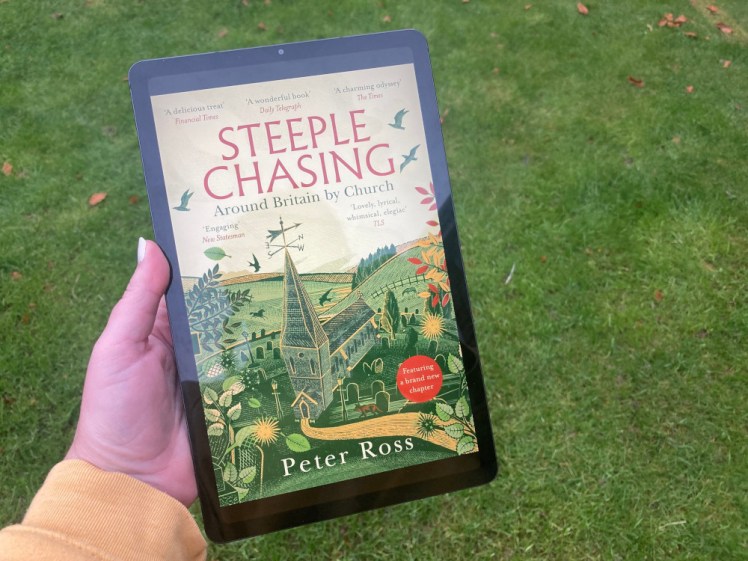
Actually, although it does feature several churches – St Paul’s and Durham Cathedrals among them – it feels more like a tour of religious sites than exclusively actual churches. There’s an entire chapter on wells and springs and the rituals that have formed around them, one on the sense of religion, history and saints on Lindisfarne, some about ruins or monastaries or abbeys and so on. The chapters are grouped by theme, rather than geography, so Durham Cathedral shares a chapter called Steel with Morningside Parish Church in Edinburgh and some musings on angels inspired by the Angel of the North, Bar Convent in York shares the Bone chapter with St Patrick’s in Belfast and Paint brings Holy Trinity Church in Cookham together with Sandham Memorial Chapel in Burghclere, Old St Paul’s, Edinburgh and St Peter & St Paul’s in Chaldon. It’s not quite how I imagined it was going to go and it’s not the book I’d have written with the brief “write a book about churches around the UK” but that’s the point of reading, to see something that’s not just yourself reflected back at you.
Most of the churches aren’t the big famous ones, the “superstar” cathedrals that might feature in my version of this in twenty years when I’ve finished visiting the remaining 73% of the Anglican ones. Neither does this book limit itself to Anglican, come to that. It’s a bit of a whirlwind tour of monasteries, churches, chapels, wells & ruins, telling their stories both past and present and the people who find these places special. The one who particularly stands out for me is 82-year-old Martin Dunn from Darkness, the very first chapter. He’s an adventurer and mountaineer who spent 52 years married to the love of his life, is still adventuring now and spends some time every year in a Benedictine monastery five miles outside Elgin in Scotland. But there are people who “rescue” abandoned churches, people who’ve been tour guides and custodians for decades, people who feel inexplicably drawn to a particular church or site, even a cat. The churches’ stories are told through the stories of these people.
Some of them are about art – paintings on walls and ancient artefacts that would be kept under lock and key if they were in museums, the people who look after them, the people who come to see them, the people who know their stories. Some chapters are about death or destruction – see Fire, an entire chapter that more or less revolves around keeping St Paul’s standing during the Blitz – or about hope or determination. Some, yes, are about cats. Wildlife, water, angels, immortality – any angle you can imagine a church’s story taking, it probably takes it in this book. I think I imagined it would be more a mix of fairly dry history of various churches, sticking to bald facts and it’s not. It meanders off into what the church means to people, what its story means, what its artefacts mean, how it affected people in the past and the present and a little musing into the future too.
You might think if you’re not into churches or religion that this isn’t the book for you. Well, after DNFing the original November Travel Library book halfway through the month, I absolutely flew through this one in six days, several of which were work days. I think “compelling” is a little too strong a word but I enjoyed it, I kept adding places to my mental “to-visit” list and I’ll probably read Ross’s previous book, A Tomb With a View, at some point in the not-too-distant future, which I suspect takes a similar style but applies it to the graveyards outside the churches rather than what goes on inside them.
Steeple Chasing is a book about people, communities, history and the places that are or that become important. You can be the single most fervent atheist or Christian-hater in the world and still enjoy this book of English villages, Scottish cities and Welsh countryside. It feels very green, very peaceful. It’s also a tale of the world venturing out of isolation – it takes place during late 2020 and 2021, when life began, tentatively, to return to some semblance of normal. Churches that have been empty begin to fill, communities that have been in hiding start to come together again and some kind of indefinable spirit begins to come back to the places where faith is made tangible. Yes, I enjoyed this and I hope you will too.
 I Am A Polar Bear